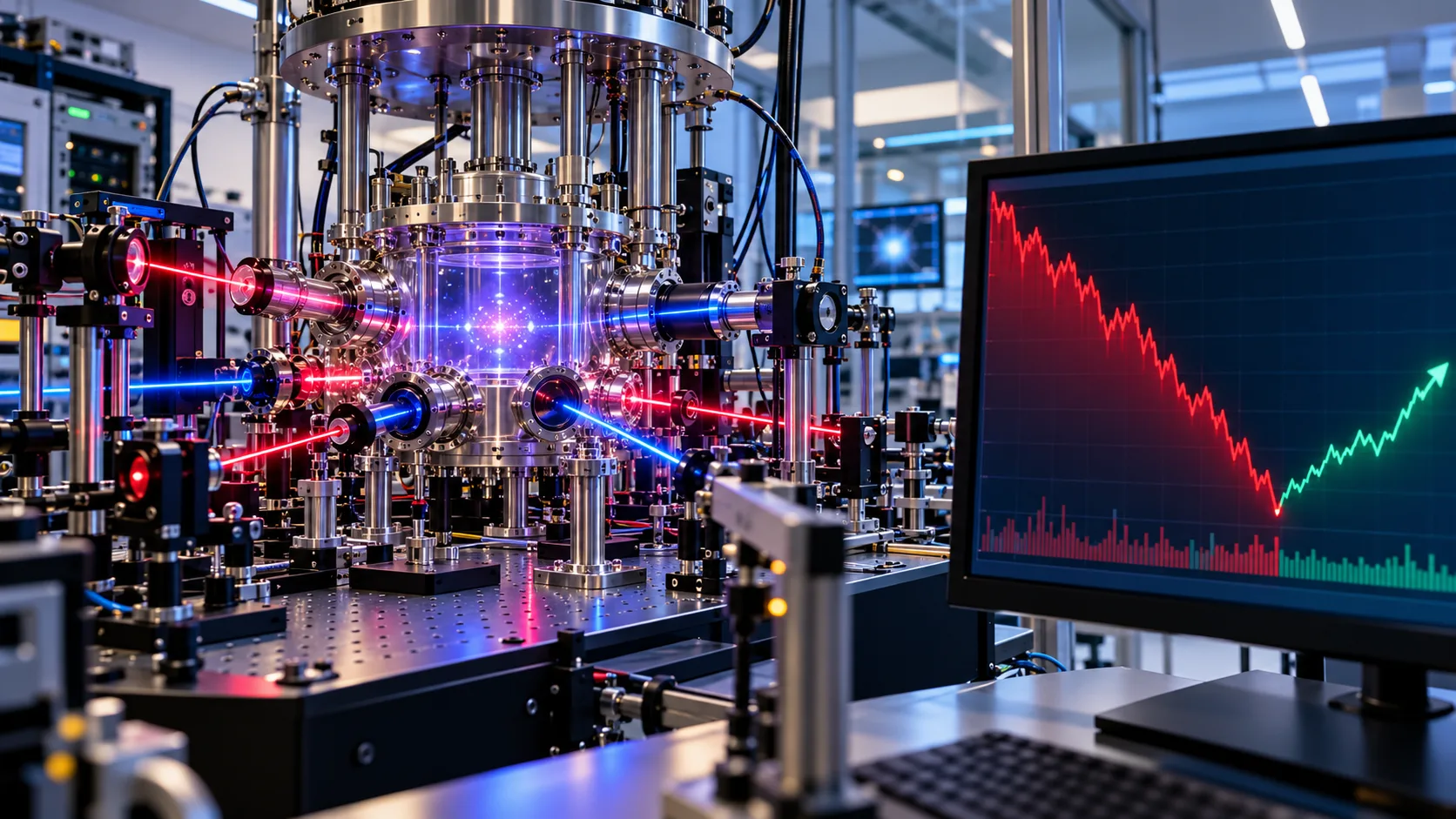
A newly public quantum computing stock has lost nearly 70% since late August, but Wall Street analysts are beginning to argue that the selloff may have gone too far.
Needham analyst David Williams initiated coverage of Pasqal (NASDAQ: PSQL) with a Buy rating and $16 price target Wednesday, pointing to the company’s existing commercial deployments, growing customer base and substantial cash position.
At the roughly $6.29 share price cited when the call was released, Williams’ target implied about 154% upside.
A Brutal Start on Wall Street
Pasqal began trading on Nasdaq on Aug. 28 after completing its merger with Bleichroeder Acquisition Corp. II, joining the small but rapidly growing group of publicly traded quantum computing companies.
The shares initially jumped, but enthusiasm disappeared quickly. Pasqal has since fallen nearly 70% from its early trading levels, leaving investors trying to determine whether the decline reflects deteriorating fundamentals or the type of volatility that frequently follows speculative technology listings.
Needham is betting on the second explanation.
Williams described Pasqal as one of the more commercially advanced companies pursuing neutral-atom quantum computing and argued that investors may be overlooking how much infrastructure the company already has in the field.
Pasqal currently has seven quantum processors deployed, with another three in production. The company says its manufacturing infrastructure can support as many as 13 systems annually without requiring a major expansion of production capacity.
That matters because one of the biggest questions surrounding quantum computing is whether companies can turn impressive laboratory experiments into systems customers will actually pay to use.
Pasqal is beginning to provide some evidence that it can.
Real Customers Matter More Than Quantum Hype
The quantum computing sector has attracted enormous investor attention, even though commercially useful quantum machines remain years away from replacing conventional computers for most applications.
Pasqal’s opportunity is somewhat different.
Rather than waiting for fully fault-tolerant quantum computers to arrive, the company is attempting to generate revenue from existing systems while developing more advanced machines.
Its customers and partners include research institutions, governments and major corporations such as Saudi Aramco, Nvidia, Google and Crédit Agricole.
Pasqal reported €70.4 million in booked and awarded business as of June 30, including commercial contracts, grants and other awards. First-half QPU-related services revenue increased 34% from a year earlier to €3.9 million.
Those figures remain small relative to Pasqal’s valuation and operating expenses, but they provide something many early-stage technology companies lack: evidence that customers are already experimenting with and paying for the technology.
The Nvidia Connection Could Be Important
Another piece of the story is Pasqal’s ability to connect quantum processors with existing computing infrastructure.
Its systems support Nvidia’s CUDA-Q platform, which allows developers to create applications using conventional CPUs, GPUs and quantum processors together.
That hybrid approach could make adoption easier.
Companies are unlikely to rip out billions of dollars of existing computing infrastructure simply because quantum technology improves. A more realistic path is for quantum processors to operate alongside conventional computing systems, handling specific problems where they eventually demonstrate an advantage.
Integration with existing high-performance computing infrastructure could therefore reduce one of the largest barriers facing quantum companies: actually getting experimental machines into corporate workflows.
For Nvidia, quantum computing could also become another layer of the accelerated computing ecosystem it has spent years building around GPUs.
For Pasqal, compatibility with that ecosystem potentially gives customers a much easier path for testing quantum applications.
Neutral Atoms Are the Bigger Bet
Pasqal’s technology differs from the superconducting systems being pursued by companies including IBM and Google.
Its processors use lasers to manipulate individual neutral atoms, which function as qubits.
The attraction is scalability.
Neutral atoms can potentially be arranged into large arrays while maintaining similar physical properties, potentially reducing some of the manufacturing challenges associated with other quantum architectures.
That does not guarantee neutral atoms will win the quantum race. Several competing technologies remain under development, including superconducting qubits, trapped ions, photonics and Microsoft’s topological approach.
But investors should recognize that quantum computing is increasingly becoming a competition between architectures rather than simply a race between individual companies.
The company that ultimately develops the most scalable, stable and commercially useful architecture could gain an enormous advantage.
The Balance Sheet Buys Pasqal Time
For an early-stage quantum company, cash may be almost as important as technological progress.
Pasqal finished June with €110.8 million in cash and cash equivalents. Following completion of its business combination and related financing, that figure increased to approximately €312.9 million as of Aug. 27.
That capital gives the company room to fund research, manufacturing and commercial expansion while its technology matures.
It is particularly important because Pasqal remains deeply unprofitable.
The company reported a first-half operating loss of €59.2 million, compared with €19.8 million a year earlier, although much of the increase came from share-based compensation and expenses associated with the public listing.
Investors also need to watch the company’s convertible securities and warrants, which could eventually dilute existing shareholders.
Strong liquidity reduces the immediate financing pressure, but it does not eliminate the fundamental challenge facing every quantum company: eventually producing enough commercial revenue to justify its spending.
The Biggest Risk Is Still Time
The easiest mistake with quantum stocks is assuming technological progress automatically translates into shareholder returns.
Quantum computing could become enormously valuable while individual companies still struggle.
Development timelines can slip. Competing technologies can leapfrog one another. Customers may spend years running pilot programs before committing meaningful capital. Today’s leading architecture could eventually lose to something entirely different.
Pasqal’s collapse since going public shows how quickly investors can move from enthusiasm to skepticism.
Its $16 analyst target should therefore be viewed as a Wall Street estimate rather than a prediction.
Still, the company’s installed systems, growing commercial relationships and sizable cash position provide tangible metrics investors can monitor rather than relying solely on promises about what quantum computing might eventually accomplish.
The Three Numbers Investors Should Watch
Pasqal’s story can be reduced to three measurements over the next several quarters.
Deployments: The company needs to continue increasing the number of quantum systems operating with customers.
Commercial bookings: Booked business needs to translate into increasingly meaningful revenue rather than remaining primarily grants and long-term awards.
Cash burn: Pasqal’s roughly €313 million cash position gives it considerable runway, but investors should watch how quickly that capital is consumed.
If deployments and revenue accelerate while cash burn remains manageable, the recent stock collapse could eventually look excessive.
If commercial adoption stalls, a large cash balance alone will not protect the valuation.
A Quantum Stock With Something to Prove
Pasqal remains exactly the kind of stock investors should expect to be volatile.
It operates in one of technology’s most promising fields, but the industry is still trying to prove that quantum computers can deliver commercially meaningful advantages at scale.
Needham believes the market may be discounting Pasqal too aggressively after its nearly 70% decline.
The case for a rebound ultimately depends on more than a $16 analyst price target. Investors should watch whether Pasqal can convert its technology, existing installations and nearly €313 million cash position into sustained commercial growth.
That will determine whether this beaten-down quantum stock becomes one of the sector’s survivors or simply another expensive experiment.
About Author