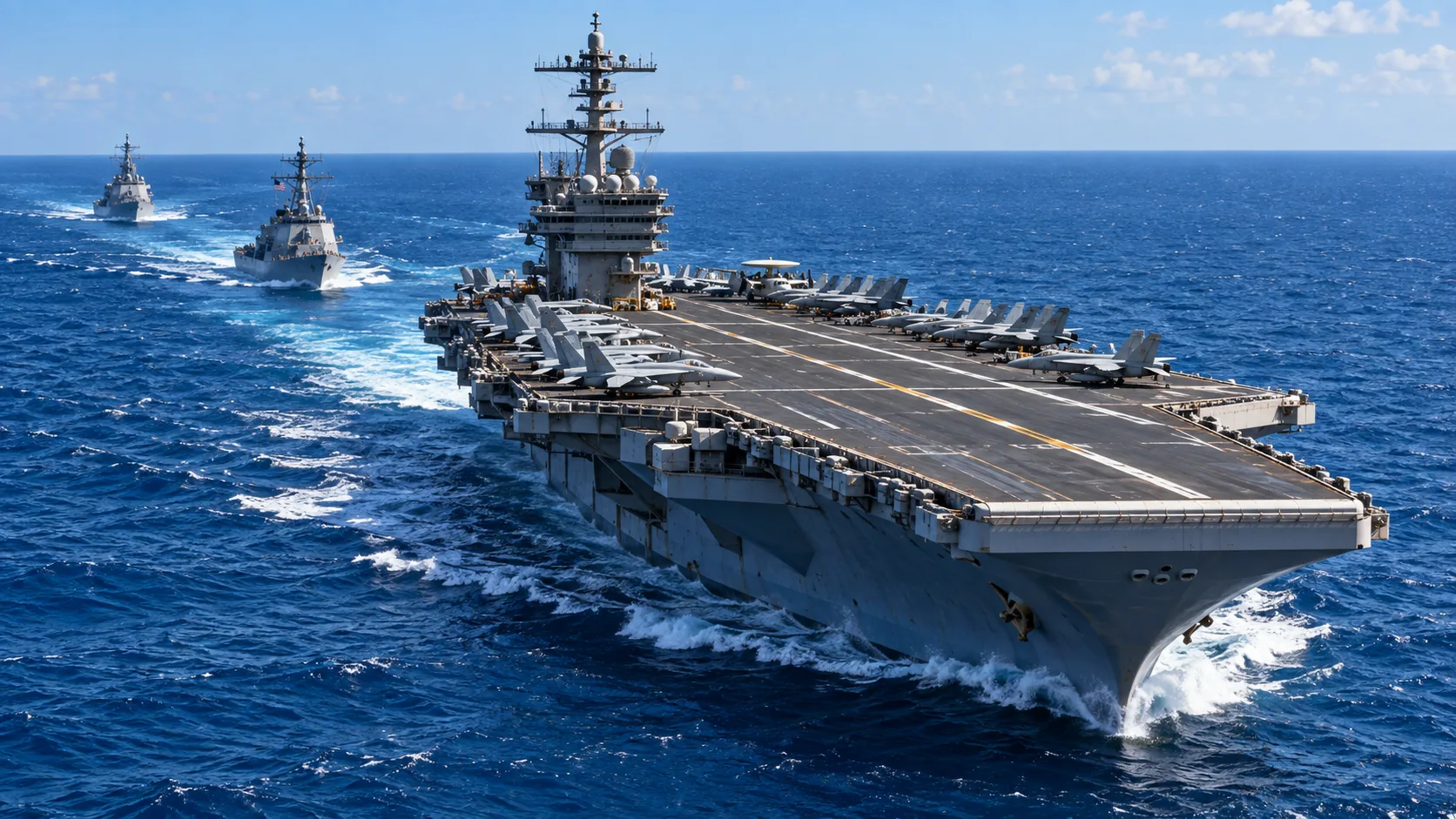
While all American personnel survived, the incident highlights how rapidly intensifying conflict conditions can create operational risks even among allied forces and why defense stocks, military procurement, and geopolitical risk premiums are suddenly back in focus for investors.
The episode comes amid one of the most volatile geopolitical environments in years, as markets closely monitor the expanding regional conflict and its implications for oil supply routes, defense spending, and global market stability.
What Happened: Friendly Fire During Active Combat Operations
According to U.S. Central Command, the aircraft were downed during nighttime operations connected to the broader military campaign currently underway in the region.
“All six aircrew ejected safely, have been safely recovered, and are in stable condition,” U.S. Central Command said in an official statement. “Kuwait has acknowledged this incident, and we are grateful for the efforts of the Kuwaiti defense forces and their support in this ongoing operation.”
Initial reports indicate Kuwaiti air defense systems misidentified the aircraft amid heightened alert conditions, underscoring how complex modern airspace coordination becomes during large-scale military activity involving multiple allied forces.
Friendly-fire incidents are extremely rare but historically tend to occur during periods of rapid escalation when identification systems, communications timing, and threat assessments are strained.
Military officials have launched a joint investigation to determine exactly how the misidentification occurred.
Understanding the F-15 Strike Eagle
The aircraft involved were F-15E Strike Eagles, one of the most battle-tested fighter platforms ever produced by the United States.
Originally introduced in the 1970s by McDonnell Douglas, the F-15 was designed primarily for air superiority missions during the Cold War. Over time, upgraded variants transformed the jet into a dual-role platform capable of both air-to-air combat and precision ground strikes.
The “E” designation refers to this expanded mission capability.
Key specifications include:
- Length: roughly 64 feet
- Wingspan: about 43 feet
- Twin-engine configuration
- Long-range strike capability
- Advanced targeting and weapons systems
Powered by Pratt and Whitney F100 turbofan engines, the aircraft remains a core component of U.S. tactical airpower decades after its introduction.
Despite its age, the platform continues evolving.
Why the F-15 Still Matters in the Fifth-Generation Era
Modern U.S. air dominance increasingly relies on fifth-generation stealth fighters such as the F-22 Raptor and F-35 Lightning II, both manufactured by Lockheed Martin.
However, defense planners never fully replaced the F-15 fleet. Instead, they modernized it.
The newest version, the F-15EX Eagle II, is still being manufactured by Boeing in St. Louis following Boeing’s merger with McDonnell Douglas in 1997.
Aerospace analyst Richard Aboulafia described the updated aircraft’s continued relevance:
“The EX is actually quite modern. The Air Force resumed procurement a few years ago and exports are still active.”
Unlike stealth fighters optimized for penetration missions, the F-15EX is designed to carry extremely large weapons payloads and operate alongside stealth aircraft as a high-capacity weapons platform.
This complementary role has made the jet attractive to international buyers.
Israel has already moved forward with purchases, while Saudi Arabia continues evaluating acquisition options.
The Global Fighter Jet Arms Race
The United States and China now dominate global fighter aircraft production, reflecting the growing strategic competition between the world’s two largest military powers.
The F-35 remains America’s highest-volume fighter program, with 191 aircraft delivered in 2025 alone. The jet has become the backbone of NATO and allied air forces worldwide.
Meanwhile, the U.S. Air Force recently awarded development of its sixth-generation fighter program, known as the F-47, to Boeing, signaling the next phase of aerial warfare centered on AI integration, autonomous support drones, and advanced sensor networks.
As geopolitical tensions rise, demand for both new aircraft and modernization upgrades is accelerating globally.
Cost and Capability: Then vs. Now
When the F-15E first entered service in the 1980s, it carried a price tag of roughly $25 million per aircraft. Adjusted for inflation, that equates to about $60 million today.
The modern F-15EX costs approximately $90 million per aircraft, putting it in a similar price range as the F-35 despite very different mission roles.
The increase reflects advances in:
- radar systems
- electronic warfare defenses
- avionics computing power
- precision weapons integration
For defense contractors, modernization programs often generate higher margins than entirely new aircraft development.
Market Reaction: Defense Stocks Move as Conflict Risk Rises
Financial markets reacted quickly as geopolitical risk intensified across the Middle East.
Shares of Lockheed Martin and RTX Corporation, the parent company of Pratt and Whitney engines used in the F-15, moved higher in early trading as investors anticipated increased defense spending and replenishment orders.
Boeing shares, however, traded slightly lower. Analysts suggest investors remain more focused on Boeing’s commercial aviation exposure, which tends to suffer during global instability due to reduced travel demand and airline uncertainty.
Major stock indexes also weakened:
- The S&P 500 fell roughly 0.7%
- The Dow Jones Industrial Average dropped about 0.8%
Markets historically price geopolitical shocks quickly, particularly when energy supply routes or major military powers are involved.
Why This Incident Matters Beyond the Battlefield
Although no lives were lost, the downing of three advanced U.S. aircraft by an allied nation highlights several broader risks investors are now evaluating.
1. Rising Operational Complexity
Modern coalition warfare involves multiple nations operating overlapping air defense systems. Mistakes become more likely as operational tempo increases.
2. Defense Spending Acceleration
Friendly-fire losses still require replacement aircraft, maintenance expansion, and upgraded identification systems. That typically translates into increased procurement budgets.
3. Technology Modernization Pressure
Incidents like this often accelerate adoption of improved identification-friend-or-foe systems, AI battlefield coordination, and integrated command networks.
4. Market Volatility Premium
Geopolitical uncertainty historically pushes investors toward defense contractors, energy assets, and safe-haven investments.
The Bigger Picture for Investors
Defense stocks tend to outperform during periods of prolonged geopolitical instability, not because of conflict itself but due to predictable government spending increases that follow.
The United States already maintains one of the largest defense budgets in history, and sustained tensions in the Middle East, Eastern Europe, and the Indo-Pacific could reinforce long-term procurement cycles benefiting aerospace and defense firms.
At the same time, incidents involving allies remind markets that escalation risks are rarely linear or predictable.
For investors, the takeaway is not simply that conflict increases defense demand. It is that uncertainty itself becomes an economic driver, influencing everything from energy prices to airline stocks and global risk sentiment.
As investigations continue into the incident, markets will watch closely for signs of operational changes, new military contracts, or expanded regional involvement.
Those signals often move markets long before official policy announcements arrive.
Sources
https://www.centcom.mil/MEDIA/PRESS-RELEASES/
https://www.boeing.com/defense/f-15ex/
https://www.lockheedmartin.com/en-us/products/f-35.html
https://www.rtx.com/what-we-do/pratt-whitney
https://www.airandspaceforces.com/f-15ex-eagle-ii-facts/
https://www.defense.gov/News/
About Author