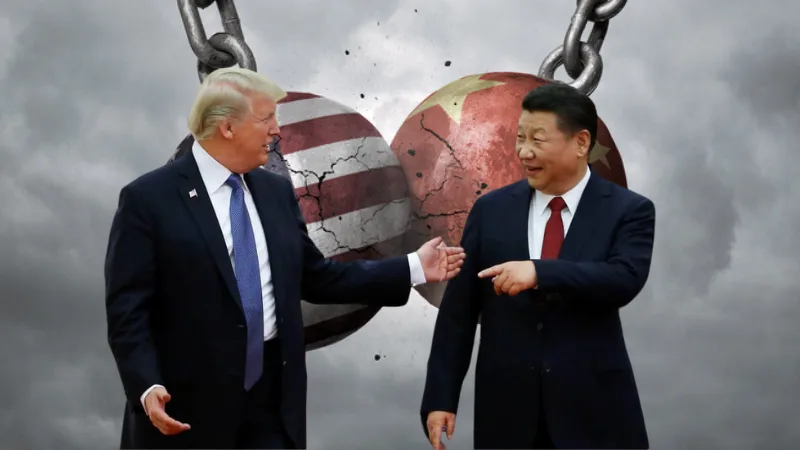
President Donald Trump and Chinese President Xi Jinping have reached a limited trade truce following a high-stakes meeting in South Korea, easing tensions that had been threatening to reignite a full-scale trade war between the world’s two largest economies.
The Core of the Deal
According to statements from both sides, China has agreed to pause for one year the sweeping export controls on rare earth elements it announced earlier this month. The restrictions had shaken markets, as rare earths are essential in the production of semiconductors, magnets, electric vehicles, and advanced defense systems.
“We have a deal,” Trump told reporters aboard Air Force One. “Now, every year we’ll renegotiate the deal, but I think the deal will go on for a long time, long beyond the year. But all of the rare earth has been settled, and that’s for the world.”
Trump added that he expects to visit China in April, with Xi planning a follow-up visit to the United States later this year.
Tariff Relief and Economic Implications
Trump said he has cut tariffs on Chinese goods tied to fentanyl from 20% to 10%, bringing the overall U.S. tariff rate on Chinese imports down to roughly 47%. The move came just weeks after the White House threatened to impose tariffs as high as 100% over Beijing’s export restrictions.
China’s Ministry of Commerce confirmed that the U.S. will postpone its blacklist rule targeting Chinese subsidiaries and suspend certain port fees for one year. Both sides characterized the deal as a “reset” designed to stabilize relations and restore confidence in trade flows.
Beijing’s Leverage in Rare Earths
Analysts warn that China used its dominance in rare earth production as a powerful negotiating tool. The United States currently depends on Chinese processing for the majority of these critical materials.
“Xi was ready for Trump in his second term and has a powerful weapon in rare earths,” said Andy Laperriere of Piper Sandler. “China is getting the better of the U.S. in these recent truce negotiations.”
Tobin Marcus of Wolfe Research agreed, saying that China’s move to restrict exports and limit agricultural imports successfully forced the White House to soften its stance on tariffs.
Not a Comprehensive Trade Agreement
While the deal eases immediate tension, experts stress that it falls short of a comprehensive trade pact. Former U.S. ambassador to China Nicholas Burns described it as “an uneasy truce in a long, still simmering trade war.”
Key areas such as agriculture, energy, and fentanyl cooperation remain only partially addressed. Trump claimed that Beijing agreed to purchase large amounts of U.S. farm goods, including 25 million metric tons of soybeans annually over the next three years, according to Treasury Secretary Scott Bessent.
However, China’s Ministry of Commerce merely stated that both nations “agreed to expand agricultural trade,” offering no details or timeline.
Piper Sandler analysts cautioned that China made similar promises during Trump’s first term. “It is doubtful Trump received anything in return for lowering tariffs on China,” Laperriere said.
Potential Energy Expansion
Trump also mentioned that China may purchase oil and gas from Alaska, though discussions are still preliminary. Energy Secretary Chris Wright and Interior Secretary Doug Burgum are expected to meet with Chinese officials in the coming weeks to explore possible agreements.
The potential for large-scale U.S. energy exports to China could benefit American producers and pipeline companies, but without a signed contract, it remains speculative.
The Nvidia Connection
Technology exports were another key topic. Trump said he discussed Nvidia chips with Xi, noting that the talks did not include the company’s most advanced Blackwell processors. “I said that’s really between you and Nvidia, but we’re sort of the arbitrator,” Trump said.
This remark signals that while the U.S. government remains involved in regulating advanced chip exports, it may allow commercial negotiations to resume in limited areas.
TikTok, Fentanyl, and the Unresolved Issues
China’s Commerce Ministry also mentioned that Beijing will work with Washington to “resolve issues related to TikTok,” though no timeline or specifics were given. Trump did not reference TikTok or any social-media-related concerns in his own remarks.
Likewise, cooperation on fentanyl trafficking remains vague. Both nations have made repeated promises to curb illegal shipments, but enforcement has lagged behind public statements.
What It Means for Investors
For investors, the Trump-Xi truce provides short-term relief but long-term uncertainty. The pause in rare earth restrictions eases pressure on sectors dependent on Chinese minerals, including defense contractors, electric vehicle manufacturers, and semiconductor firms.
Agricultural producers and logistics companies may see an uptick in demand if China follows through on its purchase commitments. Energy producers could benefit from potential export deals tied to Alaskan oil and gas.
However, structural risks remain. China’s continued leverage in rare earth processing, unresolved tech export restrictions, and limited clarity on enforcement all point to potential volatility once the one-year pause expires.
The Bigger Picture
This truce buys both sides time. For Trump, it’s an opportunity to claim a diplomatic win while keeping inflation in check ahead of the 2026 midterms. For Xi, it’s a chance to stabilize trade and maintain economic growth amid a sluggish domestic recovery.
But neither side appears ready for a true decoupling or a full resolution of structural issues such as intellectual property theft, subsidies, and geopolitical rivalry.
Investors should treat the deal as a temporary ceasefire rather than a turning point. The coming months will show whether this fragile peace holds—or simply sets the stage for another escalation in 2026.
About Author