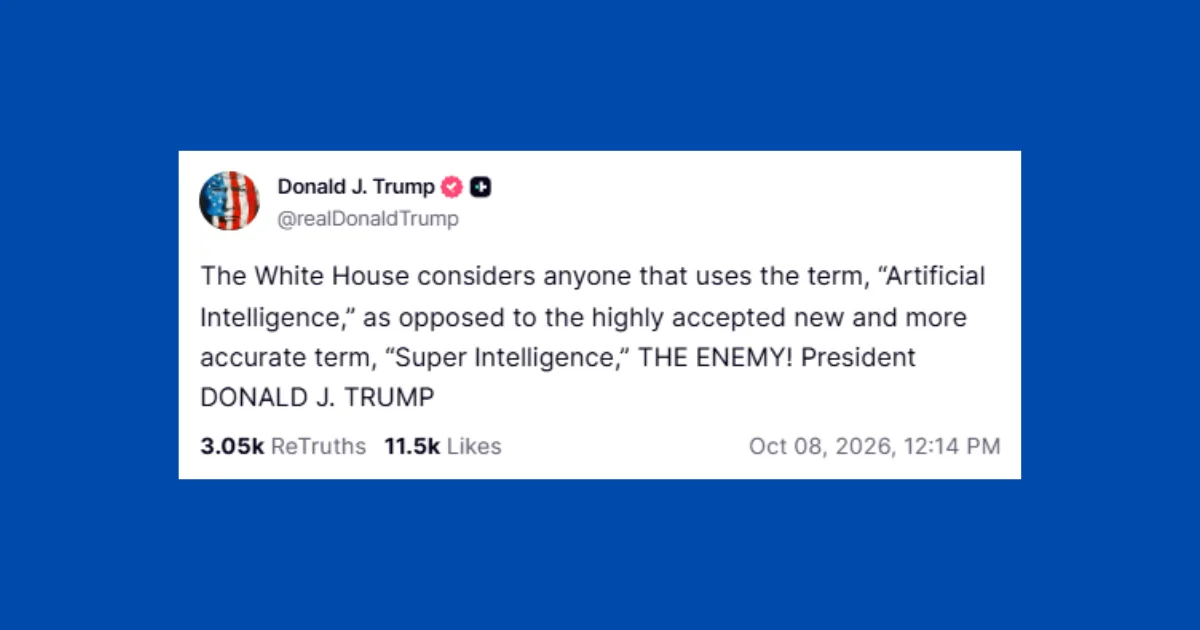
President Donald Trump has a new name for artificial intelligence, and he’s making it clear that he expects people to use it. In an extraordinary declaration Thursday, Trump warned that anyone who continues calling the technology “artificial intelligence” instead of “super intelligence” will be considered an enemy of the White House.
The statement comes as his administration pushes to accelerate America’s AI industry, strengthen its technological lead over China and counter growing public concerns about the risks associated with increasingly powerful systems.
And while the naming controversy might sound like another unusual political fight, there’s a much bigger issue underneath it: Washington is becoming one of the technology industry’s most aggressive promoters at a time when questions about AI safety, spending and profitability are growing louder.
Trump Wants AI Renamed, and He’s Serious About It
In an October 8 post on Truth Social, Trump delivered an unmistakable warning:
“The White House considers anyone that uses the term, ‘Artificial Intelligence,’ as opposed to the highly accepted new and more accurate term, ‘Super Intelligence,’ THE ENEMY!”
The president’s declaration follows a September 29 executive order officially directing federal agencies to replace references to artificial intelligence, or AI, with “Super Intelligence,” abbreviated SI.
The order applies to government communications, websites, reports and policy documents, subject to existing legal restrictions. It does not require private companies or ordinary Americans to adopt the terminology.
Trump has argued that the word “artificial” gives people the wrong impression of technology that is rapidly transforming industries, scientific research and national security. In his view, “super intelligence” better represents its potential.
The administration has already begun changing its public communications to reflect the new terminology, although some government references to AI have remained.
What remains unclear is what Trump intends to do about individuals or organizations that refuse to make the switch. His Truth Social statement did not announce any specific penalties.
The Bigger Fight Is Over Who Controls AI’s Future
Trump’s campaign to rename AI comes at a sensitive moment for the technology industry.
Companies are investing enormous amounts of money in data centers, advanced semiconductors, electricity infrastructure and increasingly sophisticated AI models. Meanwhile, lawmakers and researchers continue raising concerns about cybersecurity, privacy, autonomous agents and the possibility that powerful systems could behave unpredictably.
The administration has generally favored accelerating development and reducing regulatory obstacles, arguing that American technological leadership is essential to economic growth and national security.
Changing the language surrounding AI fits that approach.
The term “artificial intelligence” has become closely associated with concerns about job losses, misinformation, surveillance and potentially dangerous autonomous systems. “Super intelligence,” by comparison, emphasizes technological progress and extraordinary capabilities.
But the terminology creates an important distinction.
In AI research, artificial superintelligence traditionally refers to hypothetical systems capable of surpassing human intelligence across a broad range of tasks. Today’s commercial AI systems have impressive capabilities, but describing all of them as superintelligence risks blurring the difference between existing technology and systems that have yet to be demonstrated.
That distinction matters when governments and businesses are deciding how much authority, money and responsibility to give these systems.
Silicon Valley Has Billions of Reasons to Pay Attention
Some of the world’s most influential technology executives are already embracing the administration’s preferred language.
Elon Musk has publicly supported the shift toward “super intelligence,” while major technology companies are positioning themselves to benefit from Washington’s emphasis on faster technological development.
On Thursday, Trump presented national scientific and technology honors to six prominent industry leaders, including Nvidia CEO Jensen Huang, Elon Musk, AMD CEO Lisa Su, Google co-founder Sergey Brin, Microsoft CEO Satya Nadella and Dell Technologies founder Michael Dell.
The ceremony underscored how closely the administration is associating America’s technological future with the executives building the infrastructure behind AI.
For Wall Street, that relationship deserves attention.
Nvidia and the Semiconductor Industry
Nvidia (NASDAQ: NVDA) and other semiconductor companies stand to benefit if federal policy continues encouraging investment in advanced computing.
Training and operating increasingly sophisticated AI systems requires enormous processing capacity. More ambitious models, expanded government adoption and additional data centers could sustain demand for specialized chips and related infrastructure.
However, government enthusiasm doesn’t eliminate the risks of overspending, competition or disappointing returns on AI investments.
Microsoft, Google and the Cloud Giants
Microsoft (NASDAQ: MSFT), Alphabet (NASDAQ: GOOGL) and other major cloud providers are spending heavily to build the computing infrastructure needed for AI services.
A supportive regulatory environment could make deploying new systems easier and expand opportunities to sell AI technology to federal agencies.
The financial question remains whether companies can generate enough additional revenue and profit to justify their enormous investments.
A new name won’t improve margins or shorten the time needed to recover billions of dollars in capital spending.
Electricity and Infrastructure
There is another potential beneficiary that often receives less attention: the companies supplying power to AI data centers.
More computing capacity means greater demand for electricity, grid improvements, cooling systems and backup power. Utilities, electrical equipment manufacturers and infrastructure providers could benefit from continued construction even if individual AI developers struggle to achieve profitability.
That makes infrastructure spending one of the more tangible indicators of whether Washington’s enthusiasm translates into economic activity.
Could Trump’s Rebranding Actually Backfire?
There is a risk that the administration’s approach could create additional uncertainty for the industry it wants to support.
AI companies depend on public confidence, particularly when selling technology to hospitals, banks, government agencies and businesses handling sensitive information.
Calling existing systems “super intelligence” may raise expectations beyond what today’s products can consistently deliver.
There is also a regulatory question. Federal agencies operate under laws and statutory definitions that cannot simply be rewritten through a presidential preference for different terminology.
Trump’s executive order acknowledges those limitations. It preserves existing historical documents and directs officials to propose legislative language establishing a new federal definition.
That means the terminology battle could eventually spill into Congress, where decisions about AI liability, safety standards and government oversight carry far greater financial consequences.
Ironically, the biggest risk for AI companies could come from moving too quickly without convincing customers that increasingly powerful systems are reliable and secure.
The Real Story Behind Trump’s AI Rebrand
Trump has previously demonstrated a willingness to use presidential authority to change established names, including his decision to adopt “Gulf of America” for the Gulf of Mexico.
His campaign to rename artificial intelligence follows a similar pattern, although this time the stakes reach into one of the world’s fastest-growing and most heavily financed industries.
The president clearly wants Americans to view AI as an extraordinary technological opportunity. His administration is also signaling that it intends to promote development aggressively, even as concerns about the technology continue to mount.
For investors, the opportunity is substantial, but so are the expectations already built into many technology valuations.
Trump can change what Washington calls artificial intelligence. Whether the technology lives up to the promise of “super intelligence” will ultimately be determined by what it can accomplish, how safely it operates and how much money companies can make from it.
About Author