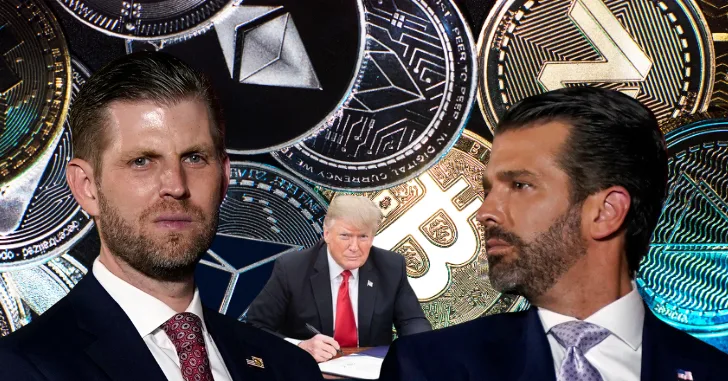
The Trump family crypto allegations are gaining renewed attention as one of the largest investors in their flagship digital asset venture publicly turns against the project. What started as a high-profile entry into decentralized finance is now facing mounting scrutiny from insiders, regulators, and investors questioning transparency, governance, and risk.
At the center of the controversy is World Liberty Financial, a crypto platform tied to President Donald Trump’s family. The company is now under fire from billionaire crypto entrepreneur Justin Sun, who claims the project misled investors and implemented centralized controls that contradict the core principles of cryptocurrency.
For investors, this situation is more than political noise. It raises deeper questions about governance in crypto markets, the risks of centralized token control, and how political influence intersects with financial innovation.
A Major Investor Turns Critic
Justin Sun, a well-known figure in the crypto industry and one of the largest backers of World Liberty Financial, has gone public with serious accusations. Sun says he committed at least $75 million to the project and was, at one point, its largest investor.
Despite initially supporting President Trump’s pro-crypto stance, Sun now claims the platform operates in a way that contradicts the decentralized ethos it promotes.
“I have always been an ardent supporter of President Trump and his crypto friendly policy,” Sun wrote publicly. “This is the opposite of decentralization. This is a trap door marketed as an open door.”
According to Sun, the platform allows company insiders to freeze user accounts at will. He alleges that his own holdings have been locked since September, preventing him from selling or accessing his tokens.
Blockchain analysis from Bubblemaps suggests that the value of Sun’s frozen holdings has dropped significantly, declining by more than $80 million to roughly $43 million. That loss highlights the real financial consequences tied to governance risks in crypto projects.
World Liberty Fires Back
World Liberty Financial has strongly denied the allegations. The company responded by accusing Sun of misconduct and suggested legal action could follow.
“We have the contracts. We have the evidence. We have the truth,” the company stated. “See you in court.”
The company claims that any restrictions placed on accounts were justified and aligned with its internal rules. This back-and-forth is now escalating into what could become a high-profile legal battle in the crypto space.
The Bigger Issue: Centralization in “Decentralized” Finance
The Trump family crypto allegations highlight a broader issue that has plagued the crypto industry for years. Many platforms advertise decentralization but retain significant control over user funds and governance.
In theory, decentralized finance removes intermediaries and gives users full control. In reality, many projects include mechanisms that allow developers or insiders to intervene, freeze assets, or change rules.
Austin Campbell, a crypto consultant and instructor at New York University, summed up the concern:
“If you took this conduct and translated it to traditional markets, you would have some problems.”
That statement reflects a growing concern among investors. Crypto may be new, but the risks tied to governance, transparency, and control are not.
Financial Pressure and Token Collapse
The controversy comes at a time when World Liberty Financial is already facing financial pressure.
The platform’s primary token, WLFI, has fallen sharply. Since August, it has dropped approximately 74 percent in value and is now trading around 8 cents. This decline mirrors broader weakness in speculative crypto tokens but also raises questions about confidence in the project.
At the same time, the company has taken on significant debt. Reports indicate that World Liberty borrowed $75 million from another crypto firm, Dolomite, using a portion of its token supply as collateral.
This type of structure can create a dangerous feedback loop. If the token price continues to fall, the company may need to post additional collateral or risk liquidation.
World Liberty has attempted to reassure investors, stating it is “nowhere near liquidation” and has already repaid $25 million of the loan. However, concerns remain about its long-term financial stability.
Stablecoin Success Adds Complexity
Interestingly, not all aspects of the business are struggling.
World Liberty’s stablecoin, USD1, has gained traction and ranks among the most widely used stablecoins. Stablecoins are designed to maintain a fixed value, typically pegged to the U.S. dollar, and are often used for trading and liquidity.
USD1’s adoption has been boosted by partnerships and listings on major exchanges such as Binance and Kraken. This creates a mixed picture for investors. While the primary token is declining, the stablecoin side of the business appears to be gaining momentum.
This split performance raises an important question. Is the company fundamentally strong, or is success in one segment masking deeper issues elsewhere?
Political and Regulatory Scrutiny
The Trump family crypto allegations are also drawing attention from lawmakers and regulators.
Democrats have previously accused President Trump of benefiting financially from crypto ventures tied to his name and influence. Critics argue that these ventures blur the line between public office and private gain.
The White House has denied any wrongdoing, stating that Trump is not involved in managing the business and has distanced himself from operational decisions.
However, financial disclosures show that Trump reported more than $57 million in income from World Liberty. Additionally, a Trump family-owned entity is reportedly entitled to a large share of revenue generated from token sales.
This financial connection is likely to keep the project under scrutiny, especially as crypto regulation continues to evolve.
A Pattern in Trump-Linked Crypto Projects
World Liberty is not the only crypto venture linked to the Trump brand.
Shortly before his 2025 inauguration, a separate entity launched a token known as TRUMP. That token initially surged to around $45 but has since fallen dramatically, now trading near $2.81.
A similar trajectory occurred with a token associated with Melania Trump.
These price swings are not unusual in the crypto market, but they reinforce concerns about volatility, hype-driven launches, and long-term sustainability.
What This Means for Investors
The Trump family crypto allegations offer several key lessons for investors navigating the digital asset space.
First, governance matters. Even in crypto, where decentralization is a core promise, control often remains concentrated. Investors need to understand who has authority over accounts, tokens, and rules.
Second, token economics are critical. When projects use their own tokens as collateral for loans, they introduce additional risk. A falling token price can quickly create financial stress.
Third, political connections do not eliminate risk. In some cases, they may increase scrutiny and volatility.
Finally, diversification within a project does not guarantee stability. World Liberty’s stablecoin success does not offset the risks tied to its primary token.
The Bottom Line
The situation surrounding World Liberty Financial is still unfolding. What began as a high-profile crypto venture tied to one of the most recognizable names in politics is now facing internal disputes, financial pressure, and regulatory attention.
For investors, the takeaway is clear. Crypto remains a high-risk, high-reward space where transparency and governance can make or break a project.
As the Trump family crypto allegations continue to develop, the outcome could have broader implications not just for World Liberty, but for how politically connected crypto ventures are viewed and regulated in the future.
About Author