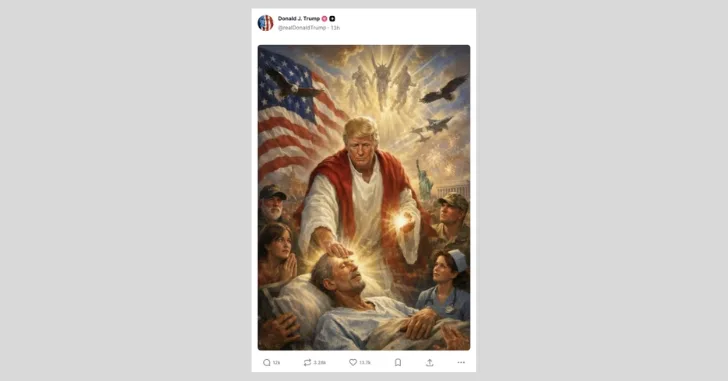
President Donald Trump is facing an unusual wave of criticism from a core pillar of his political support following a controversial AI-generated image he shared on social media.
The image, which depicted Trump in a Christ-like role performing a healing, quickly ignited backlash among prominent Catholic and evangelical leaders. For a president who has maintained strong loyalty among religious conservatives through multiple election cycles, the response marks one of the most notable fractures in that relationship since his return to the White House.
A Viral Image That Crossed a Line
The now-deleted image showed Trump in flowing robes, illuminated by a glowing light, placing his hand on the forehead of a man in a hospital bed. The scene included overtly symbolic elements such as prayerful figures, patriotic imagery, and military visuals in the background.
While Trump has frequently used provocative messaging and imagery to energize supporters, this post struck a different chord.
Within hours, conservative religious figures began publicly condemning the image, describing it as offensive and inappropriate.
John Yep, CEO of Catholics for Catholics, captured the sentiment shared by many in his network:
“We are a little bit beside ourselves.”
He went on to describe the reaction among fellow believers:
“was one of sadness, because we were truly confused by this president after Catholics gave him such a resounding vote, and yet he is treating our faith with such disrespect at this moment.”
Yep reportedly reached out directly to contacts within Trump’s orbit to express concern and frustration.
Religious Allies Speak Out
The criticism did not stop there.
Conservative writer Rod Dreher delivered one of the harshest assessments, stating:
“Not saying Trump is the Antichrist, but he’s radiating the spirit of Antichrist, no question.”
Pastor Douglas Wilson also condemned the image, calling it “blasphemous.”
These are not fringe voices. Both figures represent segments of the religious right that have largely supported Trump through political turmoil, including impeachments and contentious elections.
That is what makes this backlash significant.
For years, Trump has maintained a transactional but effective alliance with religious conservatives. In return for their support, he delivered on key priorities, most notably reshaping the Supreme Court, which ultimately led to the overturning of Roe v. Wade.
This moment suggests that even that loyalty has limits.
Tensions With the Vatican Add Fuel
The controversy surrounding the image did not happen in isolation.
It followed Trump’s public criticism of Pope Leo XIV, whom he accused of being weak on crime and aligned with liberal viewpoints after the pope spoke out against escalating conflict in the Middle East.
The combination of attacking a sitting pope and posting imagery that many interpreted as mocking Christian theology amplified the reaction.
For many religious leaders, the issue was not just political. It was deeply personal.
Why This Matters Politically
Trump’s relationship with religious voters has been one of the most reliable pillars of his political strength.
Exit polling from recent elections has consistently shown overwhelming support among white evangelical voters and strong backing from conservative Catholics. That coalition has helped anchor his campaigns and drive turnout in key swing states.
But moments like this introduce risk.
Even a modest erosion of enthusiasm among religious voters could have outsized effects in close elections. These voters are not just supportive. They are highly engaged and influential within their communities.
If trust begins to weaken, it could impact turnout, grassroots organizing, and donor activity.
That said, it is far from certain that this controversy will lead to lasting damage. Trump has weathered numerous political storms that initially appeared threatening but ultimately had little long-term impact on his base.
The question now is whether this issue fades quickly or signals a deeper shift.
The Role of AI in Political Messaging
Beyond the political fallout, the incident highlights a growing and underappreciated issue.
Artificial intelligence is rapidly changing how political figures communicate and shape narratives.
AI-generated imagery allows for the creation of highly symbolic, emotionally charged content that can spread instantly across social media. But it also introduces new risks.
In this case, the use of AI blurred the line between satire, symbolism, and perceived disrespect. What may have been intended as a dramatic or provocative visual instead triggered backlash from a key audience.
This raises broader questions for campaigns, media outlets, and investors:
- How will AI reshape political branding and messaging?
- Where is the line between effective communication and reputational risk?
- How will audiences respond as AI content becomes more common?
These are not abstract concerns. They have real implications for trust, influence, and ultimately, power.
About Author