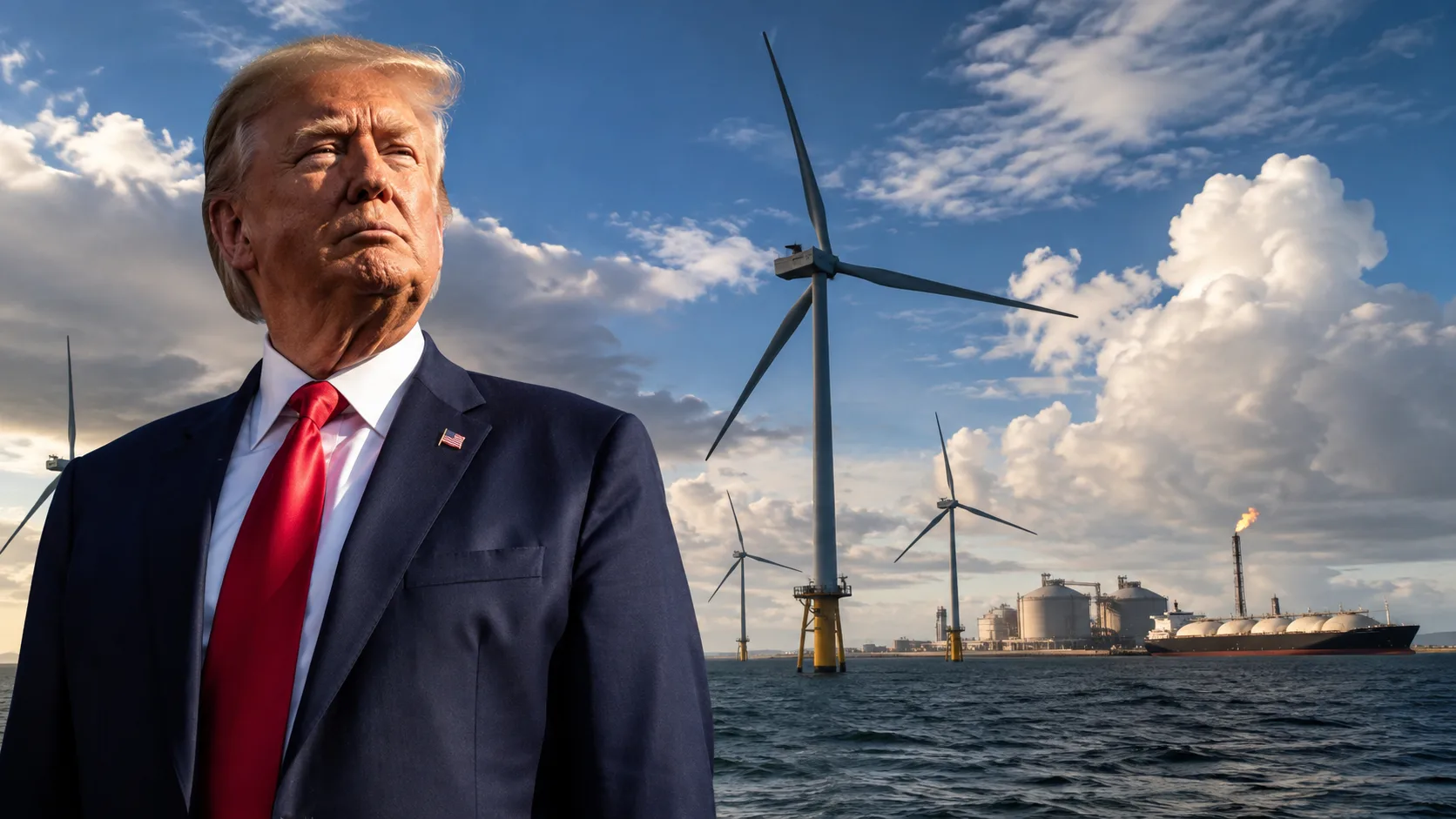
The Trump administration has reached another major agreement aimed at reshaping America’s energy landscape, with German energy giant RWE agreeing to abandon its U.S. offshore wind projects in exchange for a $1.2 billion government payout.
Instead of developing offshore wind farms, RWE says it will redirect billions of dollars into natural gas and liquefied natural gas (LNG) infrastructure, marking another significant victory for President Donald Trump’s effort to shift U.S. energy policy toward fossil fuels.
RWE Walks Away From Offshore Wind
RWE announced it will surrender its offshore wind leases located off the coasts of California, Louisiana, and New York after concluding there was no realistic path to obtaining permits for the projects.
“After careful consideration, it was determined there is no path forward to permit these projects in the US for the foreseeable future,” the company said in a statement.
As part of the agreement, the U.S. Department of the Interior will pay RWE approximately $1.2 billion.
Billions Shift From Wind to Natural Gas
Rather than exiting the U.S. market, RWE plans to redirect much of its investment toward conventional energy infrastructure.
The company said it intends to invest approximately $900 million into a liquefied natural gas export terminal in Louisiana as part of a broader plan to invest roughly €17 billion (about $19.6 billion) in U.S. electricity generation over the next six years.
The move underscores how major global energy companies are adapting their investment strategies as federal energy policy changes under the Trump administration.
Trump Continues Campaign Against Offshore Wind
President Trump has long been one of offshore wind’s most vocal critics.
Throughout his presidential campaign and since returning to office, he has repeatedly argued that wind turbines are expensive, visually unappealing, and harmful to wildlife.
Shortly after taking office, Trump declared:
“We’re not going to do the wind thing.”
More recently, he told supporters that “any country with windmills is a loser.”
His administration has instead prioritized expanding domestic oil and natural gas production under its familiar “drill, baby, drill” agenda.
Interior Department Calls Agreement a Win
Interior Secretary Doug Burgum praised the agreement, saying it reflects a return to what the administration considers practical energy policy.
“We welcome RWE’s agreement and voluntary investment in projects that strengthen our nation’s energy security,” Burgum said.
He also argued that Americans deserve an energy system based on “common sense” rather than one reliant on costly government subsidies.
Part of a Broader Energy Strategy
The RWE agreement is not an isolated case.
Earlier this year, the Trump administration reached a similar deal with French energy company TotalEnergies, ending its planned offshore wind developments in the United States.
In exchange, TotalEnergies redirected investment toward an LNG export facility in Texas and additional conventional oil development in the Gulf of Mexico.
The agreements suggest the administration is pursuing a broader strategy of encouraging energy companies to replace renewable energy investments with oil and gas projects.
What It Means for Investors
For investors, the agreement highlights several emerging trends:
- LNG infrastructure continues attracting major capital commitments as companies shift investment toward export capacity.
- Offshore wind developers face increasing regulatory uncertainty under current federal policy.
- Traditional energy companies involved in natural gas production, LNG exports, and pipeline infrastructure could benefit if similar policy shifts continue.
- Renewable energy developers with significant U.S. offshore exposure may face additional permitting and political risks.
With another global energy company redirecting billions away from offshore wind and into fossil fuel infrastructure, the Trump administration is accelerating one of the most significant reversals of U.S. energy policy in recent years.
About Author