Shares of Archer-Daniels-Midland (NYSE: ADM), a leading U.S. supplier of high-fructose corn syrup (HFCS), took a sharp hit Thursday morning after President Donald Trump claimed he had convinced Coca-Cola to switch from using HFCS to real cane sugar in its U.S. soft drinks.
In a Truth Social post that rippled through commodity and food manufacturing markets, Trump declared, “I have been speaking to Coca-Cola about using REAL Cane Sugar in Coke in the United States, and they have agreed to do so. I’d like to thank all of those in authority at Coca-Cola. This will be a very good move by them — You’ll see. It’s just better!”
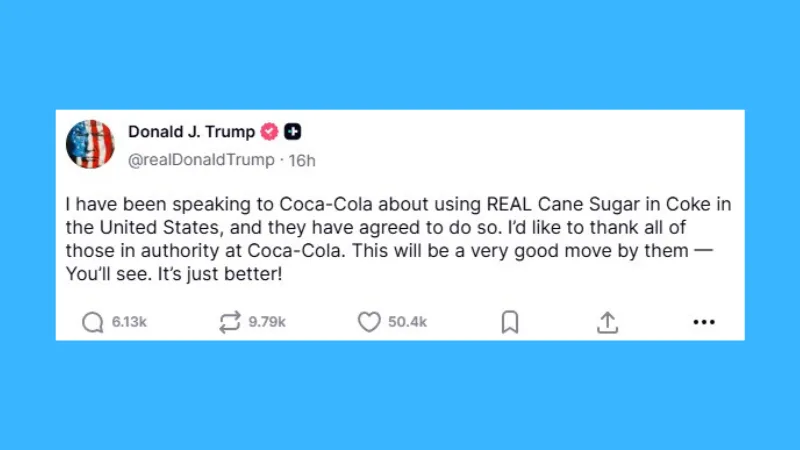
While Coca-Cola didn’t confirm the switch outright, the market responded swiftly to the possibility. ADM stock dropped more than 6% at its lows on Thursday before recovering slightly to trade down around 3% in premarket hours. Ingredion (NYSE: INGR), another key supplier of corn-based sweeteners and starches, also saw its stock fall by more than 5%.
Coca-Cola’s Careful Response
Coca-Cola issued a cautious statement that neither confirmed nor denied the change in ingredients: “We appreciate President Trump’s enthusiasm for our iconic Coca-Cola brand. More details on new innovative offerings within our Coca-Cola product range will be shared soon.”
Despite the ambiguity, Coca-Cola shares rose modestly, up 0.3% in premarket trading and more than 11% year to date. The stock has outperformed the S&P 500 in 2025, bolstered by renewed consumer demand and recent product innovation.
Implications for ADM and the Corn Industry
The reaction in ADM’s share price reflects deep investor concern that Trump’s endorsement of cane sugar over HFCS could signal broader regulatory or market-driven changes in U.S. food manufacturing.
ADM, which generates a substantial portion of its earnings from corn refining—including high-fructose corn syrup production—has seen its stock rebound in recent months, up around 13% in the past quarter and nearly 7% year to date. But Thursday’s selloff was a stark reminder of the company’s exposure to shifting public policy and consumer sentiment.
The Corn Refiners Association, which represents ADM and other players in the space, pushed back hard. John Bode, president and CEO of the group, issued a statement warning that the proposed shift would come at a steep cost to American jobs and agriculture.
“Replacing high fructose corn syrup with cane sugar doesn’t make sense,” Bode said. “President Trump stands for American manufacturing jobs, American farmers, and reducing the trade deficit. Replacing high fructose corn syrup with cane sugar would cost thousands of American food manufacturing jobs, depress farm income, and boost imports of foreign sugar, all with no nutritional benefit.”
Why This Matters for Investors
For equity investors, this development raises several critical questions:
- Is this a one-off comment or a signal of broader policy direction?
While Coca-Cola hasn’t formally announced a switch, Trump’s post, combined with earlier comments from Health and Human Services Secretary Robert F. Kennedy Jr. pushing for cleaner food formulations, may indicate that more food ingredient reform is coming. - What’s the risk exposure for companies like ADM and Ingredion?
HFCS producers have long defended the ingredient as a cost-effective and safe sweetener. However, they are vulnerable to public backlash, regulatory pressure, and customer decisions. Coca-Cola moving away from HFCS—even partially—could open the floodgates for competitors to follow, hurting demand across the board. - What happens to corn prices and the broader agricultural market?
If major beverage and food companies begin sourcing cane sugar over corn syrup, the downstream impact could be massive. Corn farmers may face weaker demand and lower prices, while sugar growers could see a boom. International trade relationships might also be affected, particularly if more cane sugar is imported from Latin America or Southeast Asia. - Does this reflect a shift in consumer or political priorities?
The Trump administration appears to be aligning itself with consumer health trends—at least symbolically. Health-conscious younger consumers have shown a preference for “natural” ingredients, and major food companies have responded by reducing artificial additives and HFCS in recent years. Investors should track how this influences portfolio companies in the food and beverage sector.
Understanding the HFCS vs. Cane Sugar Debate
High-fructose corn syrup has long been the dominant sweetener in U.S. soft drinks, mainly due to its lower cost compared to cane sugar. HFCS is derived from corn starch, a key product for both ADM and Ingredion. In contrast, cane sugar—though more expensive—is often perceived by consumers as more “natural” or “healthier,” despite offering virtually identical nutritional value.
In recent years, demand for HFCS has already started to decline, particularly among premium or “natural” brands. A shift by a major player like Coca-Cola, even if only partial or symbolic, could accelerate this trend and threaten the long-term demand outlook for corn-based sweeteners.
Trump’s Food Reform Agenda
Trump’s statement fits into a broader trend within his administration that includes calls for reforming the U.S. food system. Earlier this year, Robert F. Kennedy Jr., now serving as Secretary of Health and Human Services under Trump, told food executives he wants “the worst ingredients” out of American products.
If this rhetoric turns into concrete policy—whether through new labeling laws, tax incentives, or trade rules—it could fundamentally reshape which food inputs are favored in U.S. supply chains.
Investors in agriculture, food processing, and commodity trading should prepare for increased volatility and uncertainty around ingredient demand. Regulatory risk is now back on the table in sectors that had grown used to stability.
Could This Be a Trade Policy Signal?
Another consideration: Trump’s endorsement of cane sugar may hint at trade policy moves. The U.S. imports most of its raw cane sugar from countries like Brazil, Mexico, and the Dominican Republic. If Trump pushes to replace domestically produced HFCS with imported cane sugar, it would clash with his long-standing protectionist stance.
Alternatively, this could be part of a strategy to secure more favorable trade deals with sugar-producing countries—possibly through tariff negotiations or supply chain incentives. For investors in agricultural commodities, watching how this plays out will be key to forecasting price trends.
How Investors Can Respond
If you’re an investor, here are some steps to consider in light of this development:
1. Reevaluate Exposure to Corn Refiners
If you’re holding ADM, Ingredion, or similar stocks, take a hard look at their revenue breakdowns. How reliant are they on HFCS production? What is their exposure to Coca-Cola or other large beverage makers?
Consider trimming positions or hedging through options if you’re concerned that policy shifts could weigh on margins or demand.
2. Look for Upside in Sugar Producers
Companies with exposure to cane sugar—either in agriculture or processing—could benefit if demand shifts. This includes firms operating in Brazil, Mexico, or Florida-based sugar cooperatives.
ETFs or commodity funds tracking sugar futures might also see inflows if this trend accelerates.
3. Watch for Signals on Food Reform Policy
Stay alert to further comments from the Trump administration about food policy. If regulatory changes or executive orders follow this announcement, the broader packaged food industry could see substantial disruptions—both risks and opportunities.
Companies that have already reformulated away from HFCS—like PepsiCo with some of its craft sodas—may benefit.
4. Consider Consumer Behavior Trends
Investors should also assess portfolio exposure to evolving consumer preferences. The “clean label” movement is gaining traction, with buyers prioritizing simpler ingredients, natural formulations, and sustainable sourcing.
Food companies positioned to meet those preferences will likely outperform those stuck defending older formulas.
Final Thoughts
President Trump’s unexpected post about Coca-Cola and cane sugar may seem like a small headline, but its ripple effects across the commodities, food manufacturing, and equity markets are real. For Archer-Daniels-Midland and Ingredion, the market is pricing in the risk of long-term demand erosion. For investors, this is a moment to reevaluate assumptions about what’s safe in the consumer staples sector.
While it remains unclear whether Coca-Cola will fully commit to the switch or whether the administration will follow through with enforceable policies, the signal has been sent. The Trump White House is paying attention to what’s in America’s food—and that could be the beginning of a much larger shake-up for the $1.5 trillion U.S. food and beverage industry.
About Author