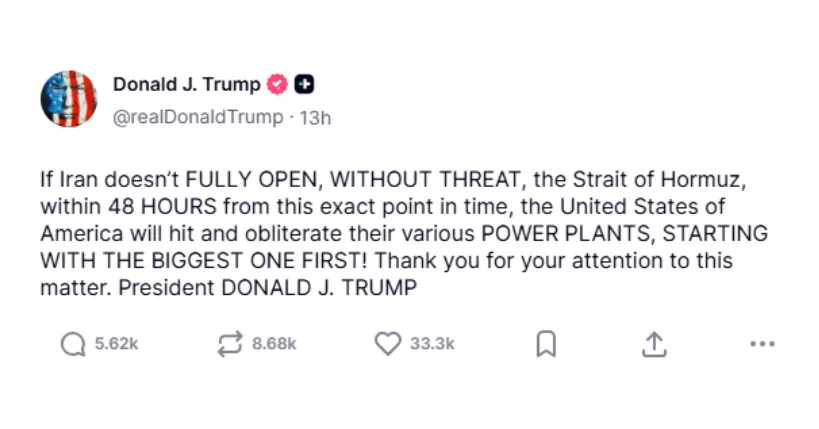
President Trump has sharply escalated the Middle East crisis, warning that the United States will strike Iran’s major power plants if Tehran does not fully reopen the Strait of Hormuz within 48 hours. The threat marks one of the clearest signs yet that the conflict is moving beyond military exchanges and into a direct fight over global energy infrastructure.
According to Reuters and the Associated Press, Trump said Iran must reopen the Strait of Hormuz “FULLY OPEN, WITHOUT THREAT,” or the U.S. would target Iran’s electricity infrastructure, including major power facilities. Iran responded by warning that if its energy infrastructure is attacked, it could retaliate against U.S.-linked and allied infrastructure across the region.
That is not just another war headline. It is a direct threat against the backbone of Iran’s domestic economy at the same time one of the most important oil chokepoints in the world is under pressure. For investors, this matters because a prolonged Hormuz disruption can hit oil, liquefied natural gas, shipping, inflation expectations, defense stocks, airline names, and the broader market all at once. Reuters reports that roughly one-fifth of global oil and LNG shipments move through the Strait of Hormuz, making it one of the most economically important maritime routes on earth.
What Trump Actually Threatened
The core message from Trump was simple: reopen the strait or face a U.S. strike on Iran’s power grid and power plants. The AP reported that Trump threatened to “obliterate” Iranian power plants if the passage was not reopened within 48 hours. Reuters similarly reported that Trump threatened strikes on Iran’s power infrastructure as the war escalated.
This is a major escalation for two reasons.
First, it shifts the conversation away from limited military targets and toward civilian-adjacent infrastructure that keeps the economy functioning. Power plants are not symbolic targets. They help run homes, hospitals, industrial sites, water systems, communications networks, and transport operations.
Second, it increases the odds that retaliation would not stay neatly contained. Iran has already signaled that attacks on its energy sector could trigger responses against regional energy, desalination, and infrastructure assets tied to the U.S. and its partners. That means the conflict could spread into the broader Gulf energy system, not just stay inside Iran.
Why the Strait of Hormuz Matters So Much
The Strait of Hormuz is one of those places most Americans rarely think about until markets start breaking. But it is one of the most critical energy arteries in the global economy.
It links the Persian Gulf to the Gulf of Oman and the Arabian Sea, serving as the export route for crude oil and liquefied natural gas from major producers in the region. Reuters reports that around 20% of global oil and LNG flows move through the strait. That means even partial disruption can quickly ripple into higher energy prices, supply shortages, shipping insurance spikes, and inflation pressure.
Iran has said the strait remains open to all but “enemy-linked” ships, but that is not the same as normal global commercial access. A chokepoint is still a chokepoint even if access is selective, politicized, or threatened. Shipping companies, energy traders, insurers, and governments do not need a full legal closure to panic. They just need enough uncertainty to back off, delay routes, or raise costs.
That is why investors should not get hung up on whether Iran says the strait is technically “open.” The real question is whether the flow of energy is stable, predictable, and commercially usable. Right now, it clearly is not.
Why Power Plants Are a Bigger Threat Than They Sound
A threat to destroy power plants is not just a military headline. It is an economic warfare headline.
Electricity infrastructure is a force multiplier. If a country loses major generation capacity, it can face rolling blackouts, industrial disruption, communications failures, supply chain stress, and strain on hospitals and essential services. In Iran’s case, that could worsen existing economic pressure from war damage, sanctions, and domestic fragility.
The AP also noted that facilities potentially at risk could include strategically important sites such as Bushehr, highlighting how dangerous and escalatory this rhetoric has become.
For markets, that raises three immediate concerns.
The first is energy shock. If Iran’s domestic infrastructure is hit, Tehran could retaliate against regional energy assets, creating a wider supply shock.
The second is inflation. Higher crude and LNG prices would filter into transportation, utilities, manufacturing, and food.
The third is risk sentiment. When traders start pricing in broader regional infrastructure warfare, they usually cut exposure to cyclical sectors and move toward safe havens, defense, or energy plays.
How Markets Could React
This is where the investor angle gets real.
If the standoff worsens, the most obvious market reaction is in oil and gas. Higher oil prices can support energy producers in the short term, but they also squeeze consumers, raise transportation costs, and increase recession risk if the spike lasts long enough. Reuters said the conflict around Hormuz has already intensified fears in global energy markets.
Defense stocks may also stay in focus if investors believe U.S. military involvement will deepen or broaden. The more Washington signals long-duration force projection in the region, the more capital tends to rotate toward names tied to missiles, naval systems, logistics, and surveillance.
On the other side, airlines, cruise operators, transport names, and other fuel-sensitive sectors could remain vulnerable if oil prices stay elevated. Industrials and consumer-facing businesses could also feel pressure if inflation expectations start moving higher again.
Gold can attract safe-haven flows in moments like this, though it does not always move in a straight line if traders are forced to sell liquid assets to cover losses elsewhere. The dollar can also strengthen during periods of acute geopolitical panic, depending on how global capital interprets the risk.
In plain English, this kind of geopolitical escalation can produce winners and losers fast, and the first move is usually not the final move.
Iran’s Response Raises the Stakes Further
Iran did not shrug off Trump’s warning. Its response was effectively: hit our infrastructure and the region will pay a price.
Reuters and AP both reported that Iranian officials warned that attacks on their energy infrastructure could trigger retaliation against broader infrastructure networks linked to the U.S. and its allies.
That matters because the Gulf is full of infrastructure that global markets depend on. Energy export terminals, refining capacity, IT systems, ports, and desalination plants are all pressure points. If those come under threat, this stops being just an Iran story and becomes a global supply story.
That is also why investors should pay attention to secondary indicators, not just war headlines. Watch oil shipping traffic, tanker insurance rates, LNG export disruptions, airline fuel commentary, and statements from Gulf governments. Those details often tell you more about market risk than political rhetoric alone.
The Broader Investor Takeaway
The biggest mistake investors can make with stories like this is treating them like background noise. This one is not background noise.
A U.S. president threatening to destroy Iranian power plants unless a globally vital energy chokepoint is reopened is the kind of event that can move commodities, change inflation expectations, shake risk assets, and alter sector leadership.
At minimum, investors should understand that this situation increases the odds of:
higher oil and gas prices,
more volatility in global equities,
fresh inflation pressure,
a stronger bid for defense and safe-haven assets,
and renewed stress for fuel-sensitive sectors.
It also raises the possibility of policy ripple effects. If energy prices surge hard enough, central banks may have a tougher time declaring victory over inflation. That could complicate rate-cut hopes and hit the kinds of stocks that have been relying on easier monetary policy.
What Investors Should Watch Next
The next phase of this story likely comes down to five things.
Watch whether Iran changes its position and allows clearly unrestricted commercial navigation through Hormuz.
Watch whether the U.S. follows up Trump’s threat with visible military positioning or a countdown toward action.
Watch for any direct attack on Iranian energy or electricity infrastructure.
Watch oil and LNG price action for signs that traders think this is becoming a prolonged supply shock.
And watch for retaliatory threats or attacks on regional infrastructure outside Iran itself.
If this de-escalates, some of the panic premium in energy could come out quickly. But if it escalates, markets may be forced to reprice geopolitical risk in a much bigger way.
Final Word
Trump’s threat to destroy Iran’s power plants if the Strait of Hormuz is not reopened is not just a dramatic soundbite. It is a warning that the conflict may be entering a more dangerous economic phase, where energy systems and civilian infrastructure become central targets.
That is the kind of development that can hit markets far beyond the Middle East. Oil, inflation, defense spending, shipping, and consumer costs all sit downstream from what happens next.
Investors do not need to panic. But they do need to pay attention.
About Author