On May 17, 2025, President Donald Trump ignited a political and economic firestorm by publicly rebuking Walmart on Truth Social. His message was clear: the retail giant should absorb the costs of his administration’s tariffs rather than passing them on to consumers. This confrontation has spotlighted the tensions between government trade policies and corporate pricing strategies, raising questions about the broader implications for the U.S. economy.
The President’s Directive
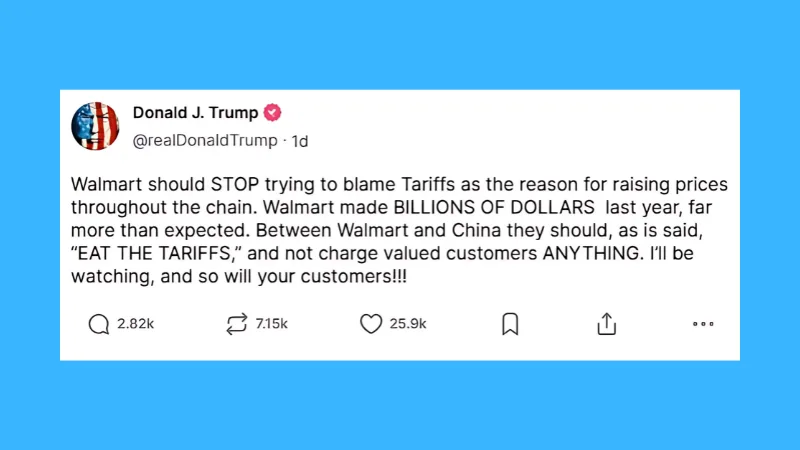
In his Truth Social post, President Trump stated:
“Walmart should STOP trying to blame Tariffs as the reason for raising prices throughout the chain. Walmart made BILLIONS OF DOLLARS last year, far more than expected. Between Walmart and China they should, as is said, ‘EAT THE TARIFFS,’ and not charge valued customers ANYTHING. I’ll be watching, and so will …
This statement came in response to Walmart’s announcement that it would increase prices on various goods due to elevated import costs stemming from the administration’s tariffs.
Walmart’s Position
Walmart CEO Doug McMillon addressed the issue during the company’s Q1 FY2026 earnings call, emphasizing the challenges posed by the tariffs: Investopedia
“Even at the reduced levels, the higher tariffs will result in higher prices.” CBS News
CFO John David Rainey further elaborated on the impact, noting that the company is “wired for everyday low prices,” but the magnitude of the tariff increases is more than any retailer … . He warned that consumers would start seeing price increases by the end of May, affecting items like fruits, vegetables, and children’s car seats. The US Sun
Treasury Secretary’s Acknowledgment
Treasury Secretary Scott Bessent acknowledged the situation, stating that while Walmart would absorb some of the tariff costs, others might be passed on to consumers:KPRC
“Walmart will be absorbing some of the tariffs, some may get passed on to consumers.”
Bessent also mentioned that he had spoken with Walmart’s CEO and that the company would absorb some tariffs, just as they had in previous years. Fox Business
Expert Analysis
Economists have weighed in on the broader implications of the tariffs. Mark Blyth, a political economist at Brown University, described the situation as a “policy-induced supply shock,” indicating that the tariffs are leading to increased prices for consumers. He emphasized that such shocks can have significant effects on the economy, especially when they disrupt established supply chains.
Former Walmart CEO Bill Simon also commented on the company’s financial position, suggesting that Walmart’s improved profit margins could allow it to manage the tariff impact more effectively. The US Sun
Broader Economic Context
The confrontation between President Trump and Walmart occurs against the backdrop of the administration’s “Liberation Day” tariffs, announced on April 2, 2025. These tariffs imposed a 10% universal tariff on imports and higher country-specific tariffs, leading to increased costs for importers and potential price hikes for consumers.
While a temporary 90-day reduction on Chinese tariffs to 30% was agreed upon, the long-term impact on prices and consumer behavior remains a concern.
Conclusion
The exchange between President Trump and Walmart underscores the complex interplay between government trade policies and corporate pricing strategies. While the administration aims to protect domestic industries through tariffs, companies like Walmart face challenges in maintaining low prices amid increased import costs. This situation highlights the broader economic impact of trade policies on both businesses and consumers.
As the situation evolves, it will be important to monitor how such policies affect not only corporate decisions but also consumer behavior and the broader economy.
To provide the best experiences, we use technologies like cookies to store and/or access device information. Consenting to these technologies will allow us to process data such as browsing behavior or unique IDs on this site. Not consenting or withdrawing consent, may adversely affect certain features and functions.
Functional
Always active
The technical storage or access is strictly necessary for the legitimate purpose of enabling the use of a specific service explicitly requested by the subscriber or user, or for the sole purpose of carrying out the transmission of a communication over an electronic communications network.
Preferences
The technical storage or access is necessary for the legitimate purpose of storing preferences that are not requested by the subscriber or user.
Statistics
The technical storage or access that is used exclusively for statistical purposes.The technical storage or access that is used exclusively for anonymous statistical purposes. Without a subpoena, voluntary compliance on the part of your Internet Service Provider, or additional records from a third party, information stored or retrieved for this purpose alone cannot usually be used to identify you.
Marketing
The technical storage or access is required to create user profiles to send advertising, or to track the user on a website or across several websites for similar marketing purposes.