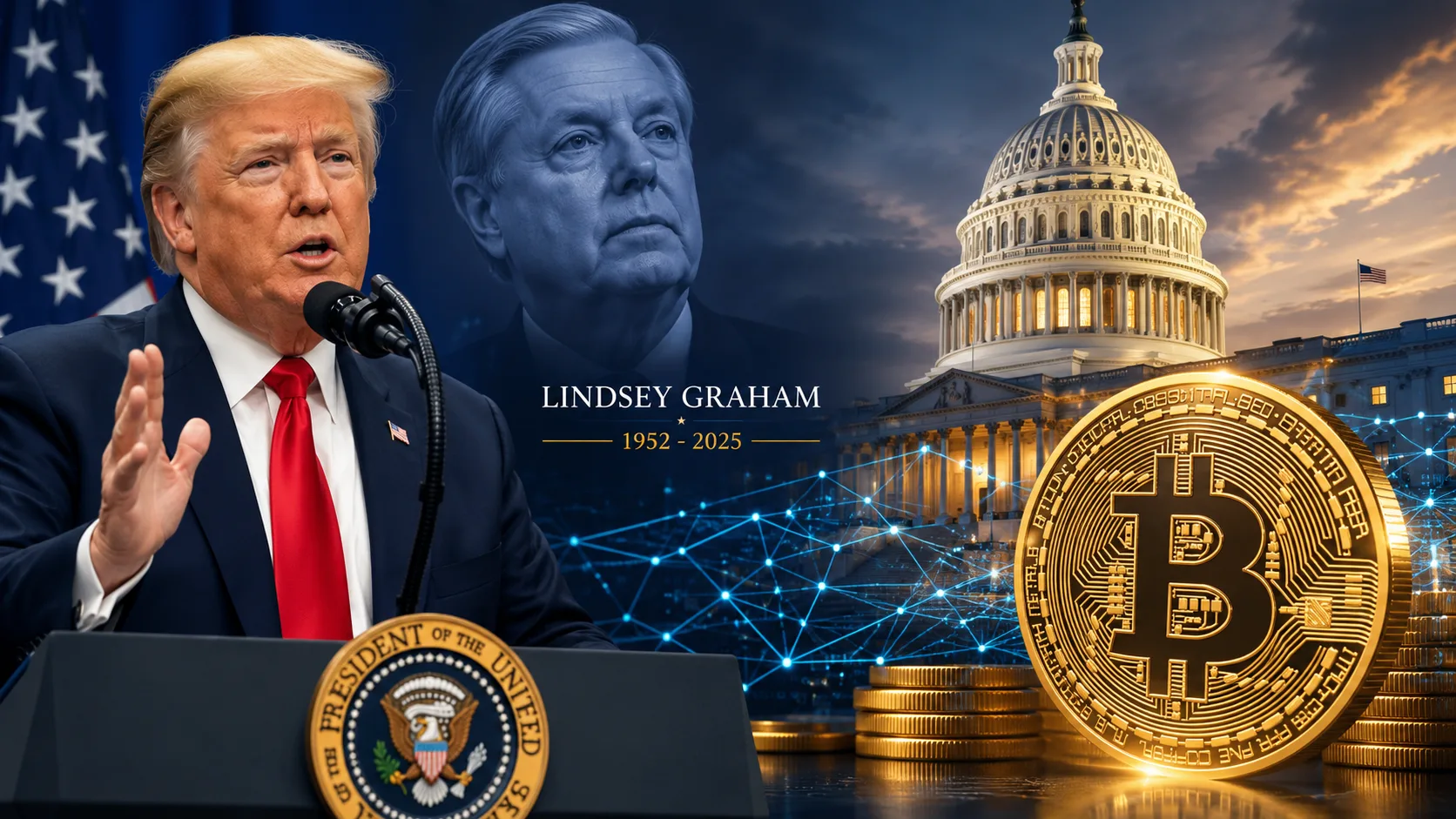
President Donald Trump is urging the Senate to approve one of the most significant cryptocurrency bills ever considered by Congress, saying passage of the Clarity Act would honor the legacy of the late Sen. Lindsey Graham.
In a Truth Social post Monday, Trump called on lawmakers to move the legislation forward following Graham’s death over the weekend at age 71.
“In honor of Senator Lindsey Graham, a big supporter, the U.S. Senate should pass the Clarity Act,” Trump wrote.
Trump also framed the legislation as part of a broader strategic competition with China.
“China, and many other countries, would like to take complete and total control of this major financial ‘happening,’ as well as A.I., where we are now leading, but where they are fighting hard. Don’t let China win on either subject!!!”
The White House has made digital asset policy a major priority, arguing that clear rules would help keep cryptocurrency innovation and investment inside the United States rather than overseas.
What the Clarity Act Would Do
The Clarity Act is among the first comprehensive attempts by Congress to establish a regulatory framework for digital assets.
The legislation seeks to define which federal agencies oversee different categories of cryptocurrencies while creating clearer rules for companies operating in the industry. Supporters argue the current regulatory environment has discouraged investment and driven crypto businesses abroad.
Many of the largest names in the digital asset industry, including Coinbase, Circle and Ripple, have backed the measure, saying regulatory certainty would encourage institutional investment and strengthen America’s position in the rapidly growing crypto economy.
The White House has also endorsed the legislation as part of a broader effort to position the United States as a global leader in both cryptocurrency and artificial intelligence.
Graham Wasn’t a Lead Sponsor, But Trump Says the Bill Honors His Legacy
Although Trump described Graham as a supporter of the legislation, the South Carolina senator was not one of its primary architects.
The Clarity Act has largely been championed in the Senate by Sen. Tim Scott of South Carolina and Sen. Cynthia Lummis of Wyoming, two of Congress’ most vocal advocates for cryptocurrency regulation.
Graham also did not vote on the bill in committee because he was not a member of the Senate Banking Committee, which approved the legislation by a 15-9 vote in May with bipartisan support.
The senator was better known for his work on foreign policy and national security than cryptocurrency legislation.
In fact, several lawmakers have suggested that Graham’s most fitting legislative tribute would be passage of a bipartisan Russia sanctions package that he spent years developing.
Sen. Jeanne Shaheen, D-N.H., said there “can be no more fitting memorial to Lindsey, his legacy, or the causes he fought for, than to pass this legislation and realize his long-held dream of an independent and secure Ukraine.”
Crypto Industry Backs the Bill While Banks Push Back
The legislation has received strong support from much of the cryptocurrency industry, which argues that federal regulatory clarity is essential for long-term growth.
Industry leaders believe standardized rules could attract additional institutional investors and reduce uncertainty that has weighed on digital asset markets for years.
However, traditional financial institutions have raised concerns.
Banking groups argue portions of the legislation could allow crypto companies to offer products resembling interest-bearing accounts, potentially drawing deposits away from traditional banks and reducing available capital for consumer and business lending.
Law enforcement organizations and some labor groups have also voiced opposition, citing concerns about financial stability, consumer protection and oversight.
Graham’s Death Could Make Senate Approval More Difficult
While Graham was not central to negotiations surrounding the Clarity Act, his death may still affect the legislation’s prospects.
His passing reduces the Senate Republican majority from 53 seats to 52, leaving party leaders with even less room for defections on closely contested votes.
Democrats have also sought additional ethics provisions related to elected officials’ involvement in cryptocurrency ventures, an issue that has become increasingly prominent given Trump’s own growing ties to the digital asset industry.
Those disagreements could complicate efforts to bring the legislation to the Senate floor in the coming weeks.
Why Investors Are Watching Closely
The Clarity Act represents one of the most consequential crypto bills Congress has considered.
If enacted, it would provide regulatory certainty that many investors and companies have sought for years while potentially accelerating institutional adoption of digital assets.
For investors, the outcome could influence the future growth of major cryptocurrency exchanges, stablecoin issuers, blockchain developers and publicly traded companies with significant exposure to digital assets.
Whether Trump’s public endorsement helps build momentum remains uncertain, but with a narrower Senate majority and ongoing partisan disagreements, the legislation now faces a more challenging path than supporters anticipated.
About Author