In a rare and highly symbolic move, President Donald Trump will tour the Federal Reserve headquarters in Washington, D.C., on July 24, 2025. Ostensibly inspecting a $2.5 billion renovation project, the visit was widely interpreted as a political broadside aimed at Federal Reserve Chair Jerome Powell—just days before the Fed’s next interest rate decision.
Trump’s tour comes amid escalating tensions between the White House and the central bank. The president has repeatedly criticized Powell for keeping interest rates “too high,” calling him a “knucklehead” and threatening to remove him—though legal constraints make that difficult. While markets largely shrugged off the event, the underlying message is far more consequential: Trump wants lower rates, and he’s willing to apply direct political pressure to get them.
So what’s really going on, and why does it matter for investors?
A Presidential Visit to the Fed—Why That’s a Big Deal
Only three presidents in history have visited the Fed’s headquarters: Franklin D. Roosevelt in 1937, Gerald Ford in 1975, and George W. Bush in 2006. Trump’s visit breaks a long-standing tradition of political neutrality between the executive branch and the central bank—a relationship crucial for maintaining economic stability and investor confidence.
According to The Wall Street Journal, Trump’s visit was coordinated with White House budget director Russ Vought and several conservative policy advocates. While the official line focused on oversight of the Fed’s renovation spending—now $2.5 billion, up from the original $1.9 billion budget—the optics and timing couldn’t be clearer: this was a strategic move to apply political pressure.
The Interest Rate Dispute: A Clash of Economic Visions
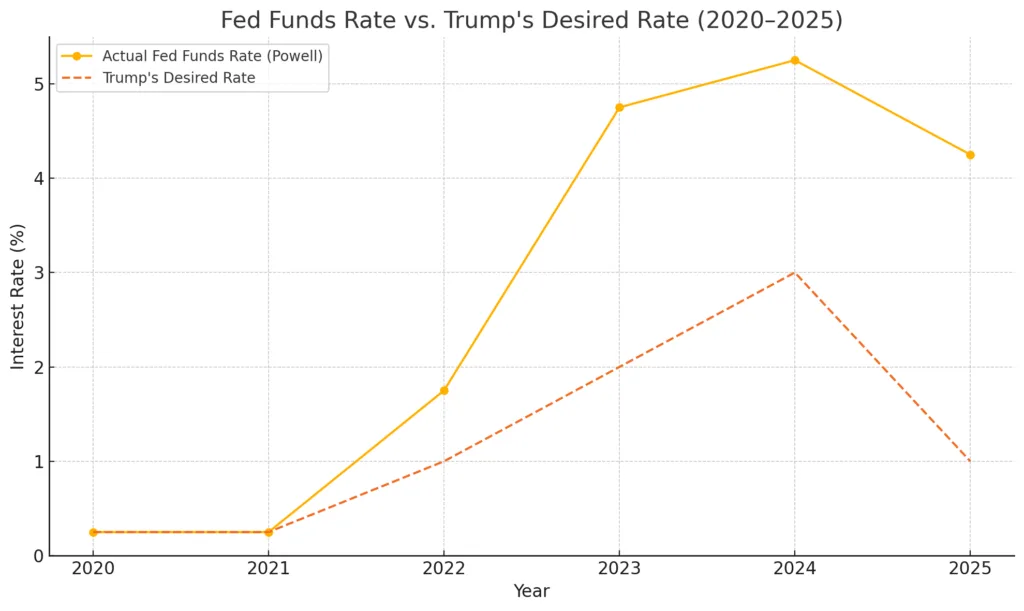
At the core of the conflict is the Fed’s benchmark interest rate, currently sitting between 4.25% and 4.50%. Trump wants that slashed to near 1%, arguing that lower borrowing costs are essential for spurring growth, reducing federal debt servicing costs, and boosting investment in American infrastructure.
However, the Fed’s position is grounded in economic caution. While inflation has cooled from 2022 highs, it remains sticky in services and wages. Most Fed officials believe that cutting rates too fast could reignite inflation, forcing a longer-term policy reversal.
“Chair Powell’s responsibility is to make decisions based on data, not political pressure,” said a former Fed governor quoted by Reuters.
Trump’s Pressure Campaign
This visit is just the latest salvo in what is now a months-long campaign by the Trump administration to cast doubt on Powell’s leadership. Trump has accused Powell of:
- Mismanaging the Fed’s real estate project.
- Failing to cut rates quickly enough to respond to economic slowdowns.
- Undermining U.S. global competitiveness by keeping monetary policy too tight.
White House advisor Bill Pulte claimed the Fed’s HQ renovation “epitomizes waste and bureaucratic overreach.” But this line of attack is more about political leverage than fiscal scrutiny.
Meanwhile, Treasury Secretary Scott Bessent has walked a fine line—saying there are “no plans to remove Powell,” but also suggesting the Fed “should be reviewed.”
Charting the Divergence: Powell vs. Trump on Rates
The chart below illustrates the divergence between the Fed’s actual interest rate path under Powell and Trump’s publicly expressed targets:
As shown, Trump’s desired rates are consistently lower than Powell’s policy decisions, especially post-2022. Trump’s vision reflects a more aggressive, pro-growth strategy, while the Fed continues to prioritize inflation stability.
Market Reaction: Shrug for Now, But Risks Remain
Despite the media frenzy, financial markets barely blinked. The 10-year Treasury yield held around 4.39%, and equity markets were mostly steady.
Why the calm? Investors are betting that Powell and the Fed will remain largely insulated from political noise—at least through the end of his term.
But that confidence has limits. If Trump intensifies pressure or attempts to replace Powell in 2026, markets could react more violently. Fed independence is one of the cornerstones of U.S. financial stability. Undermining that could lead to higher risk premiums, greater bond market volatility, and a weaker dollar.
“Even the perception of political interference can lead to long-term damage,” said former Fed Chair Ben Bernanke in comments cited by AP News.
Fed’s Defense: Transparency and Modernization
In response to criticism, Powell has emphasized that the headquarters renovation is necessary for both safety and modernization. The project—originally approved under a prior administration—is designed to bring the historic Marriner S. Eccles Building into compliance with seismic and environmental standards.
In a letter to White House officials, Powell noted that “design changes did not trigger a need for reauthorization,” pushing back on claims of reckless spending.
Whether investors accept that rationale or see it as a convenient excuse, the broader narrative remains: the Fed is caught in a political crossfire.
What Investors Should Watch Next
1. July Fed Meeting
Markets expect the Fed to hold rates steady at the upcoming policy meeting, but forward guidance will be key. Any softening in tone could be interpreted as a political concession—even if unintended.
2. Inflation and Economic Data
If inflation continues to fall and unemployment stays low, the Fed may start cutting rates in Q4 2025. But that will depend on data, not Trump’s tweets.
3. Trump’s Next Move
Will the President continue with symbolic gestures, or escalate with legal or legislative action against the Fed? Investors should prepare for potential political volatility—especially heading into election season.
4. Global Confidence
Central banks around the world watch the Fed closely. Any sign that the U.S. central bank is losing independence could ripple across bond markets, currency reserves, and international investment flows.
Don’t Fight the Fed—Unless You’re the President?
Trump’s visit to the Fed wasn’t about architecture. It was a power play designed to reshape monetary policy through political pressure. While markets remain calm for now, the underlying risks are real.
For investors, the key takeaway is this: the fight over interest rates isn’t just an academic debate. It could shape everything from inflation expectations to the value of the dollar, Treasury yields, and equity market multiples.
About Author