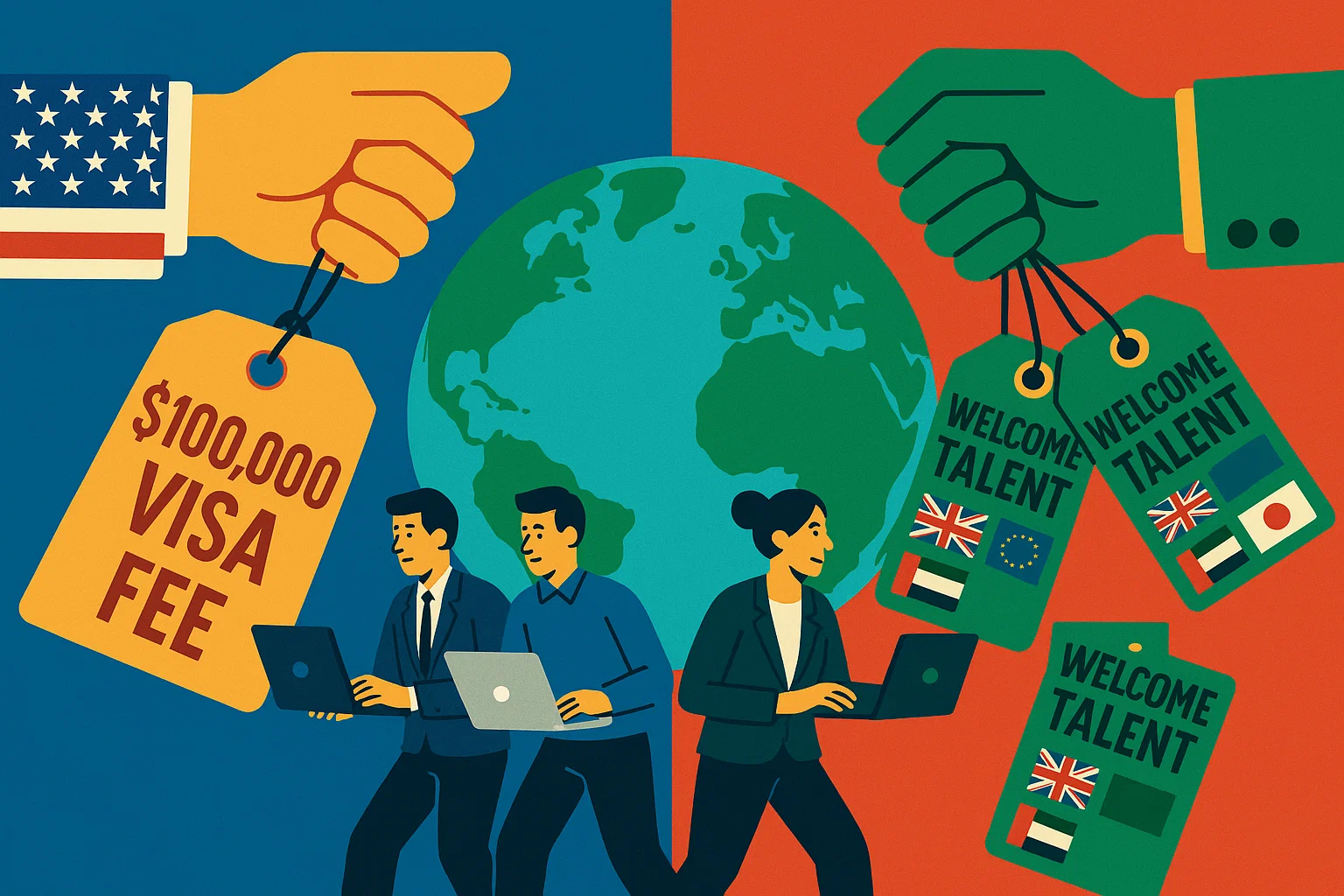
The U.S. government’s abrupt decision to impose a $100,000 application fee on H-1B visas for skilled foreign workers has sent shockwaves through corporate America and talent hubs worldwide. The Trump administration framed the measure as a way to protect American jobs. Yet experts say the policy could backfire by weakening the country’s innovation edge and accelerating a global competition for highly skilled workers.
The New H-1B Landscape
On September 21, 2025, the Trump administration raised the application fee for new H-1B visas to $100,000 per petition. According to U.S. Citizenship and Immigration Services, the fee applies only to new petitions and not to renewals or existing holders. (ABC7) The policy took effect on September 22.
The administration said the change is intended to push companies to hire more American workers and invest in domestic STEM training. The move marks one of the largest fee increases for skilled worker visas in U.S. history. (Reuters)
H-1B visas have long been essential to industries like technology, finance, healthcare, and engineering. They allow companies to hire highly skilled workers from countries such as India and China to fill specialized roles. The program caps the number of visas at 85,000 per year, with far more applications than slots available.
Immediate Reactions from Key Players
India Pushes Back
India, whose nationals receive the majority of H-1B visas, criticized the policy, calling it likely to have humanitarian consequences. The Indian government said the fee could disrupt families and careers while hurting the flow of talent between the two countries.
Big Tech Companies Brace for Higher Costs
Large U.S. technology companies have been among the biggest users of H-1B visas. Amazon employed more than 14,000 H-1B holders as of June 2025, while Microsoft, Meta, Apple, and Google each had over 4,000.
Although these firms have large cash reserves and global reach, even a one-time fee of $100,000 per hire can add up quickly when recruiting thousands of workers. Smaller companies, which often rely on international hires for specialized roles, may be hit even harder.
Opportunities Abroad
Charles-Henry Monchau, chief investment officer at Syz Group, told CNBC the six-figure fee could deliver a boost to global talent hubs eager to attract skilled workers. “It definitely could be painful for the U.S. in terms of innovation,” Monchau said. “It could be an opportunity for the U.K., it could be an opportunity for Europe, for locations like Dubai, for instance, or maybe China… Because obviously if the U.S. becomes more stringent, this is a golden opportunity for many of these countries to open the door to offshore experts and workers.”
The Global Race for Talent Accelerates
The fee hike may mark a turning point in global talent migration. Countries competing for high-skilled workers are moving quickly to capitalize.
Harry Stebbings, founder of VC fund and podcast 20VC, called the policy “the greatest opportunity” for Europe. “The single biggest threat to European innovation is the loss of talent,” Stebbings wrote on social media. “Trump has handed Europe the greatest opportunity.” He urged the U.K. to fast-track all H-1B visa holders to make the country a “talent magnet.”
British Prime Minister Keir Starmer is reportedly considering proposals to drop visa fees for top-level professionals to attract global talent. A Home Office spokesperson told the Financial Times the country’s global talent routes are designed to attract and retain high-skilled professionals, particularly in science, research, and technology.
Barney Hussey-Yeo, CEO of British artificial intelligence startup Cleo, described the U.S. change as “an unprecedented opportunity.” He said that since the H-1B turmoil began, he had received over 1,000 direct messages from highly skilled professionals considering leaving the U.S., including computer science graduates from elite universities now working at top tech companies. “The U.K. should do everything possible to become the default destination for this world-class talent,” he added.
Economic and Market Implications
Cost Pressures for Indian IT and U.S. Tech
Indian IT service providers, which deploy thousands of workers to the U.S., face significant cost pressures. Unless they can pass the fees onto clients, their margins could shrink. For U.S. tech companies, the policy could make it harder to fill specialized roles and slow down innovation, especially in areas such as artificial intelligence, cybersecurity, and advanced manufacturing.
Diverging Effects on Big Tech and Startups
While major tech firms may view the $100,000 fee as a rounding error relative to the value each hire creates, startups could be squeezed. Metaview’s co-founder and chief technology officer Shahriar Tajbakhsh said his company is using the news as a hiring opportunity but noted that other countries’ recruiting pitches “feel a bit desperate.” He added that for his company, $100,000 is relatively modest compared to the productivity of each team member.
Shifting Talent to Other Regions
Countries such as the U.K., Dubai, Singapore, and Canada are already marketing themselves as more welcoming destinations. Lower visa fees, streamlined processes, and attractive living conditions could lure top engineers and scientists away from the U.S. if the new policy remains in place.
Actionable Insights for Investors
- Assess Exposure to H-1B Reliance
Review portfolio companies’ hiring practices. Firms that depend heavily on H-1B workers, especially in IT services and consulting, may face higher costs and slower growth. - Favor Firms with Diversified Talent Pools
Companies with established global hubs or strong domestic pipelines are better positioned to adapt. Look for firms with robust training programs and partnerships with local universities. - Watch for Opportunities Abroad
As the U.K., Europe, and Middle Eastern hubs liberalize visa policies, they may become magnets for high-growth startups. Consider exposure to venture funds, public equities, or ETFs targeting those regions. - Monitor Regulatory Developments
Litigation, political backlash, or administrative clarifications could change the scope or duration of the policy. Keep an eye on government statements and court filings. - Re-price Margin Forecasts
Incorporate higher hiring costs into earnings models for affected firms. Adjust price targets or hedging strategies accordingly.
Broader Trends
The H-1B fee hike highlights a larger global trend. Countries are using immigration policy as an economic tool to attract or retain talent. While the U.S. seeks to protect domestic jobs, other nations are positioning themselves as open alternatives. For investors, this creates both risks and opportunities.
Companies that successfully adapt by diversifying talent sources, automating processes, or expanding offshore operations may emerge stronger. Those that cannot adjust quickly may face talent shortages, rising costs, and slower innovation.
Why This Matters for Investors
The Trump administration’s $100,000 H-1B visa fee is more than a headline. It is a policy shift that could alter cost structures, hiring practices, and competitive dynamics across industries. It creates challenges for U.S. firms reliant on foreign talent but opens doors for rival economies to attract that same talent.
Investors should respond by measuring exposure, revising assumptions, and identifying winners and losers. Global talent remains one of the most valuable resources for innovation and economic growth. Policies that affect its flow can reshape entire sectors, making it essential for investors to stay ahead of the curve.
About Author