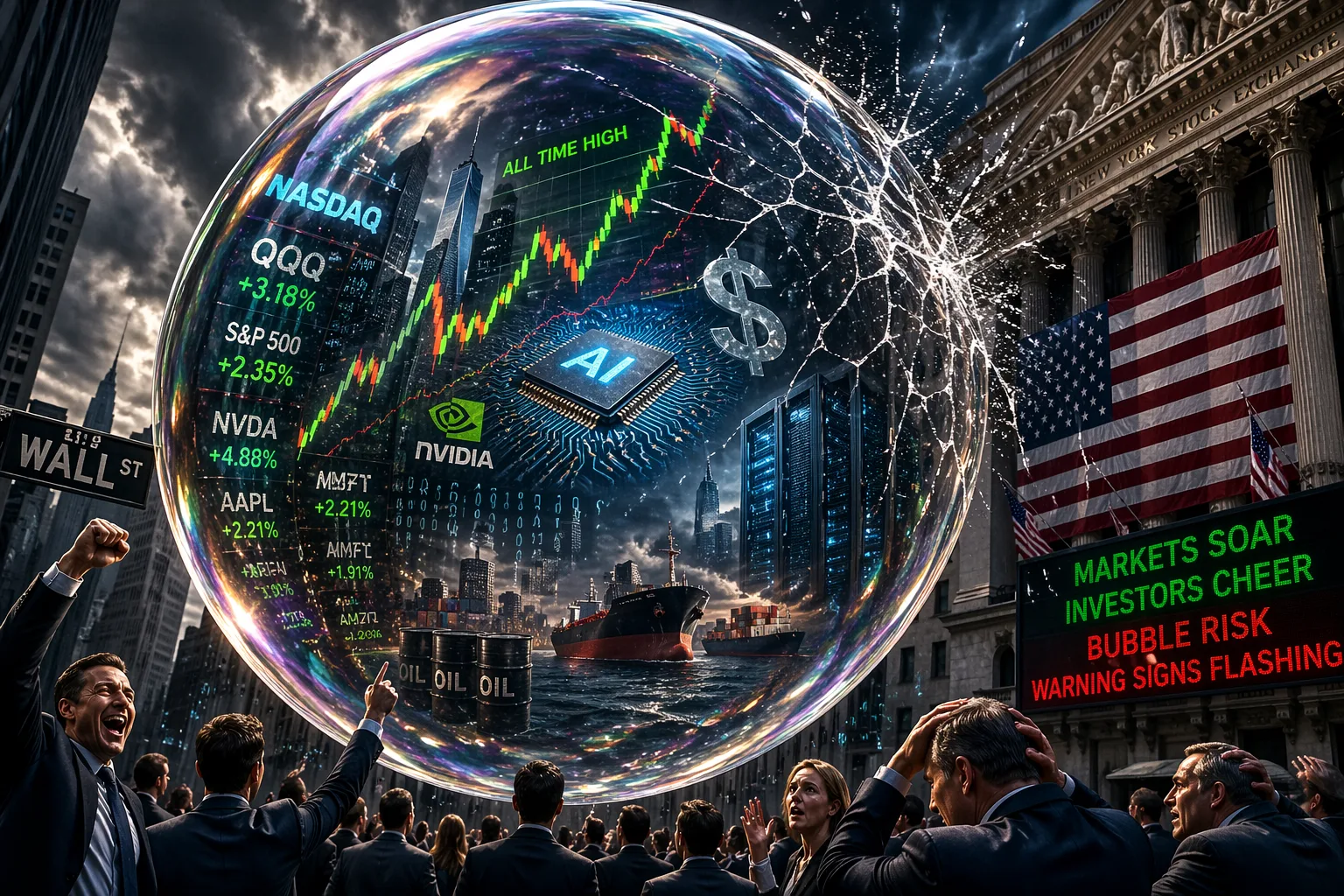
The U.S. stock market is sending mixed signals right now. On one hand, equities continue to surge, powered by relentless momentum in megacap tech and AI-driven optimism. On the other, several indicators are starting to resemble past market bubbles, raising concerns that investors may be underestimating risk.
At the center of this tension is a market that appears increasingly driven by short-term catalysts and policy headlines, particularly from President Trump. In recent weeks, traders have seen just how quickly sentiment can shift.
A Market That Moves in Minutes
In one striking example, it took less than 10 minutes after the S&P 500 closed lower for President Trump to announce a cease-fire extension tied to tensions in the Middle East. That announcement helped stabilize sentiment, even as underlying risks remained unresolved.
Despite the extension, the strategic chokepoint at the Strait of Hormuz remains partially disrupted. Iran-linked attacks on commercial vessels have already forced ripple effects across global supply chains.
Major airlines, including Lufthansa, have begun reducing flights. Meanwhile, petrochemical producers across Asia are scaling back operations due to uncertainty around energy supplies.
Ordinarily, this kind of geopolitical instability would rattle markets. Instead, equities have continued climbing.
That disconnect is exactly what has some strategists worried.
Bank of America: “Right-Tail Risks” Are Building
According to strategists at Bank of America, the current rally is being driven by what they call “right-tail momentum risks.”
In plain terms, that means the market is increasingly skewed toward extreme upside moves, often detached from fundamentals.
One of the clearest examples is the performance of the Nasdaq-100, which recently posted a 13-day winning streak. What stands out is not just the gains, but the volatility behind them.
Strategists noted that realized volatility during this run exceeded levels seen during the late 1990s dot-com bubble.
At the same time, the S&P 500 has delivered a rally comparable to some of the most turbulent periods in market history, including:
- The 2008 global financial crisis
- The 2020 COVID-19 crash and recovery
- The 1987 stock market crash
That combination of strong gains and extreme volatility is unusual. It often signals that markets are being driven more by positioning and sentiment than by earnings or macro fundamentals.
Not a Full Bubble Yet, But Parts of the Market Are Overheating
Bank of America stops short of calling the entire market a bubble. But it does highlight several sectors and regions where valuations and price behavior are starting to look stretched.
Key “Frothy” Areas
- Semiconductors: The PHLX Semiconductor Index continues to surge as AI demand fuels expectations. However, valuations are becoming increasingly aggressive.
- South Korea equities: The KOSPI, heavily weighted toward chipmakers, is showing similar momentum-driven behavior.
- Commodities: Both Brent Crude Oil and the Bloomberg Commodity Index are exhibiting sharp price swings that resemble past bubble conditions.
Beyond sectors, several global investment themes are also attracting speculative capital at a rapid pace:
- Taiwan equities
- Brazilian markets
- Space and satellite technology
- Digital infrastructure and AI-related assets
These areas are benefiting from powerful narratives, but that is often exactly what fuels bubbles.
The Bigger Picture: A Shift Toward “Asymmetry”
Strategists describe the current environment as having “right-tail asymmetry.”
That means upside moves are becoming more extreme and more frequent than downside corrections.
This dynamic creates a dangerous feedback loop:
- Rising prices attract more capital
- More capital drives prices even higher
- Investors become conditioned to expect gains
- Risk perception declines
Eventually, however, that cycle tends to reverse.
And when it does, the unwind can be sharp.
Why Geopolitics Isn’t Shaking Markets (Yet)
One of the most puzzling aspects of today’s market is its resilience in the face of escalating geopolitical risk.
The ongoing tensions involving Iran, shipping disruptions, and energy supply uncertainty would normally push investors toward defensive assets.
Instead, equities are pushing higher.
There are a few reasons for this:
- Liquidity and positioning: Institutional investors are still heavily exposed to equities and are chasing performance.
- AI-driven optimism: The artificial intelligence boom continues to dominate market narratives, particularly in tech.
- Policy expectations: Markets are increasingly reacting to real-time political developments, especially from the Trump administration.
In other words, investors are focusing on upside catalysts while largely ignoring downside risks.
That imbalance rarely lasts forever.
Economic Undercurrents: AI and the Labor Market
Beyond markets, there are broader economic shifts underway that could eventually impact valuations.
A recent study by economist Lee Tucker at the U.S. Census Bureau found that employment among early-career workers in highly AI-exposed industries declined by 15% following the release of ChatGPT.
That suggests artificial intelligence is already reshaping the labor market.
For investors, this presents a double-edged sword:
- AI boosts productivity and corporate profits
- But it may also weaken consumer demand if job growth slows
Over time, that tension could become more important for markets.
Corporate Developments Investors Are Watching
Several major corporate headlines are also shaping sentiment:
- Adobe announced a $25 billion expansion of its stock buyback program
- Deutsche Telekom is reportedly exploring a deeper combination with T-Mobile
- Trump Media & Technology Group is facing leadership changes following stock weakness
- Earnings from Tesla and IBM are expected to influence near-term market direction
These developments matter because, in a momentum-driven market, narrative shifts can have an outsized impact on prices.
What This Means for Investors
The takeaway is straightforward, even if the market isn’t.
We are not definitively in a full-blown bubble. But the conditions that typically lead to one are starting to appear:
- Rapid price increases
- Elevated volatility
- Strong narrative-driven investing
- Reduced sensitivity to risk
For investors, this is a time to stay disciplined.
Chasing momentum blindly can work for a while. But history shows that when markets become this one-sided, the eventual correction can be fast and unforgiving.
Smart Moves to Consider
- Take partial profits in overheated sectors
- Diversify beyond crowded trades like megacap tech
- Consider hedging strategies to protect downside
- Focus on fundamentals, not just momentum
The market may continue climbing in the short term.
But the margin for error is getting thinner.
About Author