

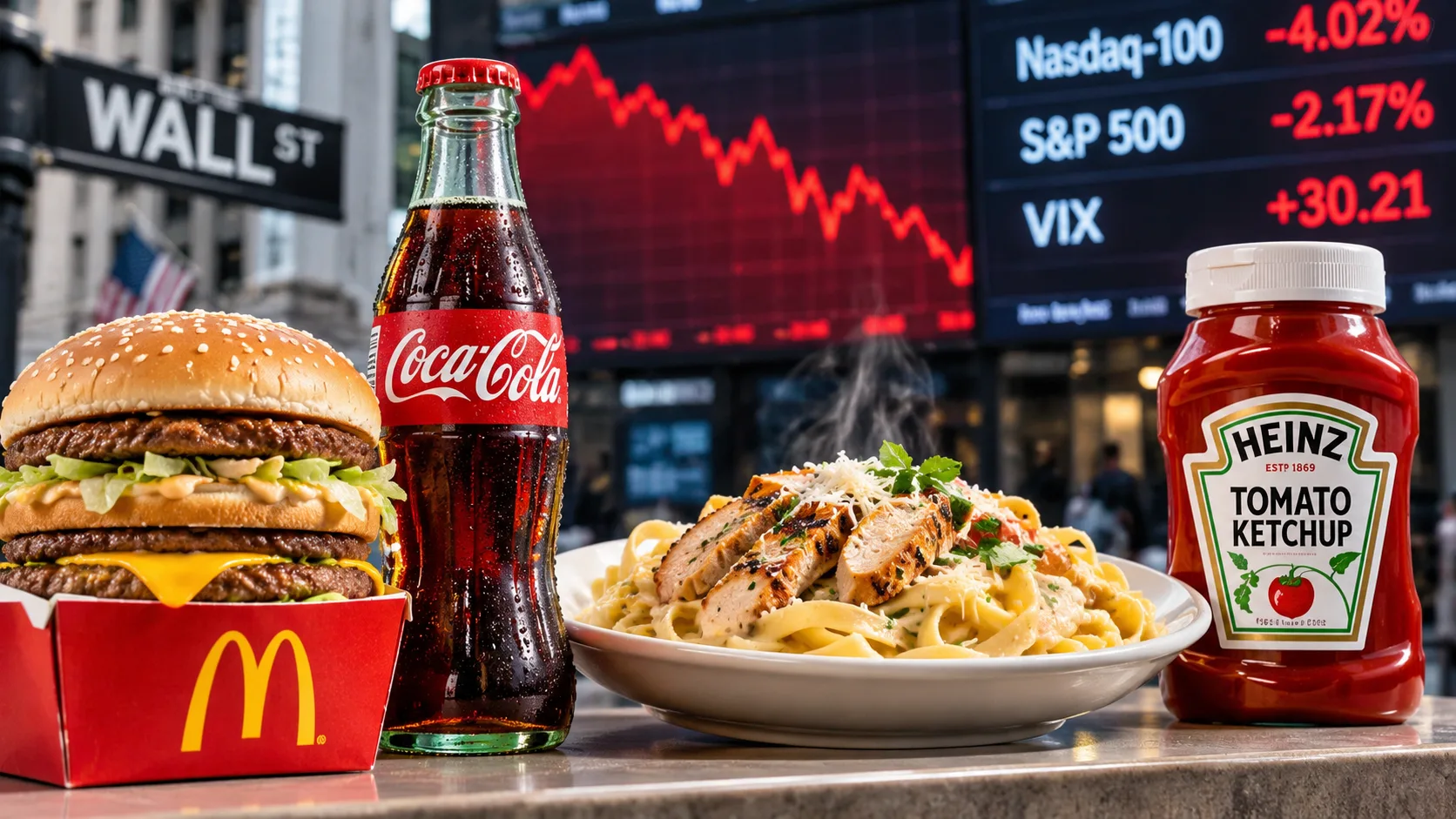
As investors flee artificial intelligence stocks and volatility surges across Wall Street, some of America’s most familiar companies are quietly delivering impressive returns. Their performance may offer an important clue about where investors are looking for shelter as inflation persists and confidence in the technology sector deteriorates.
Wall Street’s Fear Gauge Is Flashing a Warning
The Cboe Volatility Index (VIX), commonly referred to as Wall Street’s fear gauge, climbed back above 30 on Wednesday as selling pressure intensified across the technology sector. The Nasdaq-100 tumbled more than 4%, while the S&P 500 fell more than 2%.
Adding to investor anxiety is the continued resilience of inflation. The personal consumption expenditures price index, the Federal Reserve’s preferred inflation measure, rose 3.8% in October compared with a year earlier, accelerating from 3.7% in September, according to the figures reported by CNBC.
Persistent inflation could complicate the Federal Reserve’s ability to lower interest rates, creating another headwind for highly valued growth stocks. Companies whose valuations depend heavily on future earnings growth are particularly vulnerable when borrowing costs remain elevated.
Yet beneath the broader market sell-off, several companies are moving in the opposite direction.
Four Stocks Bucking the Market Sell-Off
A CNBC Pro analysis using FactSet data identified S&P 500 companies with relatively low historical volatility that had gained at least 3% in November through Tuesday’s close.
Among the companies outperforming were four familiar names in the restaurant and consumer staples industries.
The Stocks Defying November’s Turbulence
Month-to-date performance through November 24, 2026
These companies share several characteristics that can become particularly attractive during periods of market uncertainty, including established brands, recurring consumer demand and relatively predictable business models.
Darden Restaurants (NYSE: DRI): A Surprising Market Leader
Darden Restaurants, the parent company of Olive Garden, LongHorn Steakhouse and several other restaurant chains, led the highlighted group with a November gain of 9.1%.
The company’s performance is particularly interesting because restaurants are generally considered consumer discretionary businesses. When household budgets tighten, dining out is often among the first expenses consumers reduce.
However, Darden appears to be benefiting from continued momentum at Olive Garden and the strength of its diversified restaurant portfolio. KeyBanc analyst Christopher Carril recently highlighted the company’s consolidated growth and operating performance within the casual dining industry.
Darden also has a three-year beta of approximately 0.4, suggesting its historical sensitivity to broader market movements has been relatively low.
For investors, the primary risks remain rising food and labor costs, weakening consumer spending and pressure on restaurant traffic. Its ability to maintain sales growth without sacrificing profitability will be critical in the coming quarters.
McDonald’s (NYSE: MCD): The Appeal of Affordable Dining
McDonald’s has gained 8.7% in November, helped by better-than-expected third-quarter financial results reported earlier this month.
The fast-food giant has historically benefited from its ability to attract consumers looking for affordable meals. During periods of economic uncertainty, some households may trade down from more expensive restaurants, creating opportunities for companies with strong value-oriented offerings.
McDonald’s franchise-heavy business model also provides a degree of financial resilience through royalty and rental income.
Perhaps most striking is the company’s three-year beta, which currently sits near zero, according to the CNBC analysis. That suggests its stock has historically exhibited very little sensitivity to movements in the broader market over the measured period.
Investors should nevertheless monitor restaurant traffic, franchisee profitability and whether aggressive value promotions begin to weigh on margins.
Kraft Heinz (Nasdaq: KHC): Investors Return to the Grocery Aisle
Kraft Heinz has climbed 5.1% in November as consumer staples attract attention from investors seeking greater stability.
The company’s portfolio of recognizable packaged food brands provides exposure to products that consumers continue purchasing even when economic conditions deteriorate. Unlike many technology businesses, demand for these products depends less on corporate capital spending or expectations surrounding emerging technologies.
However, Kraft Heinz faces its own challenges, including competition from lower-priced private-label products and changing consumer preferences.
Its recent stock performance may reflect growing demand for defensive investments, although a sustained recovery will ultimately depend on the company’s ability to improve its underlying business performance.
Coca-Cola (NYSE: KO): Stability Comes at a Price
Coca-Cola has also gained more than 3% in November, reinforcing its longstanding reputation as a defensive investment.
The company’s global distribution network, recognizable brands and recurring consumer demand provide advantages during uncertain economic conditions. Its business is also less directly exposed to the enormous capital expenditures currently associated with artificial intelligence.
However, investors should pay particularly close attention to Coca-Cola’s valuation. A historically stable company can become an expensive investment when too many investors crowd into it seeking protection from market volatility.
A premium valuation leaves less room for disappointing earnings, slowing growth or unexpected economic developments. Even defensive stocks can experience significant losses when expectations become excessive.
Is Wall Street Beginning to Rotate Out of AI?
One of the most important developments in November may be the changing definition of opportunity on Wall Street.
For much of the AI investment boom, investors were willing to pay substantial premiums for companies promising enormous future growth. The assumption was that artificial intelligence would transform entire industries, creating unprecedented revenue opportunities for technology companies.
That investment thesis may ultimately prove correct. However, investors are increasingly being forced to distinguish between the long-term potential of artificial intelligence and the valuations they are willing to pay today.
When uncertainty increases, predictable earnings, established customers, positive cash flow and sustainable dividends become more attractive. Businesses selling hamburgers, pasta, soft drinks and packaged foods suddenly look more appealing compared with companies spending billions of dollars on technology infrastructure with uncertain returns.
The outperformance of these four stocks suggests a potential shift in investor priorities. Whether that develops into a sustained rotation away from technology remains to be seen.
Why Low-Volatility Stocks Deserve a Closer Look
Beta is one of the tools investors use to evaluate how sensitive a stock has historically been to broader market movements.
A stock with a beta of 1.0 generally has a similar sensitivity to market movements as the benchmark. A stock with a beta of 0.5 has historically exhibited approximately half that sensitivity.
However, beta measures historical behavior and cannot predict future returns or protect investors against company-specific problems.
During periods of heightened market uncertainty, low-beta stocks can offer several potential advantages:
- Reduced sensitivity to broad market sell-offs.
- Greater portfolio diversification away from technology.
- Exposure to more predictable sources of consumer demand.
- Potential dividend income during periods of limited capital appreciation.
- Less dependence on aggressive future growth assumptions.
For investors approaching or already in retirement, reducing exposure to extreme market swings can be particularly important. Significant portfolio losses early in retirement, combined with regular withdrawals, can have lasting consequences for financial security.
The Danger of Chasing Defensive Stocks
There is an important distinction between owning a defensive business and owning a defensively priced investment.
When investors collectively rush toward perceived safety, they can drive valuations to levels that introduce an entirely different form of risk. A company with relatively modest earnings growth can become vulnerable if its stock price begins reflecting unrealistic expectations.
Coca-Cola is a particularly relevant example. Its business may remain resilient even as its stock becomes increasingly sensitive to valuation concerns.
There is also the possibility that technology stocks recover sharply if inflation moderates, earnings expectations improve or concerns surrounding AI spending diminish. Such a recovery could reverse some of the recent gains in defensive sectors as investors move money back toward growth opportunities.
Three Signals That Could Determine Where Stocks Go Next
1. Inflation and Federal Reserve Policy
If inflation continues accelerating, expectations for interest rate reductions could weaken further. That environment may continue to pressure highly valued growth companies, although persistent inflation can also hurt consumer-facing businesses through rising operating costs.
2. Consumer Spending
The performance of restaurants and consumer staples companies will provide important clues about the financial health of American households. Investors should pay particular attention to customer traffic, sales volumes and whether revenue growth is coming primarily from higher prices.
3. The Direction of Market Volatility
A sustained decline in the VIX could indicate that investor confidence is returning. Conversely, continued elevated volatility alongside defensive stock outperformance could suggest that investors are preparing for a more prolonged period of uncertainty.
The Market’s Biggest Winners Could Be Changing
November’s market turbulence is a reminder that the companies dominating financial headlines are not always the companies delivering the strongest returns.
While investors remain focused on artificial intelligence, some of the strongest recent performers are businesses that have been part of American consumers’ everyday lives for decades. Their gains illustrate the potential benefits of maintaining exposure to companies outside the market’s most popular investment themes.
For investors, the opportunity may lie in identifying financially resilient businesses with reasonable valuations before the broader market begins paying closer attention to them.
The next phase of this market could reward patience, predictable earnings and valuation discipline more than ambitious promises of future growth.
About Author