For more than a decade, investors were rewarded for doing one simple thing: buying broad-market index funds and letting time do the work.
According to strategists at Charles Schwab, that era may be coming to an end.
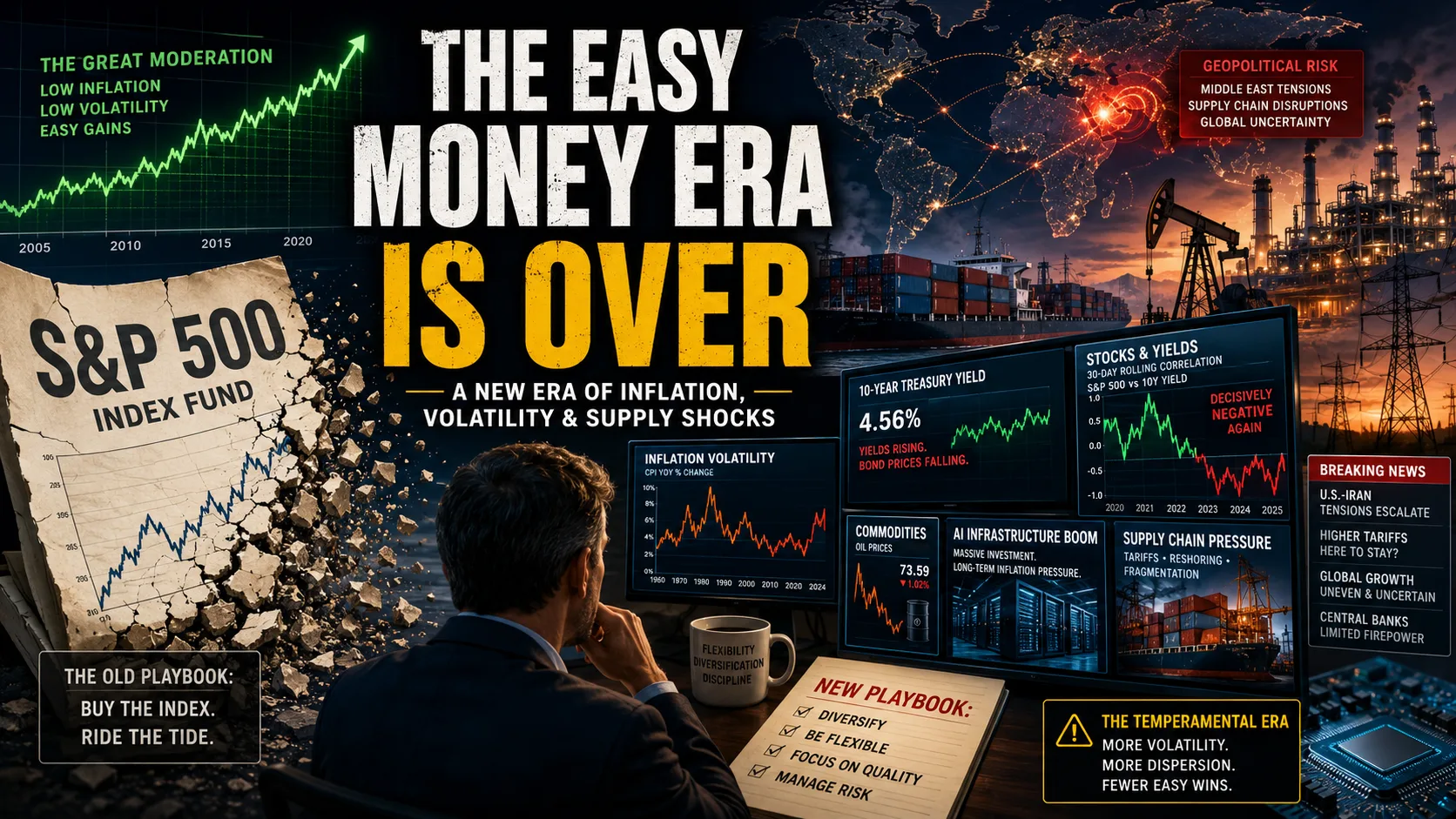
In a new market outlook, Schwab’s Chief Investment Strategist Liz Ann Sonders and Head of Macroeconomic Research Kevin Gordon argue that investors have entered what they call the “temperamental era”—a period defined by persistent inflation risks, geopolitical instability, supply shocks, and far greater market volatility.
If they’re right, investors who continue relying on yesterday’s investing playbook could face a much more challenging decade than the one that followed the 2008 financial crisis.
The “Great Moderation” Is Officially Over
For roughly two decades, markets benefited from what economists often referred to as the Great Moderation.
Inflation remained relatively subdued, supply chains were increasingly efficient, interest rates steadily declined, and central banks frequently stepped in to support financial markets during periods of stress.
That combination created an environment where simply owning the S&P 500 often produced exceptional long-term returns with relatively limited disruption.
Schwab believes those conditions no longer exist.
Instead, investors are entering a period that more closely resembles the decades between the 1960s and the early 1990s, when inflation repeatedly surged, geopolitical tensions frequently disrupted markets, and economic cycles became far less predictable.
While Schwab does not expect a return to the double-digit inflation experienced during the late 1970s and early 1980s, the firm believes inflation is likely to remain much more volatile than investors have become accustomed to over the past twenty years.
Inflation Is Becoming the Market’s Biggest Driver Again
One of the biggest changes highlighted by Schwab involves the relationship between stocks and Treasury yields.
For much of the last two decades, investors often benefited from owning both stocks and bonds because bond prices frequently rose when stocks fell.
That relationship has shifted.
Schwab notes that the correlation between the 10-year Treasury yield and the S&P 500 has moved decisively back into negative territory, signaling that inflation concerns are once again dominating investor sentiment.
When inflation expectations rise, Treasury yields climb.
Higher yields increase borrowing costs, pressure corporate valuations, and often weigh on stock prices simultaneously.
That means bonds may no longer provide the same level of portfolio protection many investors have relied upon for years.
Supply Shocks May Become a Permanent Feature of Markets
Several long-term trends could continue creating inflation spikes even if overall economic growth slows.
Schwab points to multiple forces that are likely to produce recurring supply disruptions, including:
- Higher global tariffs
- Ongoing geopolitical conflicts such as tensions involving Iran
- Massive infrastructure spending tied to artificial intelligence
- Continued reshoring of manufacturing
- More fragmented global supply chains
Rather than a smooth decline in inflation, the firm expects repeated cycles of inflationary surges followed by periods of cooling.
That environment could make it significantly harder for the Federal Reserve to consistently achieve its long-standing 2% inflation target.
Why Index Investing May Not Deliver the Same Results
One of Schwab’s more notable warnings centers on passive investing.
The firm argues that broad indexes have become increasingly concentrated in a small group of mega-cap technology companies.
As a result, headline index performance may increasingly mask substantial differences underneath the surface.
Entire industries could struggle while only a handful of dominant companies continue driving overall index returns.
That growing concentration means investors may need to become much more selective when evaluating sectors, industries, and individual companies rather than assuming the overall market will continue rising steadily over time.
The Fed May No Longer Be Able to Rescue Every Sell-Off
For years, investors operated under the assumption that the Federal Reserve would eventually lower interest rates or provide additional stimulus whenever markets experienced significant declines.
This became known as the “Fed put.”
Schwab believes investors should no longer count on that safety net.
Inflation has remained above the Fed’s target for more than five years, limiting policymakers’ ability to aggressively stimulate the economy whenever financial markets weaken.
Meanwhile, although artificial intelligence has generated enormous enthusiasm, Schwab says productivity improvements have not yet meaningfully reduced inflation pressures.
If tariffs remain elevated and supply disruptions continue, the Fed may have less flexibility than investors have come to expect.
What Schwab Thinks Investors Should Do Instead
Rather than relying exclusively on broad index exposure, Schwab believes investors should prepare for an environment that rewards flexibility and diversification.
The firm suggests investors consider:
- Maintaining greater diversification across sectors and asset classes
- Remaining flexible rather than locking large portions of portfolios into long-duration bonds
- Paying closer attention to company fundamentals instead of relying solely on passive indexes
- Considering factor-based investment strategies that focus on quality, value, profitability, or dividends
- Recognizing that different sectors may perform very differently during periods of inflation volatility
In short, active decision-making could become increasingly valuable if market leadership continues to rotate more frequently.
Why This Matters for Every Long-Term Investor
Markets have overcome wars, recessions, inflation, political crises, and countless economic shocks over the decades.
Long-term investing remains one of the most effective ways to build wealth.
However, Schwab’s message is that how investors build portfolios may need to evolve.
If inflation remains structurally higher, geopolitical tensions continue disrupting supply chains, and central banks have fewer tools available to stabilize markets, simply buying an index and expecting effortless gains could become far less reliable than it has been for much of the past fifteen years.
Investors may increasingly need to focus on portfolio construction, diversification, and disciplined security selection rather than assuming yesterday’s strategies will automatically produce tomorrow’s returns.
What Investors Should Watch Next
Whether Schwab’s outlook proves accurate will likely depend on several key variables over the next few years: inflation trends, Federal Reserve policy, geopolitical developments, tariff policy, and the pace at which artificial intelligence boosts productivity across the broader economy.
If those forces continue driving more frequent market swings, investors who remain flexible and diversified may be better positioned than those relying solely on passive index exposure.
About Author