Walmart Fires Back After Trump Says ‘Eat the Tariffs’: What It Means for Consumers and Investors
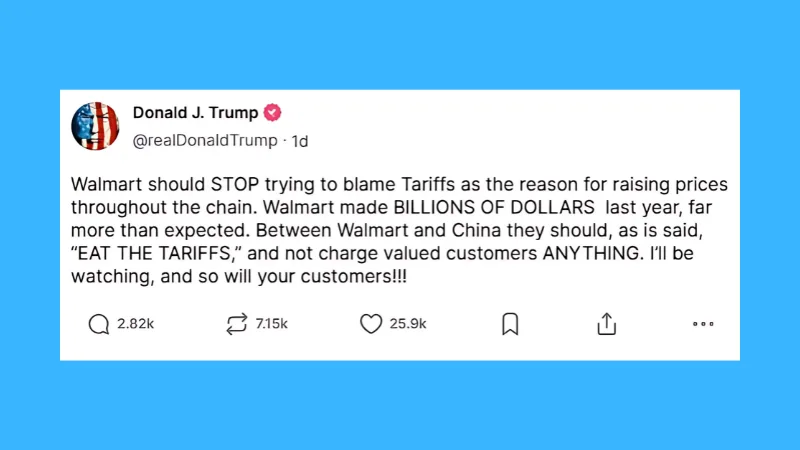
When President Donald Trump told Walmart to “eat the tariffs” in a Truth Social post on May 17, it wasn’t just a political jab—it was a warning shot in the ongoing economic tug-of-war between Washington and corporate America.
Walmart, the world’s largest retailer, has now responded, and the fallout could have real consequences for American consumers, global trade dynamics, and investor portfolios. At the heart of the issue: rising import costs, razor-thin margins, and who ultimately foots the bill in a world increasingly defined by protectionist policies.
Trump’s Message to Walmart: Don’t Blame Me for Higher Prices
In a direct post to Truth Social, President Trump accused Walmart of unfairly blaming his tariffs for upcoming price increases and ordered the retailer to absorb the costs rather than passing them on to U.S. consumers.
“Eat the tariffs,” Trump said, adding, “I’ll be watching, and so will your customers!!!”
The post came amid growing concerns that Trump’s newly imposed 10% universal tariff on imports—and significantly higher tariffs targeting specific countries—would drive up consumer prices. For many, Walmart serves as the canary in the coal mine of consumer inflation.
Walmart Responds: We’ll Keep Prices Low—But We Have Limits
On May 20, Walmart issued a formal statement in response to Trump’s remarks. Spokesperson Joe Pennington pushed back politely but firmly:
“We have always worked to keep our prices as low as possible and we won’t stop. We’ll keep prices as low as we can for as long as we can given the reality of small retail margins.”
In other words: Walmart is trying—but they can’t perform miracles.
Retail operates on famously tight margins, and Walmart’s business model depends on high volume, low pricing, and efficient supply chains. Tariffs threaten all three.
Walmart CFO: Expect Price Increases by June
In Walmart’s May 15 earnings call, CFO John David Rainey didn’t mince words about what’s coming next:
“The level of tariffs that have been proposed is pretty challenging for all retailers, for suppliers, and certainly our concern is that consumers are going to feel some of that.”
He told CNBC that customers should expect price increases to begin by the end of May and stretch into June—especially on goods like electronics, toys, and food. The categories affected are critical to Walmart’s customer base.
Douglas McMillon, Walmart’s president and CEO, emphasized that tariffs on countries like Costa Rica, Colombia, and Peru are already pressuring the company’s ability to maintain low prices on everyday staples like bananas, avocados, coffee, and roses.
Tariffs, Trade, and the Trump Doctrine
Trump’s trade policy has once again taken center stage. After a brief détente in 2024, he reignited the tariff engine in early April 2025 by announcing a 10% universal tariff on all imports—plus escalated rates for 60 specific countries, many of them key U.S. trading partners.
Some of the highest tariffs have targeted China, America’s top economic rival. At their peak, tariffs on Chinese goods reached a staggering 145%, igniting a fresh round of trade disputes. A temporary truce was reached on May 12, with both sides agreeing to slash tariffs for 90 days while negotiating longer-term terms.
But that détente doesn’t apply to the broader 10% tariff, which continues to affect retailers like Walmart that import goods from across the globe.
Who Really Pays for Tariffs? Economists vs. Trump
Trump has long insisted that foreign countries pay for tariffs, arguing that they create leverage in trade negotiations.
But economists—and now Walmart—disagree.
In reality, U.S. importers pay the tariffs, not the exporting countries. These costs are then either absorbed by companies (reducing profit margins) or passed on to consumers (raising prices). A 2019 study by the Federal Reserve estimated that Trump’s first wave of tariffs cost the average American household around $800 a year.
This time, with broader coverage and higher rates, that number could climb significantly.
Walmart’s Delicate Balancing Act
Walmart is in a tough spot. It must juggle four competing forces:
Political pressure from the White House.
Investor pressure to maintain profit margins.
Supplier pressure due to rising global costs.
Customer expectations for low prices, especially in a tight economy.
By not providing second-quarter profit guidance, Walmart joins a growing list of companies bracing for more volatility. The lack of clarity is spooking analysts and prompting questions about how resilient consumer-facing companies can be in the face of mounting costs.
How This Impacts Consumers
For the average shopper, here’s what to expect in the weeks ahead:
Electronics and toys could see the sharpest increases—many of these products come from China or other tariff-targeted nations.
Produce prices will likely creep up, especially for imported items.
Private label products (Walmart’s in-house brands) may become more prominent as the company looks for ways to offset costs.
For families living paycheck to paycheck, even small increases can add up—especially at Walmart, where customers tend to be price-sensitive.
Investor Insights: What to Watch and Where to Act
1. Retail Stocks Face Margin Pressure
Companies like Walmart, Target, and Dollar General operate on tight margins and are highly exposed to imported goods. Tariffs compress those margins further. Investors should expect higher cost-of-goods-sold (COGS) in upcoming quarters.
2. Supply Chain Reallocations
Retailers may look to diversify their sourcing away from tariff-heavy regions. This benefits logistics firms and supply chain consultancies helping companies rethink global routes.
3. Domestic Producers Could Gain
Companies that source or manufacture goods domestically may gain market share. Think Campbell’s, Whirlpool, or Newell Brands.
4. Inflation-Resistant Stocks
Investors may want to explore:
Commodity ETFs tied to goods like agriculture and raw materials.
Retailers with higher-income clientele (e.g., Costco) who are less price-sensitive.
Political Theater or Economic Turning Point?
Walmart’s calm but assertive response marks a turning point in the public dialogue about tariffs. It’s a sign that major corporations are no longer willing to quietly eat the costs while facing public criticism from the highest office in the land.
Trump’s message plays well with his base—strong, patriotic, and anti-corporate when it serves working-class interests. But it also reveals the tension between populist messaging and economic reality.
Tariffs may be a tool of negotiation, but the collateral damage is very real for businesses and consumers alike.
What Should Investors Do Now?
This situation is far from over. Investors should:
Monitor retail earnings calls and supply chain commentary.
Watch for additional White House posts targeting other firms.
Keep an eye on China–U.S. tariff negotiations set to conclude in August.
For now, it’s clear that Walmart won’t be eating tariffs quietly—and neither should investors.
To provide the best experiences, we use technologies like cookies to store and/or access device information. Consenting to these technologies will allow us to process data such as browsing behavior or unique IDs on this site. Not consenting or withdrawing consent, may adversely affect certain features and functions.
Functional
Always active
The technical storage or access is strictly necessary for the legitimate purpose of enabling the use of a specific service explicitly requested by the subscriber or user, or for the sole purpose of carrying out the transmission of a communication over an electronic communications network.
Preferences
The technical storage or access is necessary for the legitimate purpose of storing preferences that are not requested by the subscriber or user.
Statistics
The technical storage or access that is used exclusively for statistical purposes.The technical storage or access that is used exclusively for anonymous statistical purposes. Without a subpoena, voluntary compliance on the part of your Internet Service Provider, or additional records from a third party, information stored or retrieved for this purpose alone cannot usually be used to identify you.
Marketing
The technical storage or access is required to create user profiles to send advertising, or to track the user on a website or across several websites for similar marketing purposes.