Sam’s Club is opening new warehouses, cutting membership prices to attract new customers and pushing deeper into California, territory where Costco has long enjoyed an unusually strong following. For Walmart, the expansion could turn one of its fastest-growing businesses into a much bigger threat to the warehouse-club leader.
Sam’s Club Is Moving Deeper Into California
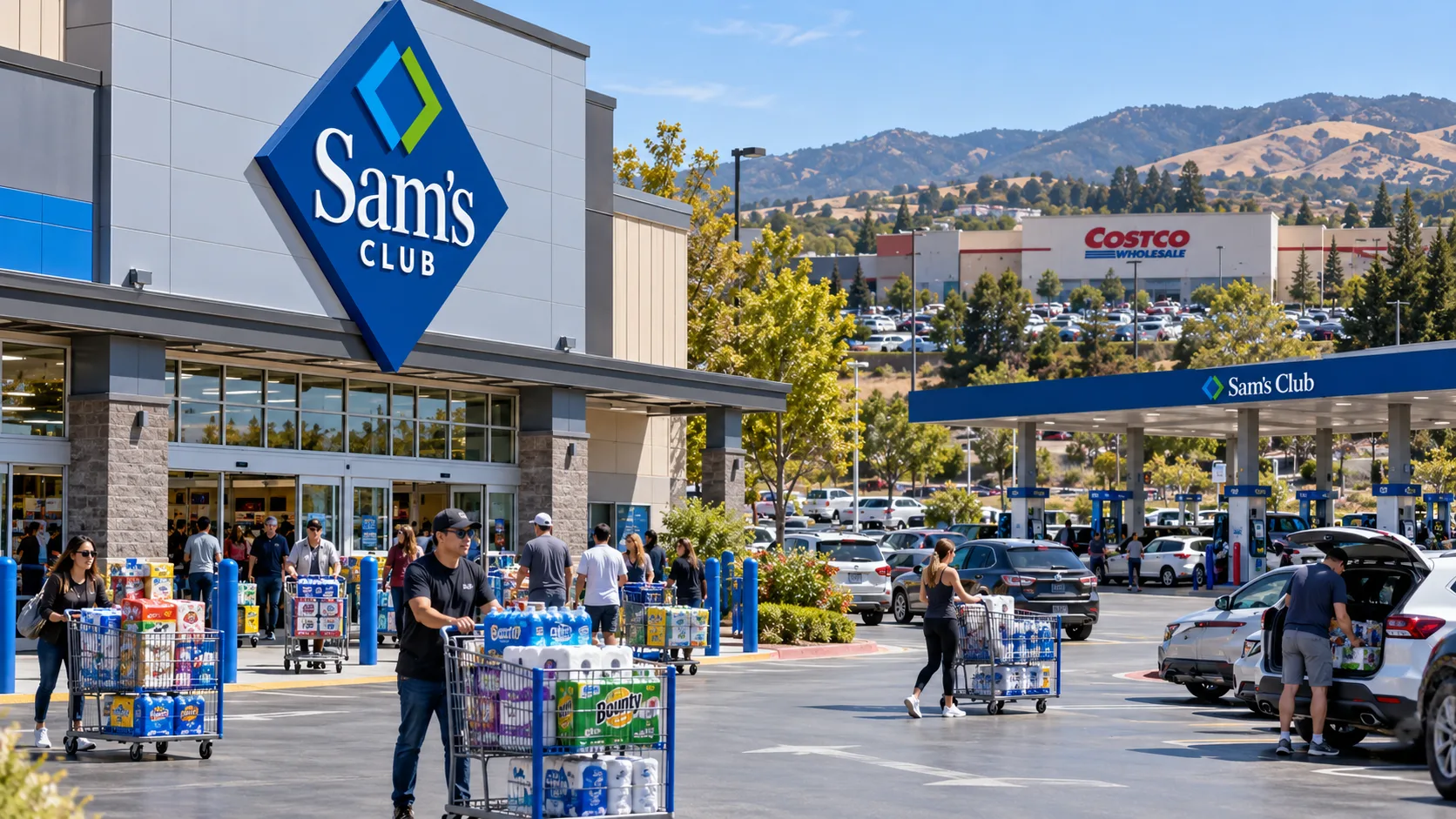
Sam’s Club has opened a nearly 170,000-square-foot warehouse in Lathrop, California, about 10 miles south of Stockton. The location gives San Joaquin County its first Sam’s Club and becomes the chain’s eighth location in Northern California.
The new warehouse includes the usual bulk groceries and household products, along with expanded fresh-food departments, a cafe, curbside pickup, delivery and a large members-only fuel station.
But Lathrop appears to be part of something much larger.
Sam’s Club has previously announced plans for at least 30 new locations, and management said in 2025 that it was building a pipeline capable of opening roughly 15 clubs per year over its longer-term planning horizon. The company also intends to remodel its roughly 600 existing U.S. clubs.
This is becoming a serious physical expansion campaign.
The Real Target Is Costco’s Membership Machine
The warehouse business works differently from conventional retail. Costco and Sam’s Club sell merchandise, but one of their most valuable products is the membership itself.
Members pay before they ever walk through the door. That recurring revenue helps support low merchandise margins while creating an incentive for shoppers to consolidate more spending with the retailer so they can justify the annual fee.
And Sam’s Club is using price aggressively.
The company is temporarily offering new members at select California locations a standard Club membership for $25 and a Plus membership for $50, according to the source material. Regular annual pricing is $60 for Club and $120 for Plus.
Costco currently charges $65 annually for Gold Star membership and $130 for Executive membership. Executive members can receive a 2% annual reward on qualifying purchases, up to $1,250.
A $5 or $10 difference probably will not convince a loyal Costco member to suddenly switch clubs. A heavily discounted introductory membership might.
That is the more interesting strategy. Sam’s Club can use cheap initial memberships to get households through the doors, then attempt to retain them through fuel savings, private-label products, delivery, technology and convenience.
Walmart Has Another Weapon Costco Can’t Easily Replicate
Costco remains one of the strongest retail businesses in America. Its enormous warehouses, limited assortment and loyal membership base create exceptional purchasing power and impressive customer retention.
Sam’s Club, however, sits inside Walmart.
That gives it access to technology, logistics, purchasing data and fulfillment infrastructure built across one of the largest retail operations in the world. Walmart currently operates 602 Sam’s Club locations in the U.S., according to company data as of July 31, 2026.
That scale increasingly matters because warehouse clubs are becoming more digital.
Sam’s Club has invested heavily in Scan & Go checkout, curbside pickup, rapid delivery and automated shopping technology. Walmart is also preparing to bring its Scintilla commerce-intelligence platform into Sam’s Club in 2027, giving merchants and suppliers additional first-party data about how members shop.
The goal appears straightforward: combine warehouse pricing with the convenience consumers increasingly expect from e-commerce.
That could remove one of the traditional weaknesses of warehouse shopping. Consumers may love Costco prices, but driving to a giant warehouse, finding parking, navigating crowded aisles and waiting in checkout lines requires effort.
Sam’s Club is betting technology can reduce some of that friction.
Why California Matters So Much
Opening another warehouse would normally be a minor retail story. California changes the equation because it is a huge consumer market and an important state for Costco.
Sam’s Club does not need to overtake Costco statewide for the strategy to work. Adding locations in underserved markets can create thousands of new memberships while increasing the usefulness of the Sam’s Club network for existing members.
Lathrop illustrates the strategy particularly well. Instead of opening another warehouse directly beside an existing Sam’s Club, Walmart is filling geographic gaps and pushing the brand into areas where residents previously had fewer convenient options.
Visalia appears to follow the same playbook.
If successful, Sam’s Club gains something more valuable than sales from another warehouse. It expands the geographic density of its membership ecosystem.
The more clubs, fuel stations and fulfillment options members can access, the harder the membership becomes to cancel.
The Bigger Battle Is Over Household Spending
Investors should view the competition between Costco and Sam’s Club as a fight over household wallet share.
A customer who buys gasoline at Sam’s Club may start buying groceries there. A grocery customer might add tires, electronics, prescriptions or furniture. Plus members have another reason to consolidate spending because eligible purchases can generate Sam’s Cash.
That is why warehouse clubs can be unusually powerful retail models. Once a company becomes part of a household’s routine, every additional visit creates another opportunity to capture spending that might otherwise go to supermarkets, department stores, Amazon or specialty retailers.
It also gives retailers valuable information about their highest-value customers.
For Walmart, Sam’s Club can therefore do more than generate warehouse sales. It strengthens the company’s broader ecosystem of retail, advertising, fulfillment and consumer data.
Costco Still Has the Advantage Sam’s Club Wants Most
There is an important reason investors should be cautious about declaring a warehouse war winner simply because Sam’s Club is expanding.
Costco’s biggest asset may be difficult to replicate: loyalty.
Customers willingly pay Costco every year for permission to shop there, and the company has spent decades building a reputation around value, treasure-hunt merchandise and its Kirkland Signature private label. That relationship gives Costco unusual pricing power over its own membership fees.
Costco raised its U.S. Gold Star membership fee to $65 and Executive membership to $130 in September 2024. It simultaneously increased the maximum Executive 2% reward to $1,250 annually.
Sam’s Club offering a cheaper membership does not automatically weaken that advantage.
In fact, the expansion may tell investors something else.
The warehouse-club model itself could still have considerable room to grow.
If consumers remain concerned about grocery prices and household expenses, paying an annual fee in exchange for perceived savings can become more attractive. Costco and Sam’s Club could both benefit if more households migrate spending toward membership retailers.
The competition would then be less about stealing the same customer and more about capturing a larger share of American retail spending from everyone else.
About Author