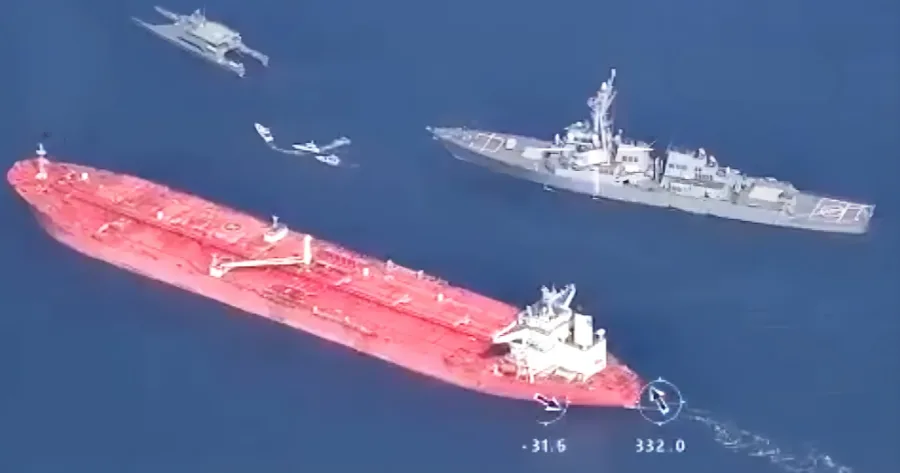
The recent U.S. seizure of a crude oil tanker off the coast of Venezuela has opened a new chapter in Washington’s pressure campaign against Nicolás Maduro. What began as a targeted operation tied to counter narcotics has quickly turned into a broader strategic tool that places Venezuela’s weakened energy sector directly in the crosshairs.
President Donald Trump has kept up his public criticism of the Venezuelan leader, saying Maduro’s “days are numbered.” While the administration has not claimed it intends to take control of the country’s vast oil reserves, the message is clear. The White House is prepared to use Venezuela’s most important economic lifeline as leverage.
Industry analysts now believe the tanker seizure was not an isolated event. Instead, it may become a repeating tactic that deepens Venezuela’s financial strain and limits the Maduro regime’s ability to maintain military support.
Christopher Hernandez Roy of the Center for Strategic and International Studies explained the logic behind future actions, saying, “I would expect [more] because it diminishes the amount of money the regime can make to sustain itself and the money it has to pay to the military to keep it happy and loyal.”
How Tanker Seizures Could Shift Trade Flows and Oil Pricing
The ripple effects extend beyond Venezuela. Iran and Russia are also facing U.S. energy sanctions and rely heavily on shadow fleets and discount markets to move crude. Shipping companies operating in these regions will not ignore the possibility that their vessels could be next.
Any increase in perceived maritime risk typically affects freight rates, insurance pricing, and willingness of third-party operators to load sanctioned oil. Even a small amount of physical disruption can tighten availability of certain grades of crude.
Oil prices ticked up after the Venezuelan tanker seizure. A barrel of crude rose $0.21 on Wednesday. While the move was small, it reflected heightened uncertainty around global supply routes.
Francisco Monaldi, director of the Latin American Energy Program at Rice University, underscored the potential impact, saying more systematic seizures would “significantly impact the tankers that would be willing to go to Venezuela, and it would force them to give massive discounts.”
Venezuela is already depending on discounted barrels to keep cash flowing. According to Monaldi, energy exports account for more than 90 percent of hard currency earnings and over half of government revenue. Any additional discount pressure would further erode the country’s fragile financial base.
A Once Dominant Producer Reduced to a Fraction of Its Capacity
Venezuela’s oil industry was once the powerhouse of Latin America. In its peak years, output topped three million barrels per day. Years of mismanagement, corruption, and infrastructure decay under successive socialist governments have taken a severe toll. Today, the country can produce only about one million barrels per day.
Data from energy consultancy Kpler shows Venezuela’s exports averaging roughly 750,000 barrels per day this year. Because the global market is expected to face an oversupply of one to three million barrels per day next year, removing additional Venezuelan barrels would not dramatically change the overall balance.
John Kilduff of Again Capital put it bluntly. “It isn’t a material amount of supply. The market has gotten used to that. If they ever get reopened, it is more impactful to the downside.”
The bigger story is not what Venezuela adds to the market today. It is what it might add in the future if political conditions change.
China’s Role and the Legal Pressure Around Tanker Networks
China remains the largest buyer of Venezuelan crude. Much of the country’s heavy oil ends up in Chinese refineries through complex trading networks designed to work around sanctions.
According to Kpler, the tanker seized by the U.S. was the Skipper, a supertanker loaded with more than one million barrels of Venezuelan heavy crude. Attorney General Pam Bondi said on X that the vessel had been sanctioned for multiple years “due to its involvement in an illicit oil shipping network supporting foreign terrorist organizations.”
President Trump signaled that the U.S. intends to keep the oil from the seized ship. That comment alone raises questions about what future seizures might look like and how the administration intends to handle confiscated crude.
Military Presence, Political Stakes, and the High-Risk Path Ahead
The U.S. military has strengthened its presence in the Caribbean. Congressional scrutiny has increased after operations involving small vessels that Pentagon officials say are connected to drug cartels. The president has not ruled out the possibility of using ground forces, and recently declared Venezuelan airspace “closed.”
John Feeley, former U.S. ambassador to Panama, described one potential scenario in which the administration launches missile strikes on cartel strongholds without deploying troops against Maduro himself. Such an approach could enable the president to claim victory over drug cartels while also creating an opening for foreign investment in Venezuela’s energy sector.
However, any strike on land would entangle the United States in Venezuelan domestic politics. Maduro remains unpopular but maintains a firm grip on power. Hernandez Roy warned that “if they strike targets on land, there’s no way they would accept Maduro not leaving.”
Even if Maduro were removed, experts doubt that the opposition could quickly take control or revive the industry. Rebuilding Venezuela’s energy sector would require tens of billions of dollars in capital investment, regulatory reform, and international cooperation.
The Long Game: How Fast Could Venezuela Rebound?
Despite the current collapse, Venezuela still holds the largest crude reserves in the world. With political reform, external financing, and modern technology, production could rebound faster than many expect.
Monaldi believes output could rise sharply with the right conditions. Oil companies “could double production if they could get back in there and put new technology to work,” he said. Long term, he estimates Venezuela could reach five to six million barrels a day.
That scenario is a long way off, but it is not impossible. Investors will watch closely because a revitalized Venezuelan energy sector would reshape global oil flows, impact U.S. refiners, and reduce China’s leverage over discounted barrels.
Why This Matters for Investors
For energy investors, tanker seizures and Venezuelan instability create both risk and opportunity.
Key areas to monitor:
- Shipping rates for sanctioned crude and shadow fleet movements
- Insurance premiums for vessels operating near Venezuela and Iran
- U.S. political signals on future military or economic escalation
- China’s response to any tightening of Venezuelan crude flows
- Potential openings for Western energy companies if political dynamics shift
The immediate supply impact remains limited. The strategic significance does not. When geopolitical pressure intersects with a struggling petrostate, markets often underestimate how fast conditions can change.
If Venezuela faces more seizures, deeper discounts, or reduced shipping capacity, its ability to maintain even current production levels may erode further. Conversely, any political transition could eventually unlock one of the largest untapped growth opportunities in the global oil market.
About Author