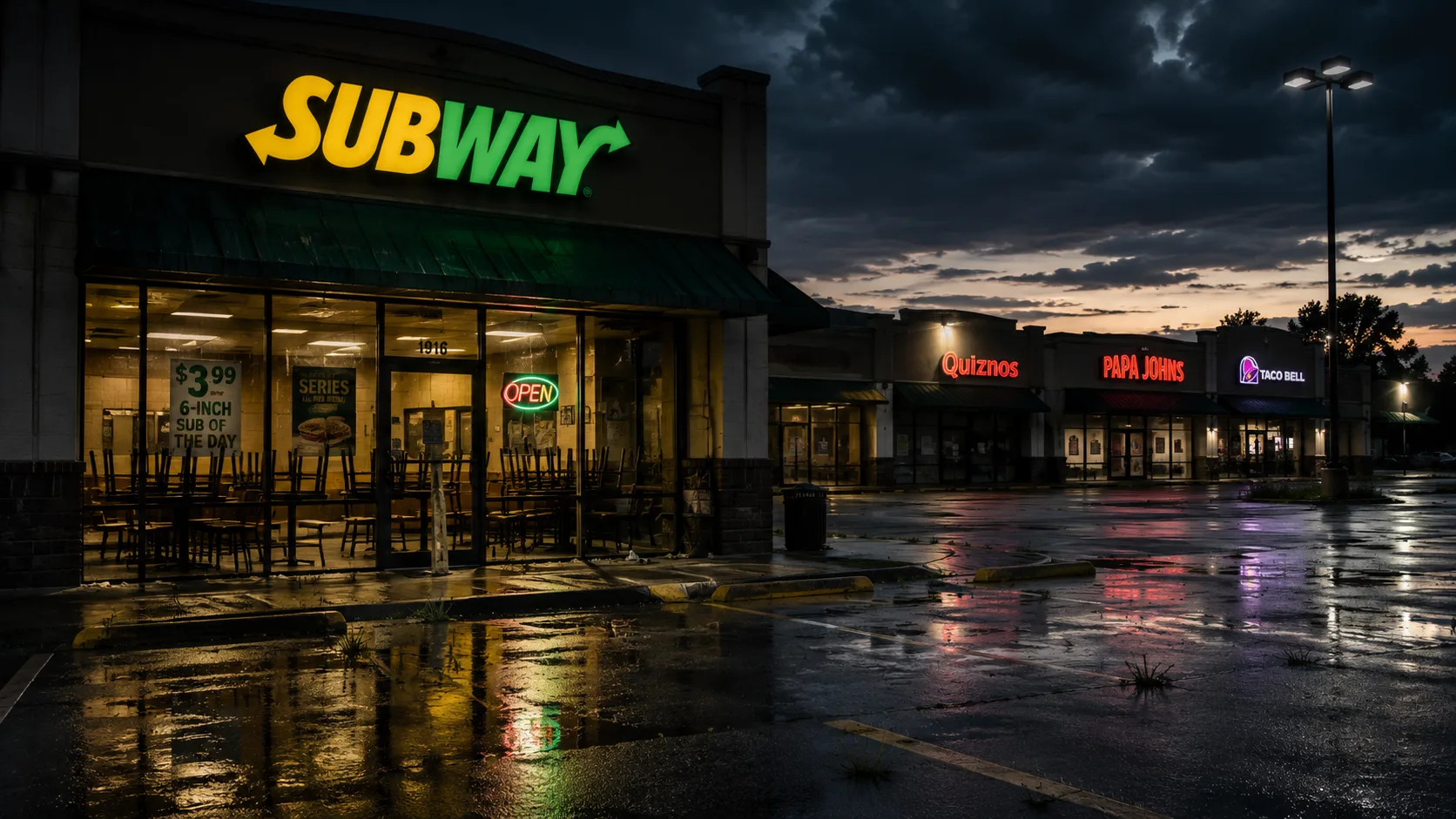
Subway just delivered one of the clearest warning signs yet that America’s low-cost franchise boom is running into a wall. The sandwich chain closed a net 729 U.S. stores in 2025, pushing its domestic footprint below 19,000 locations after once topping 22,000. That kind of contraction from one of the most recognizable restaurant brands in the country is not just a fast food story. It is a pressure test for the entire franchise economy.
The Numbers Behind Subway’s Retreat
According to a new franchise filing reviewed by FOX Business, Subway opened 499 locations during the year, but closures dramatically outpaced new openings. Roughly 800 locations were also temporarily shut as of Dec. 31, 2025, though the company says many could reopen.
Even more revealing is where the “growth” came from. More than half of the stores opened last year were previously closed locations being recycled back into the system rather than true expansion.
That matters.
A healthy franchise system typically grows through new market penetration and stronger unit economics. Reopening previously failed locations can temporarily stabilize store counts, but it also suggests the company is fighting attrition rather than creating durable momentum.
The financial picture adds another layer of complexity. Subway reported $688 million in net income for 2025, up sharply from $397 million the previous year and just $15 million in 2023. At the same time, total franchise revenue fell more than 6% to $767 million.
That divergence tells investors something important: profitability at the corporate level can improve even while the franchise ecosystem underneath weakens.
The Economics
Industry data cited in the filing shows the average Subway location generates roughly $500,000 annually in sales. In today’s labor and food inflation environment, that is a dangerous number for a restaurant franchise operator trying to survive rising wage pressure, delivery platform fees, higher rent costs, and shrinking consumer budgets.
Investors should view this as part of a broader restaurant bifurcation now happening across America.
Higher-end chains with pricing power, strong loyalty programs, and operational efficiency continue pulling ahead. Lower-ticket, oversaturated legacy chains are increasingly trapped in a squeeze between inflation-sensitive consumers and franchisees struggling to remain profitable.
Subway’s footprint became too large for its own economics years ago. The company packed stores into overlapping trade areas for decades, allowing franchisees to cannibalize one another. That strategy boosted royalty streams in the short term, but it weakened average store performance over time.
Now the bill is arriving.
The Hidden Story Beneath the Closures
The deeper story is not really about sandwiches.
It is about the franchise model itself entering a more difficult era.
For decades, franchise systems thrived because cheap commercial rent, lower labor costs, and easy credit allowed operators to survive on thinner margins. Many franchise owners could make mediocre businesses work because financing was abundant and operating costs were manageable.
That environment no longer exists.
Interest rates remain elevated compared to the zero-rate era. Insurance costs are climbing. Labor remains expensive. Consumers are becoming more selective. At the same time, private equity ownership across the restaurant sector has intensified pressure for operational efficiency and margin extraction.
Subway was acquired by Roark Capital Group in 2024, putting it inside one of the largest restaurant investment portfolios in America. Investors should expect more aggressive restructuring, tighter franchise oversight, and continued rationalization of underperforming locations going forward.
The chain may ultimately become healthier financially with fewer stores.
But fewer stores also mean less demand for strip mall space, fewer franchise opportunities, and reduced employment across local economies tied to low-cost food service.
That ripple effect matters.
Why Markets Care Beyond Fast Food
This story intersects with several major investor themes simultaneously.
First, it reinforces the growing consumer spending divide. Americans continue spending on experiences, premium dining, and convenience, while many middle-market food chains face stagnation.
Second, it highlights pressure building inside commercial real estate. Thousands of aging retail locations across the country are increasingly difficult to fill profitably as weaker franchise operators consolidate.
Third, it could accelerate consolidation across quick-service restaurants. Chains with weak average unit volumes may struggle attracting new franchisees unless they radically modernize operations or improve profitability.
Investors should also pay close attention to public restaurant companies heavily dependent on franchise expansion narratives. In a higher-rate economy, raw store count growth no longer guarantees success if underlying store productivity weakens.
Wall Street is increasingly rewarding efficiency over footprint.
What Happens Next
Key Catalysts Investors Should Watch
- Additional franchise closures across lower-tier quick service restaurant chains
- Commercial real estate vacancies in suburban retail corridors
- Consumer spending data tied to low and middle-income households
- Franchise lending conditions as interest rates remain elevated
- Potential restructuring or modernization initiatives from Subway under Roark Capital
- Competitive gains from stronger sandwich and fast casual chains
- Restaurant labor cost trends heading into 2027
The Bottom Line
Subway’s shrinking footprint is a warning shot about the economic pressures building underneath large franchise systems across America.
The company may survive this transition and potentially emerge leaner and more profitable. But the era where restaurant chains could endlessly expand low-performing locations simply to grow store counts appears to be ending.
For investors, this is another signal that markets are entering a quality-over-scale phase.
The businesses winning right now are generating stronger cash flow per location, maintaining pricing power, and operating with disciplined expansion strategies. The companies still relying on volume expansion alone are becoming increasingly vulnerable as the economic environment tightens.
About Author