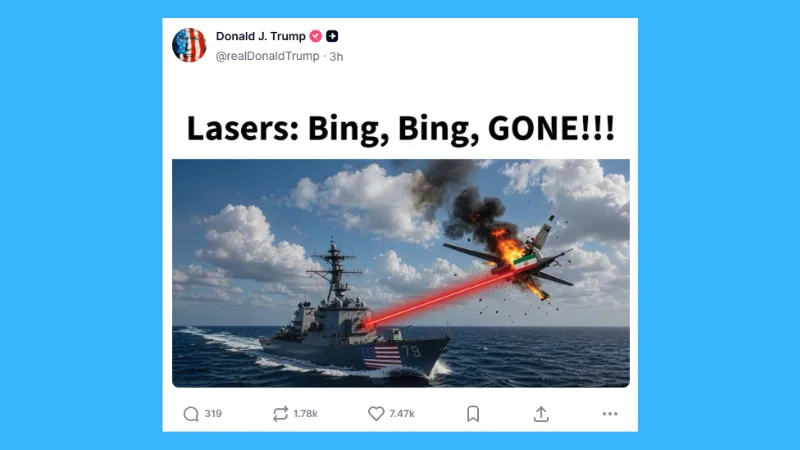
U.S. Navy destroyers and Iranian forces exchanged fire in the Strait of Hormuz late Thursday, with both governments accusing the other of firing first. The incident instantly reignited fears that the fragile U.S.-Iran ceasefire is collapsing in real time, putting global oil markets, inflation expectations, shipping costs, and defense stocks back at the center of investor attention.
President Donald Trump attempted to downplay the escalation, reportedly calling the strikes “just a love tap,” even as the White House confirmed U.S. forces carried out retaliatory attacks against Iranian military assets after what CENTCOM described as an “unprovoked” assault involving missiles, drones, and fast attack boats.
The Strait Just Became the Market’s Biggest Risk Again
According to U.S. Central Command, three U.S. Navy destroyers transiting toward the Gulf of Oman were targeted by Iranian forces using drones, missiles, and small boats. CENTCOM said no American assets were struck and that U.S. forces responded by destroying launch sites, command centers, and intelligence infrastructure tied to the attack.
Iran’s version of events tells a completely different story.
Iranian military officials accused the U.S. of violating the ceasefire first by targeting an Iranian tanker near the strait. Tehran claimed its forces retaliated against American naval assets and caused “significant damage,” though the U.S. has denied any successful Iranian strike.
The key issue for investors is not who fired first.
It is that direct military exchanges are now happening again inside the artery through which roughly one-fifth of the world’s oil supply flows.
That changes the market calculus immediately.
Trump’s Messaging Creates a New Layer of Uncertainty
One of the most unusual aspects of this situation is the gap between the military reality and the political messaging.
Trump simultaneously described the exchange as minor while also threatening significantly more violent retaliation if Iran refuses to sign a nuclear deal.
“Just like we knocked them out again today, we’ll knock them out a lot harder, and a lot more violently, in the future, if they don’t get their Deal signed, FAST!” Trump wrote on Truth Social.
That creates confusion for markets trying to determine whether:
- The administration wants de-escalation
- The administration is preparing a broader military campaign
- The ceasefire still has operational meaning
- Nuclear negotiations are actually progressing
Investors hate ambiguity during geopolitical crises because unclear messaging raises the probability of sudden repricing events.
A single missile strike on energy infrastructure, a damaged tanker, or an accidental casualty involving U.S. personnel could force markets to rapidly shift from “temporary flare-up” to “regional war” positioning.
About Author