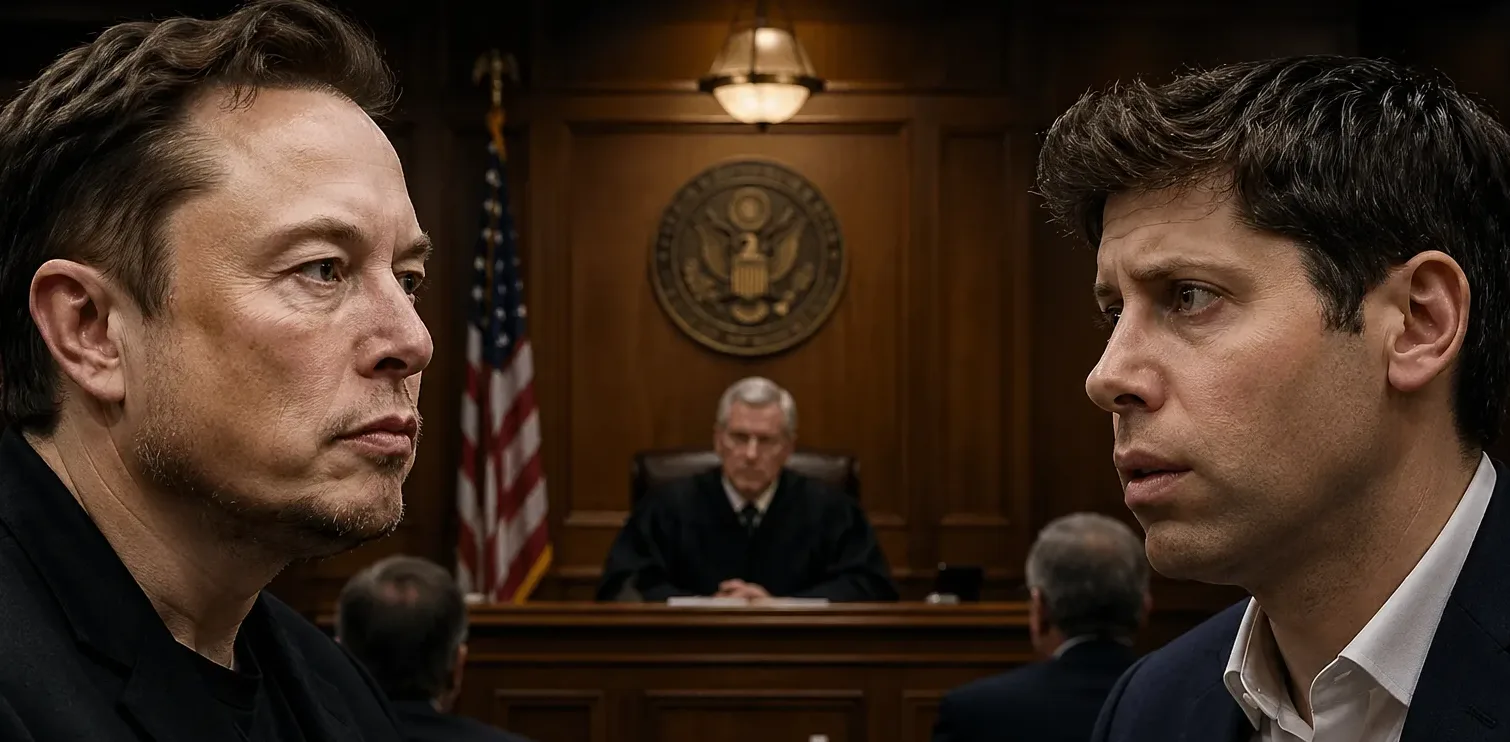
A federal jury ruled Monday that Musk waited too long to sue Sam Altman and OpenAI over the company’s transition from a nonprofit research lab into a for-profit AI powerhouse. The verdict shuts down, at least for now, Musk’s attempt to unwind OpenAI’s structure, claw back damages reportedly worth as much as $150 billion, and potentially disrupt one of the most important companies in artificial intelligence.
Markets may treat this like courtroom drama. Investors should not.
This decision removes a major cloud hanging over OpenAI at the exact moment AI capital spending is exploding, IPO chatter is intensifying, and the battle between Musk, Altman, Microsoft, and the rest of Big Tech is turning into a winner-take-most fight for the future of computing.
Silicon Valley’s Biggest AI Feud Just Hit a Turning Point
The nine-member federal jury reached its decision in less than two hours, concluding unanimously that Musk’s claims were filed after the statute of limitations expired.
That matters because the jury never had to decide whether Musk’s accusations were true.
Musk immediately pushed back on X, writing that “the judge & jury never actually ruled on the merits of the case, just on a calendar technicality.”
He added: “There is no question to anyone following the case in detail that Altman & Brockman did in fact enrich themselves by stealing a charity. The only question is WHEN they did it!”
The lawsuit centered on Musk’s claim that OpenAI abandoned its original charitable mission after creating a for-profit arm that later received billions from Microsoft. Musk argued the company effectively transformed into a commercial AI empire after initially presenting itself as an open, nonprofit effort designed to benefit humanity.
OpenAI and Altman countered that Musk fully understood the direction the company was heading years ago and even supported the idea of creating a for-profit structure capable of competing with rivals like Google.
That defense clearly worked.
Why Wall Street Actually Cares About This Case
This ruling does more than protect Altman.
It protects the current AI investment boom.
Had Musk won, the outcome could have destabilized OpenAI’s structure, triggered massive legal uncertainty around Microsoft’s multibillion-dollar investment, and potentially frozen parts of the broader AI funding ecosystem. Investors have poured enormous amounts of capital into AI companies under the assumption that OpenAI’s model would remain intact.
Now that assumption looks safer.
That is bullish for several corners of the market:
- Mega-cap AI infrastructure stocks
- Data center builders
- Semiconductor companies tied to AI demand
- Cloud providers
- Venture-backed AI startups preparing for IPOs
- Private market AI valuations
The timing is critical because both OpenAI and Musk’s own AI ambitions are moving toward major capital events.
OpenAI is racing toward a future IPO while Musk is reportedly preparing a public share offering tied to SpaceX, which has merged with his AI startup xAI. Any prolonged legal chaos surrounding OpenAI could have spilled into valuations across the broader AI ecosystem.
Instead, investors now have more clarity.
That clarity alone may support continued aggressive AI spending.
The Real Story Is About Power, Control, and AI Monopoly Risk
The courtroom fight exposed something deeper than a personal feud.
This case revealed how concentrated AI power has become.
The testimony included some of the most important figures in artificial intelligence, including Altman, OpenAI President Greg Brockman, Microsoft CEO Satya Nadella, OpenAI co-founder Ilya Sutskever, and Musk adviser Shivon Zilis.
That lineup alone shows investors where the center of gravity now sits in global tech.
The bigger issue beneath the headlines is that AI development increasingly depends on enormous capital pools, elite computing infrastructure, and access to proprietary data. OpenAI’s shift toward aggressive commercialization reflects a broader reality many investors are only beginning to grasp: frontier AI development is becoming prohibitively expensive.
Smaller competitors are getting squeezed out.
That strengthens the moat around dominant players with massive balance sheets and infrastructure advantages.
Ironically, Musk may have helped reinforce the exact market structure he was trying to challenge.
Sam Altman’s Reputation Still Took Damage
Even though OpenAI won, the trial exposed vulnerabilities around Altman’s leadership style that investors should not ignore.
Several witnesses questioned whether Altman was consistently truthful in internal dealings.
Former OpenAI executive Mira Murati testified: “My concern was about Sam saying one thing to one person and completely the opposite to another person.”
Another attorney who attended much of the trial said Altman’s cross-examination was “devastating.”
Those comments matter because trust is becoming a core asset in AI.
Governments, regulators, enterprise customers, and institutional investors are all evaluating who should control increasingly powerful AI systems. OpenAI escaped legal disaster here, but scrutiny around governance and transparency is unlikely to fade.
That creates a risk investors should monitor carefully going forward.
What Investors Should Watch Next
Key Catalysts Ahead
- Potential appeal from Musk that could keep legal pressure alive
- OpenAI’s continued march toward a future IPO
- SpaceX and xAI fundraising or IPO developments
- Additional regulatory scrutiny around AI concentration and governance
- Microsoft’s expanding influence over OpenAI infrastructure
- Escalating competition between OpenAI, xAI, Google, and Anthropic
- AI capital spending trends from mega-cap tech companies
Stocks and Themes in Focus
- AI semiconductors
- Cloud infrastructure providers
- Power and energy companies tied to data center demand
- Cybersecurity firms benefiting from AI adoption
- Private AI startups seeking late-stage funding
- Public companies with direct OpenAI ecosystem exposure
One Verdict, Bigger Implications
Musk lost the case.
But the AI war is nowhere close to over.
The verdict effectively gives OpenAI room to keep scaling without immediate legal disruption, and that likely accelerates the commercialization race across Silicon Valley. Investors betting on AI infrastructure, enterprise adoption, and large-scale model deployment just got a major uncertainty removed from the board.
At the same time, the trial exposed how fragile the politics and personalities behind AI really are.
This industry is increasingly being shaped by a tiny group of executives controlling enormous technological power, massive capital flows, and infrastructure that may define the next decade of the global economy.
That should get Wall Street’s attention fast.
About Author