Stocks have largely brushed off the first Federal Reserve meeting under Chairman Kevin Warsh.
The Fed left interest rates unchanged, but its updated projections delivered a hawkish surprise. Nine of the central bank’s 18 policymakers now expect at least one rate hike before the end of the year, while none are forecasting the rate cuts investors had been anticipating earlier in 2026.
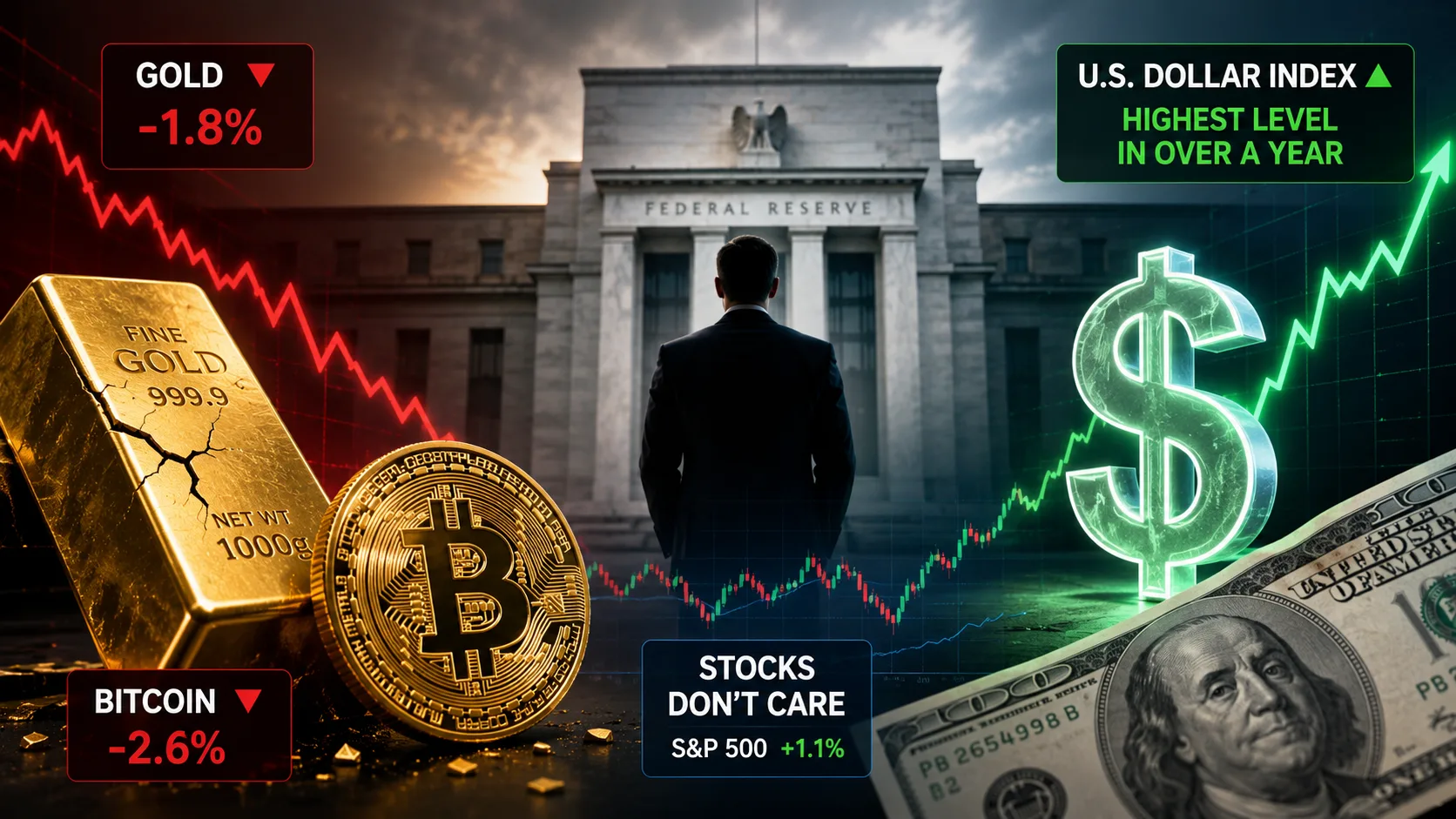
Despite that shift, the S&P 500 gained more than 1% on Thursday after initially selling off following the Fed announcement, while the Nasdaq surged nearly 2% as investors welcomed easing geopolitical tensions after President Donald Trump announced an agreement with Iran aimed at ending the conflict and reopening the Strait of Hormuz.
But beneath the surface, several of the world’s most important markets are telling a very different story.
The U.S. dollar is surging. Gold is retreating. Bitcoin is falling.
Taken together, those moves suggest investors in currencies, commodities, and alternative assets are taking Warsh’s message far more seriously than stock traders appear to be.
The Fed Didn’t Raise Rates. It May Have Done Something More Important.
The biggest surprise from Warsh’s first meeting wasn’t the decision to leave rates unchanged.
Most investors expected that outcome.
What caught Wall Street’s attention was the Federal Reserve’s updated outlook.
The central bank’s projections revealed that half of policymakers now expect rates to move higher before year-end. Just months ago, investors were debating how many rate cuts might arrive in 2026.
Now, that conversation has changed dramatically.
The Fed’s message is increasingly clear: inflation remains a concern, and policymakers may be willing to keep monetary policy restrictive for longer than markets expected.
That shift matters because much of the stock market’s rally over the past year has been built on expectations that borrowing costs would eventually move lower.
Warsh’s first meeting signaled that assumption may no longer be safe.
Three Markets Are Delivering the Same Warning
One of the most revealing aspects of the post-Fed reaction is that gold, Bitcoin, and the U.S. dollar are all pointing in the same direction.
Normally these assets don’t move together.
Yet all three appear to be reacting to the same conclusion: higher-for-longer interest rates are becoming a more realistic possibility.
Gold has fallen sharply from its recent highs. Bitcoin has retreated despite strength in technology stocks. Meanwhile, the U.S. dollar has surged to its highest level in more than a year.
When multiple asset classes begin sending the same message, investors should pay attention.
Markets often disagree on timing, but broad agreement across currencies, commodities, and alternative assets can signal a meaningful shift in expectations.
Gold’s Biggest Tailwind May Be Losing Strength
Gold has been one of the strongest-performing assets of the past year, benefiting from inflation concerns, geopolitical tensions, central-bank buying, and expectations that the Fed would eventually cut rates.
Some of those drivers remain intact.
However, higher interest rates create a challenge for the precious metal.
Unlike Treasury bonds, money-market funds, or certificates of deposit, gold generates no income. When yields rise, the opportunity cost of owning gold increases.
The stronger U.S. dollar is creating another headwind.
Because gold is priced globally in dollars, a stronger greenback often reduces purchasing power for foreign buyers, which can weigh on demand.
Even some of Wall Street’s biggest gold bulls are adjusting expectations.
Goldman Sachs recently lowered its year-end gold forecast from $5,400 per ounce to $4,900, citing the possibility that rate cuts may not arrive this year.
That still implies potential upside from current levels, but it also suggests the easy gains may already be behind investors.
Bitcoin Just Broke Away From Tech Stocks
One of the more interesting developments following the Fed meeting is what didn’t happen.
Technology stocks rebounded strongly.
Bitcoin did not.
The world’s largest cryptocurrency fell roughly 2.6% over the past 24 hours and has retreated significantly from levels above $67,000 earlier this week.
For much of the past several years, Bitcoin has often traded like a high-growth technology asset. When investors embrace risk, Bitcoin frequently benefits.
But higher interest rates complicate that relationship.
As yields on safer investments rise, speculative assets become less attractive by comparison.
Investors can suddenly earn meaningful returns from Treasury bills and money-market funds without assuming the volatility that comes with cryptocurrencies.
Bitcoin’s recent weakness suggests the market may be reassessing how attractive digital assets look in a world where the Fed is no longer discussing rate cuts.
The Dollar Is Emerging as the Clear Winner
While investors debate what higher rates mean for stocks, one market appears to have already made up its mind.
The U.S. dollar has surged.
The ICE U.S. Dollar Index climbed to its highest level in more than a year following the Fed meeting, reflecting growing confidence that U.S. interest rates may remain higher than those in many other developed economies.
This reaction is consistent with historical market behavior.
Higher rates attract capital seeking better returns. As global investors purchase U.S. assets, demand for dollars increases.
A stronger dollar can have broad consequences.
It often pressures commodity prices, creates challenges for multinational corporations that generate revenue overseas, and increases financial stress in countries that borrow heavily in dollars.
For investors, the dollar’s strength may be one of the clearest signs that markets are beginning to adjust to Warsh’s policy stance.
Wall Street Is Focused on Iran. Other Markets Are Focused on the Fed.
The stock market’s resilience isn’t entirely surprising.
Investors have another major story competing for attention.
The agreement between the United States and Iran reduced fears of a prolonged conflict and helped ease concerns about disruptions to global energy supplies.
The reopening of the Strait of Hormuz removed one of the biggest short-term risks hanging over markets.
That development gave investors a reason to focus on improving geopolitical conditions rather than the possibility of higher interest rates.
The question is whether that optimism will continue if inflation remains elevated and the Fed maintains its increasingly hawkish tone.
History shows that markets can ignore tightening financial conditions for a time.
Eventually, however, borrowing costs have a way of influencing economic activity, corporate earnings, and investor sentiment.
The Real Test for Investors Starts Now
Warsh’s first Fed meeting may ultimately be remembered less for what the central bank did and more for what it signaled.
Stocks have largely chosen to focus on improving geopolitical conditions and resilient economic growth.
Gold, Bitcoin, and the dollar are focused elsewhere.
They are focused on the possibility that the era of expected rate cuts may be ending.
If future inflation reports remain stubborn and economic data continues to hold up, investors could face a very different interest-rate environment than the one many expected just a few months ago.
The next round of inflation data, employment reports, and Fed communications will determine whether stocks eventually begin taking Warsh’s message as seriously as the rest of the market already has.
About Author