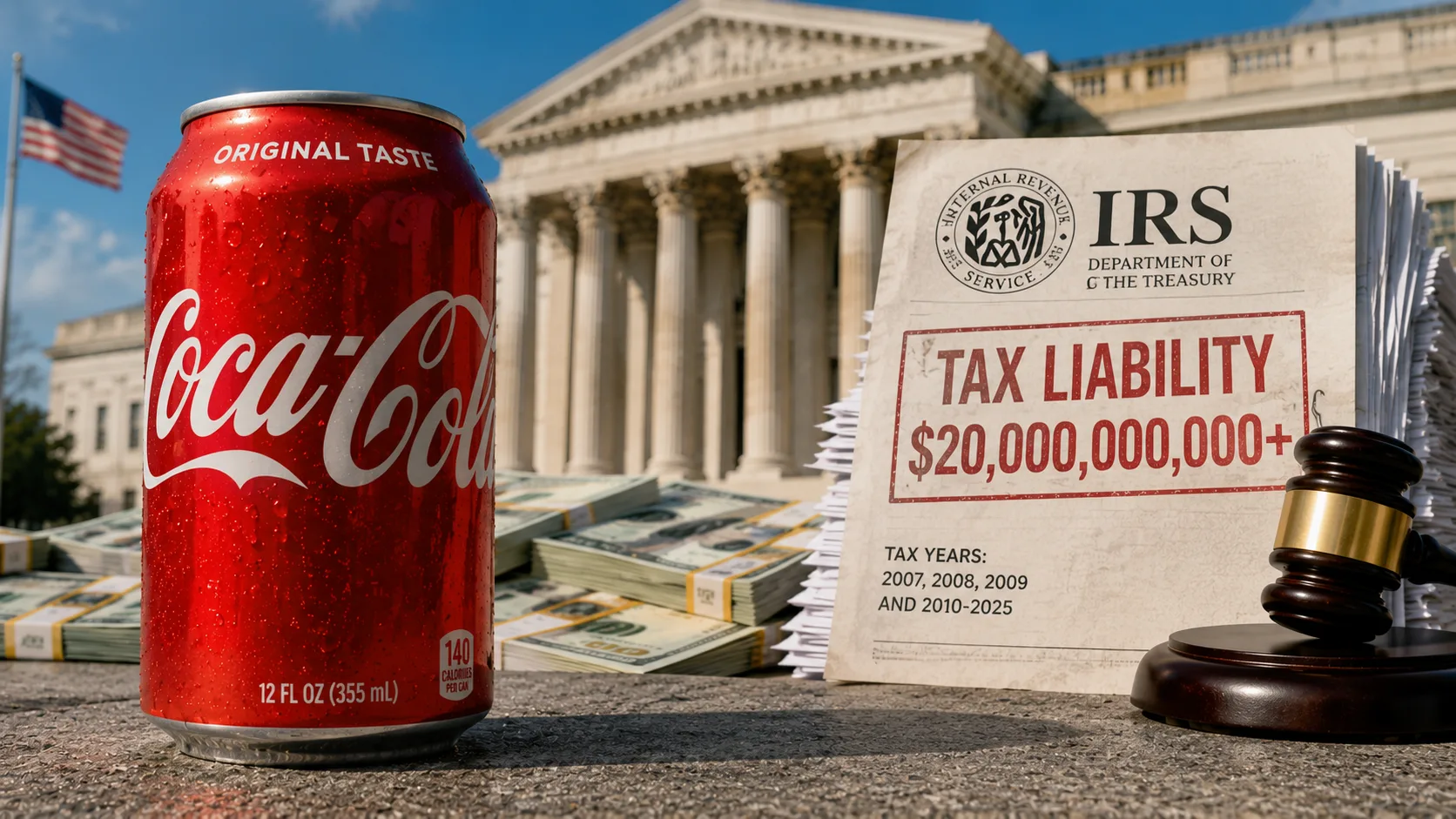
Coca-Cola is heading back to court in a tax dispute that could ultimately cost the company more than $20 billion and reshape how multinational corporations report profits around the world.
The case, which will be argued before a federal appeals court in Miami on June 25, centers on a simple but enormously expensive question: Did Coca-Cola shift too much profit overseas and pay too little tax in the United States?
While the legal fight has dragged on for more than a decade, investors are now approaching a potentially pivotal moment. A ruling against Coca-Cola could trigger billions in additional tax payments, raise the company’s future tax rate, and embolden the IRS to pursue similar cases against some of the world’s largest corporations.
For income investors who view Coca-Cola as one of the safest dividend stocks in the market, the outcome could become one of the most important developments facing the company this year.
Why More Than $20 Billion Is at Stake
The dispute dates back to tax returns filed between 2007 and 2009.
In 2020, the IRS won a major victory in U.S. Tax Court when judges ruled that Coca-Cola had improperly allocated profits to foreign subsidiaries using an internal accounting system known as the “10-50-50” method.
Following that loss, Coca-Cola paid approximately $6 billion in taxes and interest.
Now the company is appealing.
If Coca-Cola ultimately wins, it could recover much of that payment, along with additional interest.
If it loses, however, the consequences become significantly larger.
Because Coca-Cola continues to use the same accounting methodology that the IRS challenged, a loss could potentially expose the company to additional tax liabilities covering 2010 through 2025.
According to company disclosures, that could add another $14 billion in taxes and interest, bringing the total potential exposure to more than $20 billion.
That figure exceeds Coca-Cola’s current cash balance.
The company could be forced to borrow money to satisfy the obligation if courts ultimately side with the government.
The Bigger Question: Where Are Profits Really Earned?
At the heart of the case is a growing issue facing governments and multinational corporations around the world.
Many global businesses generate enormous value through intellectual property rather than physical products.
For Coca-Cola, the company’s most valuable assets are not factories or bottling plants. They are its brands, trademarks, formulas, and marketing intellectual property.
The IRS argues that too much of the profit generated by those assets was assigned to foreign subsidiaries operating in lower-tax jurisdictions.
By allocating profits overseas, companies can often reduce their overall tax burden while increasing earnings available to shareholders.
The government contends that Coca-Cola’s foreign operations received profits that should have remained with the U.S. parent company.
Tax Court Judge Albert Lauber was particularly critical of the arrangement, questioning why Coca-Cola’s foreign concentrate manufacturing operations had become some of the most profitable food and beverage businesses in the world despite performing what the IRS considers relatively routine manufacturing functions.
Coca-Cola, however, argues that its overseas subsidiaries perform substantial business functions and that the company relied on a tax structure that had previously received IRS approval.
The company maintains that it followed a methodology that government officials had effectively accepted for years before changing course.
Why Other Major Companies Are Paying Attention
The implications extend far beyond Coca-Cola.
Large multinational corporations across technology, pharmaceutical, consumer products, and manufacturing sectors frequently face similar disputes involving intellectual property and profit allocation.
The IRS is already pursuing other multibillion-dollar tax cases involving major corporations, including Meta Platforms and Amgen.
Business groups including the U.S. Chamber of Commerce and the National Foreign Trade Council have sided with Coca-Cola, highlighting concerns that a government victory could lead to broader enforcement efforts against multinational profit structures.
A victory for the IRS could give tax authorities additional leverage when challenging how corporations allocate profits across borders.
A Coca-Cola win, on the other hand, could provide reassurance for companies that use similar international tax strategies.
What It Means for Dividend Investors
One reason the market has remained relatively calm is Coca-Cola’s reputation as one of the most dependable dividend stocks in America.
The company has increased its dividend for 64 consecutive years, making it one of the longest-running dividend growth stories in the market.
Analysts generally believe the company could withstand even a significant adverse ruling without threatening shareholder payouts.
Management has recently emphasized that Coca-Cola maintains sufficient liquidity and financial flexibility to manage a potential tax bill while continuing to invest in the business and support dividend growth.
Still, some tax experts believe investors may be underestimating the legal risk.
The company currently recognizes only a small fraction of the potential liability on its balance sheet, reflecting management’s confidence that it will ultimately prevail.
That confidence will soon face its next major test.
Why This Case Matters Beyond Coca-Cola
Investors often focus on earnings reports, product launches, and economic data. Yet some of the biggest financial risks facing multinational companies emerge from regulatory and tax disputes that receive far less attention.
The Coca-Cola case has become one of the most important corporate tax battles in years because it could establish precedents that affect dozens of global companies.
A government victory would strengthen the IRS’s ability to challenge international profit-shifting arrangements.
A Coca-Cola victory could limit future enforcement efforts and provide greater certainty for multinational firms operating across borders.
Either way, Wall Street is watching closely.
Because while the headlines may mention soda, the real battle is over how trillions of dollars in corporate profits are taxed around the world.
What Investors Should Watch Next
Arguments before the federal appeals court are scheduled for June 25.
A decision could take several months, and either side could seek further review from the full appeals court or ultimately the U.S. Supreme Court.
For Coca-Cola investors, the ruling could remove a decade-long cloud hanging over the stock or create one of the largest corporate tax bills in modern history.
For the broader market, it may become a landmark case that shapes how multinational corporations manage taxes, profits, and shareholder returns for years to come.
About Author