SpaceX’s historic IPO was supposed to mark the beginning of a new era for the company. Instead, less than two weeks later, investors are being reminded that even the market’s hottest growth stories still need money.
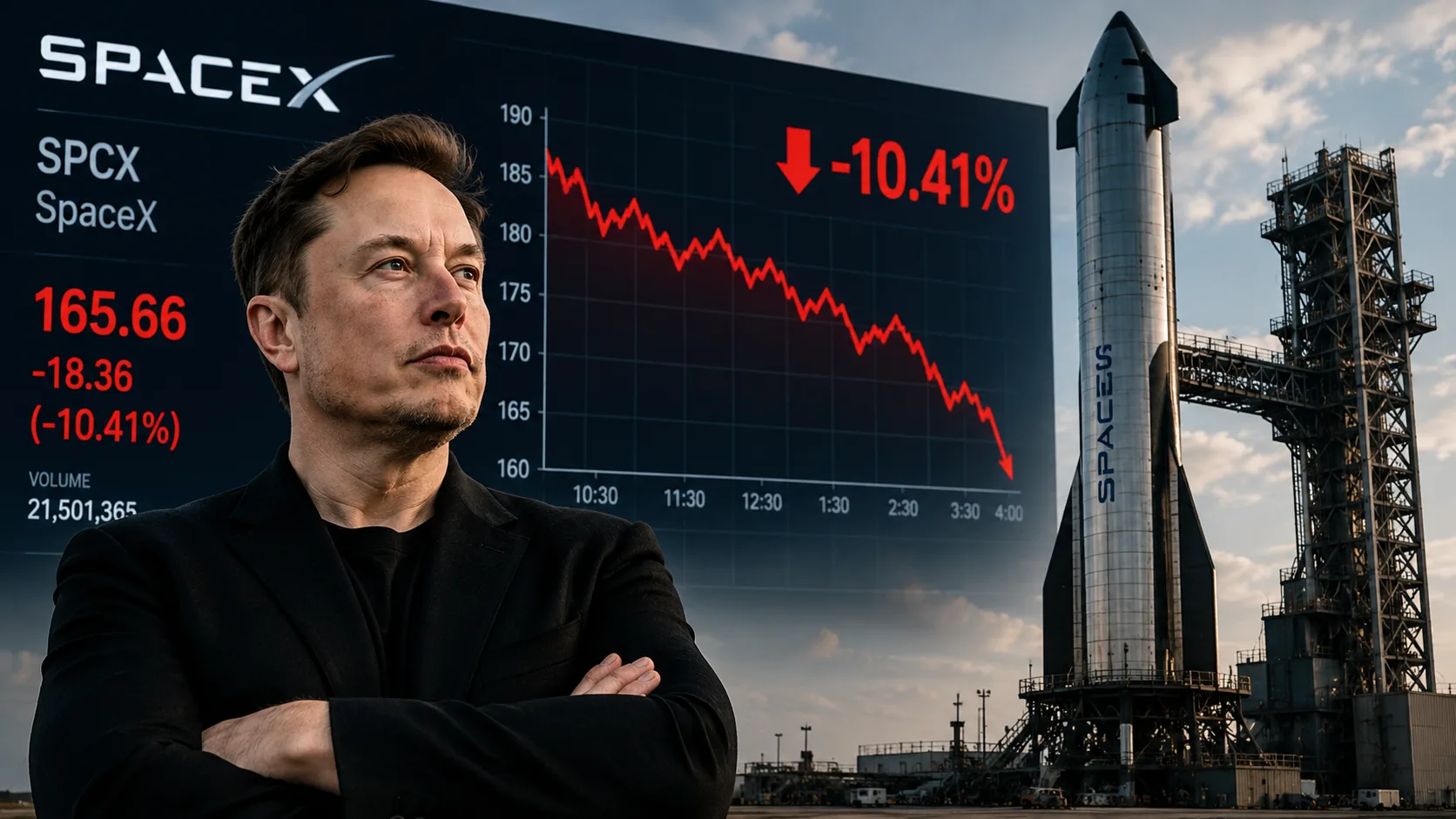
Shares of SpaceX fell more than 10% Monday after the company revealed plans to raise additional capital through the bond market, despite generating a record-breaking $85.7 billion from its initial public offering.
The move is raising new questions about SpaceX’s aggressive spending plans, its growing debt load, and whether Wall Street’s enthusiasm for Elon Musk’s newest public company may have gotten ahead of reality.
Why SpaceX Is Raising Money Again
In a filing Monday, SpaceX announced plans to issue senior unsecured notes to institutional investors.
The company did not disclose the size of the offering but said proceeds would primarily be used to repay a $20 billion bridge loan.
That bridge loan represents the majority of SpaceX’s roughly $29 billion debt burden and was originally used to refinance obligations connected to xAI, the artificial intelligence startup founded by Elon Musk that was acquired by SpaceX earlier this year.
The financing announcement comes just days after Moody’s, S&P Global Ratings, and Fitch awarded SpaceX investment-grade credit ratings, giving the company easier access to debt markets.
For many companies, issuing bonds shortly after an IPO would be viewed as a warning sign.
For SpaceX, management argues it is part of a broader strategy to optimize its balance sheet while preserving cash for future growth initiatives.
Still, investors appear unconvinced.
Investors Expected Growth. They Didn’t Expect Another Capital Raise This Fast.
The timing is what has caught Wall Street’s attention.
SpaceX raised an unprecedented $85.7 billion through its IPO and reported $100.8 billion in cash and cash equivalents as of June 19.
With that much cash on hand, many investors assumed the company would have little need to tap capital markets again in the near future.
Instead, management is already seeking additional funding.
The decision highlights just how expensive SpaceX’s long-term ambitions have become.
The company is simultaneously funding Starship development, expanding its satellite communications network, investing in artificial intelligence infrastructure, developing space-based data centers, and building a massive semiconductor research facility in Texas known as Terafab.
Those projects require enormous amounts of capital long before they generate meaningful returns.
For growth investors, the question isn’t whether SpaceX can spend money. It’s whether those investments will eventually justify the valuation investors have already assigned to the company.
The Valuation Debate Is Heating Up
While SpaceX remains above its $135 IPO price, the stock’s early momentum has cooled significantly.
Shares recently traded around $165, still a strong gain from the IPO but well below post-offering highs.
Several Wall Street firms have begun coverage with sharply different views on the company’s future.
Analysts at KeyBanc initiated coverage with a Sector Weight rating, arguing that much of SpaceX’s future success is already reflected in the stock price.
According to the firm’s estimates, SpaceX currently trades at roughly:
- 29 times projected 2027 revenue
- 71 times projected 2027 EBITDA
Those multiples place the company at a substantial premium to most aerospace, communications, and technology peers.
KeyBanc acknowledged that SpaceX possesses significant growth opportunities across rocket launches, satellite communications, and artificial intelligence but suggested investors are already paying a steep price for those opportunities.
Bulls See Massive Upside
Not everyone is concerned.
Several analysts believe SpaceX is still in the early innings of a potentially transformational growth story.
Research firm Zephirin recently initiated coverage with a Buy rating and a $310 price target, implying roughly 68% upside from recent levels.
Oppenheimer has established a $250 price target, suggesting approximately 35% potential upside.
The bullish case centers on SpaceX’s unique position across multiple high-growth industries.
Unlike most companies, SpaceX is attempting to dominate several trillion-dollar opportunities simultaneously, including:
- Commercial space launches
- Satellite internet and communications
- Artificial intelligence infrastructure
- Advanced semiconductor manufacturing
- Government and defense contracts
Supporters argue that traditional valuation metrics may fail to capture the long-term value of those opportunities.
What Investors Should Watch Next
The most important development may not be Monday’s bond offering itself.
Instead, investors should focus on whether SpaceX can demonstrate progress toward generating sustainable cash flow from its enormous investment spending.
The company now faces a challenge familiar to many high-profile growth stocks before it: proving that ambitious future plans can eventually translate into profits.
Wall Street appears divided on whether that outcome is already priced into the shares.
The stock’s 10% decline suggests some investors are becoming more cautious.
However, with shares still trading well above their IPO price and analysts maintaining targets far above current levels, the broader debate around SpaceX is far from settled.
For investors, the next few quarters may reveal whether SpaceX is following the successful financing playbook pioneered by Tesla—or whether the market’s expectations have simply become too optimistic too quickly.
About Author