

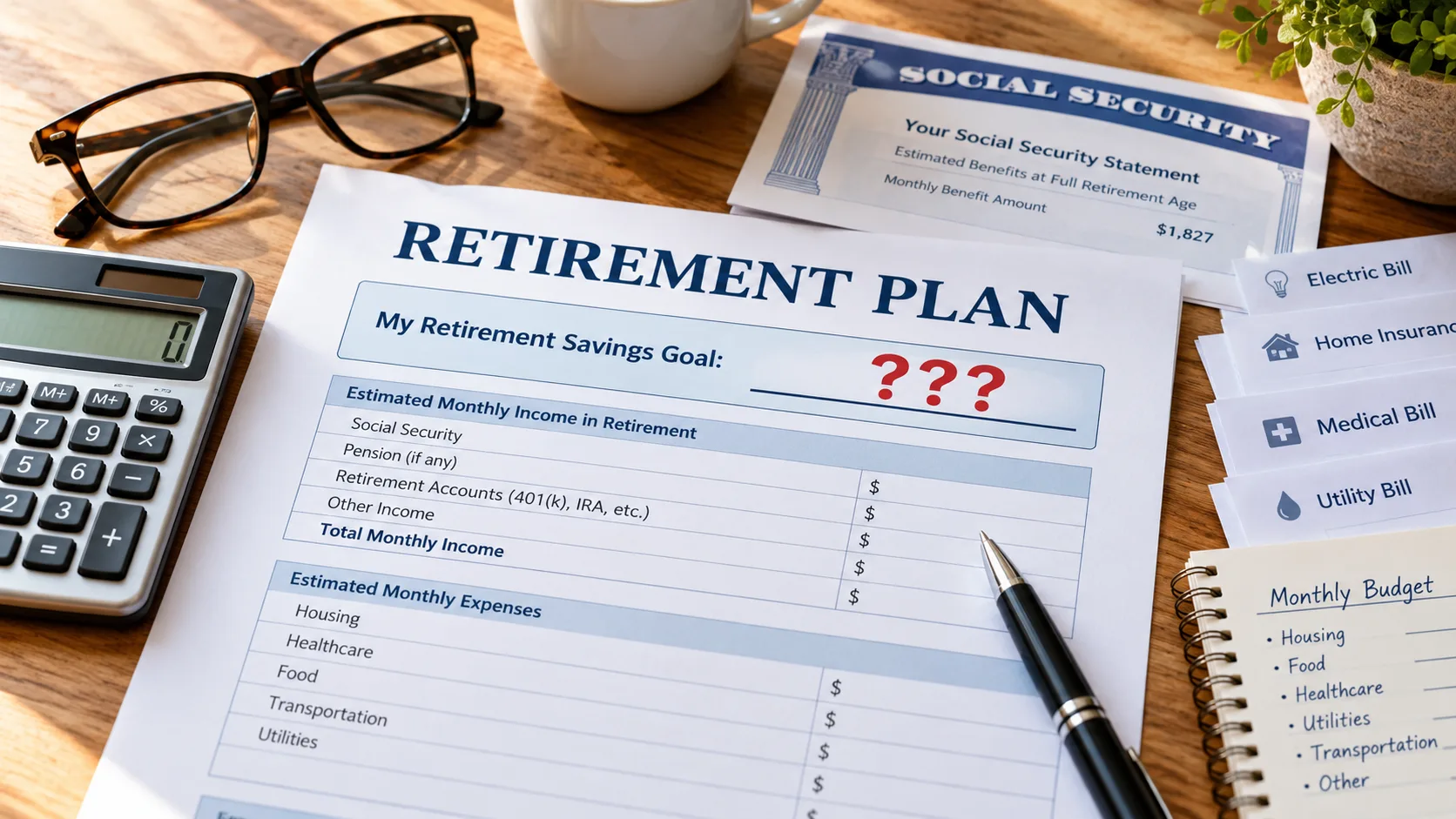
Millions of Americans are approaching retirement without knowing how much money they need to stop working. A new study finds that 42% have never calculated their retirement savings target, leaving many vulnerable to financial surprises when their paychecks stop.
The findings come from Evergreen.ai’s 2026 Financial Decisions Study, which surveyed nearly 2,000 Americans. Even among people who expect to retire within the next 15 years, roughly one-third have never calculated how much they will need.
The numbers raise serious questions about retirement readiness, particularly as healthcare costs rise, inflation continues to erode purchasing power, and uncertainty surrounds the future of Social Security.
America’s Retirement Planning Gap Is Bigger Than It Looks
The Evergreen.ai study found that 42.4% of respondents had never attempted to calculate their retirement needs. Among people expecting to retire within 15 years, that figure was 32.9%.
Separate research suggests the problem extends well beyond planning.
A 2026 report from the National Institute on Retirement Security found that the median retirement savings balance across American workers was just $955. That figure includes workers with no retirement savings and is based on data from December 2022. Among workers with positive balances in defined-contribution retirement accounts, the median was $40,000.
The difference is important, but both figures highlight the financial challenges facing many households.
Meanwhile, retirement expenses are becoming increasingly difficult to predict. Healthcare, housing, insurance, and everyday necessities can consume a substantial share of retirement income, particularly for people who rely heavily on Social Security.
The Biggest Danger May Be Retiring Before You’re Ready
Many Americans assume they can simply work longer if their retirement savings fall short. Unfortunately, that option isn’t always available.
Health problems, layoffs, family caregiving responsibilities, and other unexpected circumstances can force people to retire earlier than anticipated. Even healthy workers may find it difficult to replace their income after leaving the workforce.
Early retirement can create several financial problems simultaneously. Savings must support additional years of spending, contributions end sooner than expected, and claiming Social Security early can permanently reduce monthly benefits.
Healthcare adds another concern. Fidelity Investments estimates that a 65-year-old retiring in 2026 can expect to spend approximately $185,500 on healthcare and medical expenses over the course of retirement. That estimate excludes long-term care.
For couples, the combined expense could be considerably higher.
And inflation compounds the challenge. At an average inflation rate of 3%, something costing $50,000 today would cost approximately $90,300 in 20 years.
Retirees who underestimate these expenses could find themselves cutting back substantially later in life.
How Much Money Do You Actually Need to Retire?
There is no universal retirement savings target. A household expecting $100,000 in annual retirement expenses will have very different needs from one that can comfortably live on $50,000.
A useful starting point is to calculate the difference between expected annual spending and reliable retirement income, including Social Security and pensions.
One common planning guideline is the 4% withdrawal rule, which translates into approximately 25 times the annual amount needed from investments.
For example, consider someone expecting to spend $75,000 annually in retirement while collecting $35,000 from Social Security and other guaranteed income.
| Retirement Calculation | Annual Amount |
|---|---|
| Estimated retirement expenses | $75,000 |
| Social Security and pension income | $35,000 |
| Income needed from investments | $40,000 |
| Illustrative portfolio target at 4% | $1,000,000 |
Under this approach, a $1 million portfolio could support an initial annual withdrawal of $40,000, with subsequent withdrawals adjusted for inflation.
However, the 4% rule is a planning guideline, rather than a guarantee. Market performance, retirement length, investment allocations, taxes, and withdrawal timing can significantly change the outcome.
For someone concerned about a prolonged market downturn or a retirement lasting more than 30 years, a more conservative withdrawal assumption may be appropriate.
Three Retirement Risks Americans Frequently Overlook
1. Healthcare costs can increase substantially.
Medicare doesn’t cover every medical expense, and retirees still face premiums, deductibles, prescription costs, and potential long-term care expenses. These costs can become especially burdensome later in retirement.
2. Social Security benefits face financial uncertainty.
The Congressional Budget Office projects that Social Security’s Old-Age and Survivors Insurance Trust Fund will be exhausted in 2032 if current law remains unchanged.
Without congressional action, incoming revenue would be insufficient to pay full scheduled benefits. A September 2026 analysis from the Committee for a Responsible Federal Budget estimates that benefits could face a roughly 26% reduction at that point.
These cuts are projections, rather than enacted policy. Congress could change taxes, benefits, or program financing before the deadline. Nevertheless, the potential shortfall illustrates why retirees should evaluate how dependent they are on Social Security.
3. Market declines can do greater damage early in retirement.
A major stock market decline shortly after retirement can be particularly damaging if investors must sell investments to cover living expenses.
This is known as sequence-of-returns risk.
For example, a retiree withdrawing $40,000 annually from a $1 million portfolio may need to sell a larger percentage of remaining assets after a major market downturn. Those withdrawals can reduce the capital available to participate in an eventual recovery.
Maintaining adequate cash reserves, diversifying investments, and having flexibility with withdrawals can help manage this risk.
Having $1 Million Doesn’t Automatically Mean You’re Ready
One of the most important lessons from the new research is that retirement readiness cannot be measured by account balances alone.
Someone with $600,000 saved, a paid-off home, modest expenses, and substantial pension income may be better prepared than someone with $1.5 million who faces high expenses and relies entirely on investments.
Taxes also matter. A million dollars in a traditional IRA carries a different after-tax value from a million dollars in a Roth IRA, assuming qualified withdrawals.
The same principle applies to Social Security claiming decisions, housing costs, outstanding debt, and expected retirement age.
Ultimately, a sustainable retirement depends on whether available income and assets can support spending throughout retirement, including unfavorable economic conditions.
Five Steps to Take Before Retirement
For Americans approaching retirement, even a basic financial assessment can reveal potential problems while there is still time to address them.
- Calculate your actual spending. Review bank statements, credit cards, insurance premiums, and household expenses to establish a realistic annual budget.
- Estimate your retirement income. Include projected Social Security benefits, pensions, annuities, and other reliable income sources.
- Determine the income gap. Subtract reliable income from expected expenses and calculate how much your investments must provide.
- Test different scenarios. Consider higher inflation, a major market decline, unexpected healthcare expenses, and living into your 90s.
- Review your plan regularly. Recalculate your numbers as investments, expenses, health, and retirement expectations change.
The earlier this process begins, the greater the opportunity to adjust. Someone who discovers a savings shortfall at 50 may still have time to increase contributions, reduce debt, or reconsider investment allocations.
Discovering the same problem at 65 leaves considerably fewer options.
The Takeaway for Future Retirees
The latest findings reveal a troubling disconnect between retirement expectations and financial preparation.
With more than four in ten Americans unable to identify how much they need for retirement, millions may be making one of their largest financial decisions without understanding the costs.
The encouraging part is that calculating a retirement target does not require a complicated financial strategy. A realistic estimate of spending, income, and available savings can provide a foundation for better decisions.
Knowing your retirement number won’t eliminate financial uncertainty, but it can help prevent an unpleasant surprise when it’s finally time to stop working.
About Author