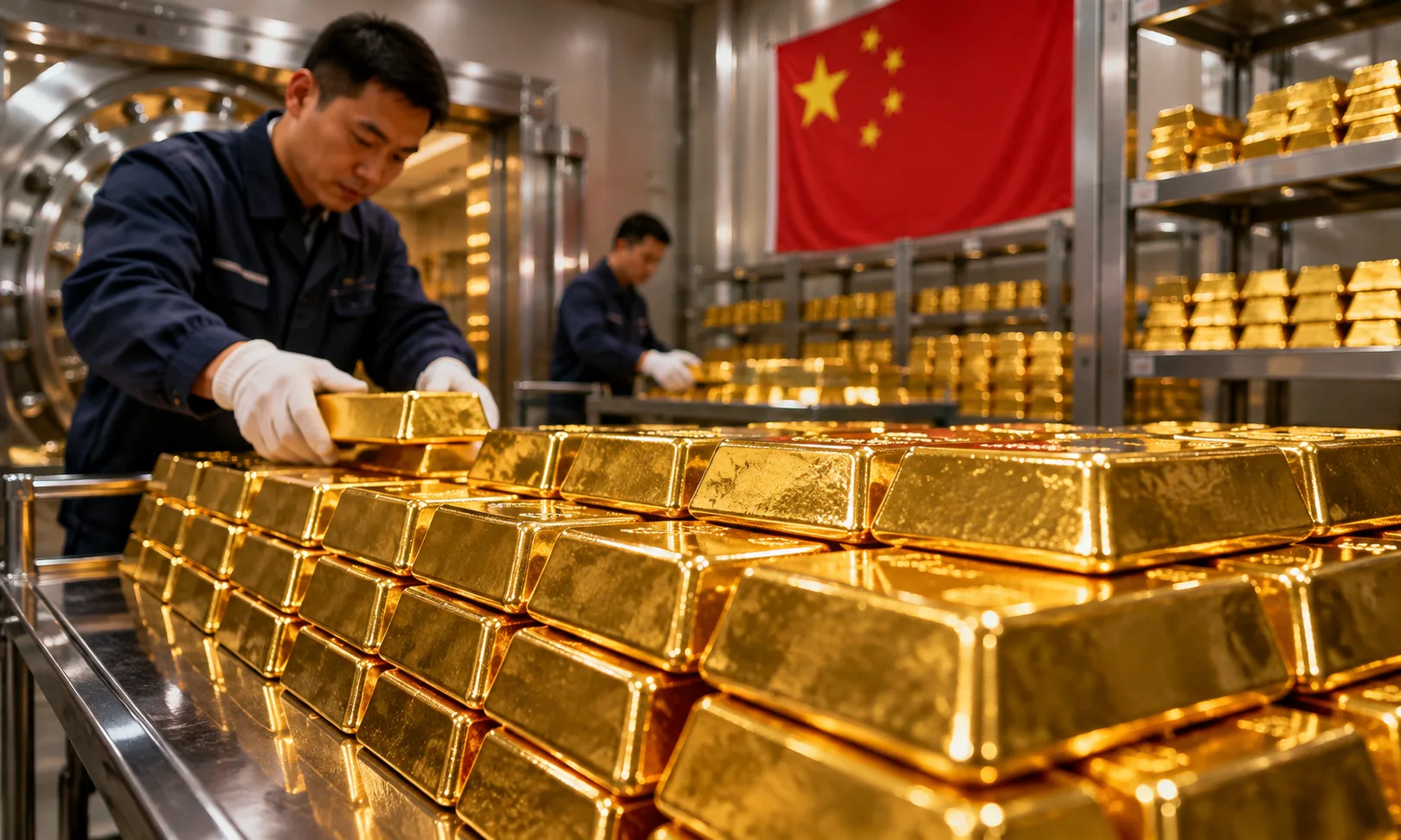
China has spent nearly $159 billion importing gold in just eight months, while its central bank has extended its buying streak to 23 consecutive months. The buying spree is raising an important question for investors: Could China’s appetite for gold help drive the next major rally?
And with gold prices well below their January highs, the timing is particularly interesting.
China’s gold purchases are being driven by two powerful forces. Beijing wants to reduce its dependence on the U.S. dollar, while Chinese households are looking for somewhere to protect their savings as the country’s property and stock markets struggle.
Together, those forces could provide lasting support for gold prices, even as higher U.S. interest rates create pressure on the precious metal.
China Has Already Bought More Gold Than It Did All Last Year
The numbers are difficult to ignore.
According to Chinese customs data, the country imported more than 1,000 tonnes of gold worth a record $158.8 billion during the first eight months of 2026.
For comparison, China imported approximately 886 tonnes worth $96.5 billion during all of 2025.
That means China surpassed an entire year’s gold imports in just eight months.
And the country’s central bank is accelerating its purchases.
The People’s Bank of China added approximately 23 tonnes of gold to its reserves in September, its largest monthly purchase in nearly three years, according to China’s State Administration of Foreign Exchange.
September also marked the 23rd consecutive month of gold buying by the central bank, its longest purchasing streak since at least 2015.
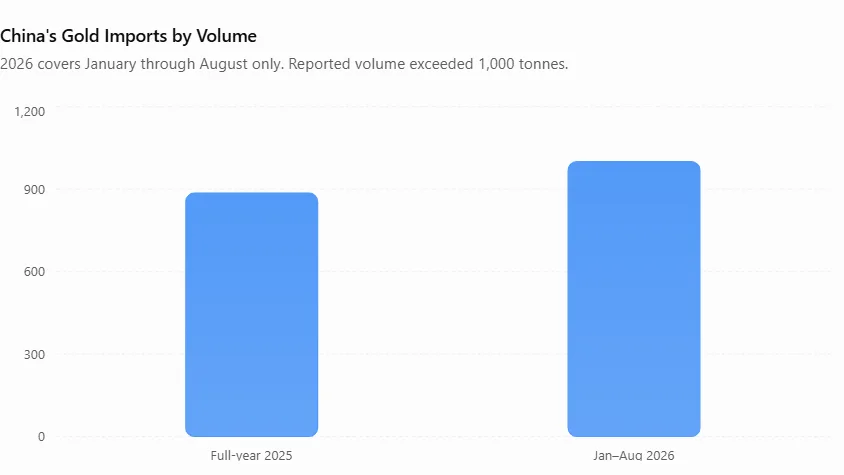
Source: Chinese customs data. The 2026 bar represents the reported minimum of 1,000 tonnes.
According to the World Gold Council, China’s official reserves reached 2,387 tonnes at the end of August, representing approximately 9% of its foreign exchange reserves.
Despite the recent accumulation, China still holds less than one-third as much gold as the United States.
That leaves considerable room for additional diversification should Beijing decide to increase gold’s share of its reserves.
Why Beijing Wants Less Dependence on the Dollar
One of the biggest reasons behind China’s gold purchases has little to do with gold’s recent performance.
It comes down to financial independence.
For decades, central banks have relied heavily on U.S. Treasury securities as reserve assets. Treasurys provide liquidity, generate interest income and are backed by the U.S. government.
However, they also expose foreign governments to the American financial system.
That became particularly clear in 2022, when Western countries froze hundreds of billions of dollars in Russian central-bank assets following Russia’s invasion of Ukraine.
For Beijing, that was a powerful reminder that overseas financial assets can become vulnerable during geopolitical conflicts.
Gold held in domestic vaults carries a different set of risks. It can be stored without relying on a foreign government’s payment system and does not represent another country’s debt obligation.
Meanwhile, China has continued reducing its exposure to U.S. government debt.
Chinese holdings of U.S. Treasurys fell to approximately $618 billion in July, their lowest level in 18 years, according to U.S. Treasury data.
Gold gives Beijing another option as it gradually reshapes its reserve portfolio.
The important distinction for investors is that central banks generally purchase gold for strategic reasons rather than short-term trading profits.
That makes their buying potentially more durable than demand from investors trying to profit from the next price increase.
Of course, China remains deeply connected to the dollar-based global financial system. Buying gold does not mean Beijing can quickly eliminate that dependence. Reserve diversification is a gradual process, and the dollar still offers liquidity that gold cannot fully replace.
China’s Struggling Economy Is Creating Another Gold Rush
There is another important part of this story.
Chinese households are increasingly turning toward gold because many of their traditional investment choices have become less attractive.
Real estate was once among the country’s most popular ways to build and preserve wealth. Years of falling property values and financial problems among developers have damaged confidence in that market.
Stocks have also disappointed.
China’s benchmark CSI 300 index has fallen approximately 8% this year, compared with a roughly 13% gain for the S&P 500, according to the supplied market figures.
Meanwhile, lower interest rates have reduced the appeal of savings accounts and bonds.
China’s one-year government bond yield has fallen to around 1.2%, compared with approximately 4.46% in the United States.
That difference matters.
Gold does not pay interest or dividends, which is usually one of its biggest disadvantages compared with bonds and savings accounts.
But when investors are earning very little on their cash, the income they sacrifice by holding gold becomes much smaller.
For Chinese households facing disappointing property returns, weak stocks and low deposit yields, owning physical gold becomes an increasingly attractive way to diversify savings.
It also helps explain why demand has remained strong despite gold’s extraordinary price increases over the past several years.
What China’s Buying Means for Gold Prices
Gold has experienced a remarkable year, although investors who bought near the highs have learned that even traditional safe-haven assets can suffer significant losses.
After reaching a record above $5,500 an ounce in January, gold declined sharply and lost more than 8% during September.
By Monday morning, December gold futures were trading around $4,196 an ounce, based on the market snapshot supplied for this report.
Normally, rising U.S. bond yields create difficulties for gold.
When Treasury yields increase, investors can earn more income by holding government bonds instead of a metal that pays nothing.
A stronger dollar can also make gold more expensive for buyers using other currencies.
Those pressures help explain why gold has retreated from its highs.
Yet China’s consistent purchases could be limiting how far prices fall.
Central banks generally operate with longer investment horizons than individual traders. If their purchases continue during periods of weakness, they can absorb some of the supply that might otherwise push prices lower.
This helps explain why analysts are paying such close attention to China’s buying activity.
Aakash Doshi, head of gold strategy at State Street Investment Management, forecasts gold prices reaching between $4,750 and $5,500 per troy ounce by the end of the first quarter of 2027.
Using the roughly $4,196 December futures price cited above, that would represent potential gains of approximately 13% to 31%.
However, those forecasts are far from guaranteed. Stronger U.S. economic growth, persistently high interest rates or renewed dollar strength could continue to weigh on gold.
China’s buying may help establish support beneath the market, but it cannot eliminate the risk of further declines.
Three Areas Investors Should Be Watching
1. Physical Gold and Gold ETFs
Investors seeking exposure to the metal itself can consider physically backed gold exchange-traded funds, including the SPDR Gold Shares ETF (NYSEARCA: GLD) and the iShares Gold Trust (NYSEARCA: IAU).
These funds are designed to track gold prices, less expenses, allowing investors to gain exposure without storing physical bullion.
If China’s buying continues and gold prices recover, these ETFs would be among the more direct ways to participate.
However, their prices can also decline sharply when gold weakens, and neither produces regular income.
2. Gold Mining Companies
Higher gold prices can create opportunities for mining companies, including Newmont (NYSE: NEM) and Barrick Mining (NYSE: B).
The attraction comes from operating leverage.
Mining companies have significant costs associated with extracting gold. When the selling price rises faster than production expenses, profit margins can expand.
That means mining stocks can sometimes outperform the metal itself during a sustained rally.
The reverse is equally important. Rising labor, energy or equipment costs can erode margins, while operational problems and political risks can hurt individual companies even when gold prices are increasing.
Investors looking for broader exposure can also consider the VanEck Gold Miners ETF (NYSEARCA: GDX), which holds shares of multiple gold mining businesses.
3. U.S. Interest Rates and the Dollar
China’s purchases represent only part of the equation.
U.S. monetary policy remains one of the largest influences on global gold prices.
The Federal Reserve has signaled the possibility of another interest rate increase in 2026, raising concerns that Treasury yields could remain elevated.
If interest rates rise further, gold could struggle to sustain a rally despite strong buying from China.
Conversely, a shift toward lower interest rates could create a more favorable environment for the metal, particularly if central-bank demand remains elevated.
For investors, that combination could be especially significant: continued purchases by major central banks alongside falling U.S. yields.
The Surprising Risk to Gold: A Stronger Chinese Economy
There is an interesting contradiction in China’s buying spree.
A meaningful portion of consumer demand has been driven by disappointing returns elsewhere.
That means improvements in China’s economy could actually weaken one of the forces supporting gold.
If the country’s property market stabilizes, equities recover and household confidence improves, investors may become more willing to put their money back into stocks and real estate.
Gold could lose some of its appeal.
A rise in Chinese interest rates could have a similar effect by making bank deposits and bonds more competitive.
There are already indications that demand is uneven. The World Gold Council reported that wholesale gold demand weakened unexpectedly in August, while jewelry consumption remained under pressure. At the same time, investment demand through gold ETFs and the central bank continued to strengthen.
That distinction matters because record imports do not necessarily mean every segment of China’s gold market is experiencing a boom.
And although Beijing has been adding substantial amounts of gold, the increase in official reserves remains relatively modest compared with the country’s overall imports.
The resilience of gold prices increasingly depends on which buyers remain active, how long they continue purchasing and whether demand elsewhere in the world can offset any slowdown.
Three Signals That Could Determine Gold’s Next Move
Investors trying to determine whether China’s buying will help produce another gold rally should focus on three developments.
First, watch China’s monthly central-bank purchases. Another several months of accumulation would strengthen the argument that Beijing’s reserve diversification is a lasting trend. An unexpected pause would raise questions about the durability of that demand.
Second, watch U.S. Treasury yields. Falling yields could remove one of the biggest obstacles facing gold, potentially allowing central-bank demand to have a stronger impact on prices.
Third, watch Chinese investment demand. Continued inflows into domestic gold ETFs, strong demand for bars and coins, and premiums in China’s local gold market would suggest households are still moving money toward the metal.
The strongest bullish scenario would involve all three forces moving in gold’s favor.
Alternatively, higher U.S. yields and weakening Chinese demand could keep prices under pressure even if Beijing continues adding to its reserves.
The Bigger Picture for Gold Investors
China’s gold buying reflects something larger than demand for a precious metal.
Beijing is gradually adjusting how it protects its financial reserves, while Chinese households are reconsidering where they can safely store their wealth.
Those decisions are helping create a potentially durable source of demand in a market that has already experienced considerable volatility.
For investors, the most important takeaway is that China’s buying could help cushion gold during periods of weakness and potentially amplify future rallies if U.S. interest rates begin moving lower.
Gold’s next major move may depend as much on decisions being made in Beijing as on the Federal Reserve in Washington.
And with China’s central bank still buying after 23 consecutive months, that is a trend worth watching closely.
About Author