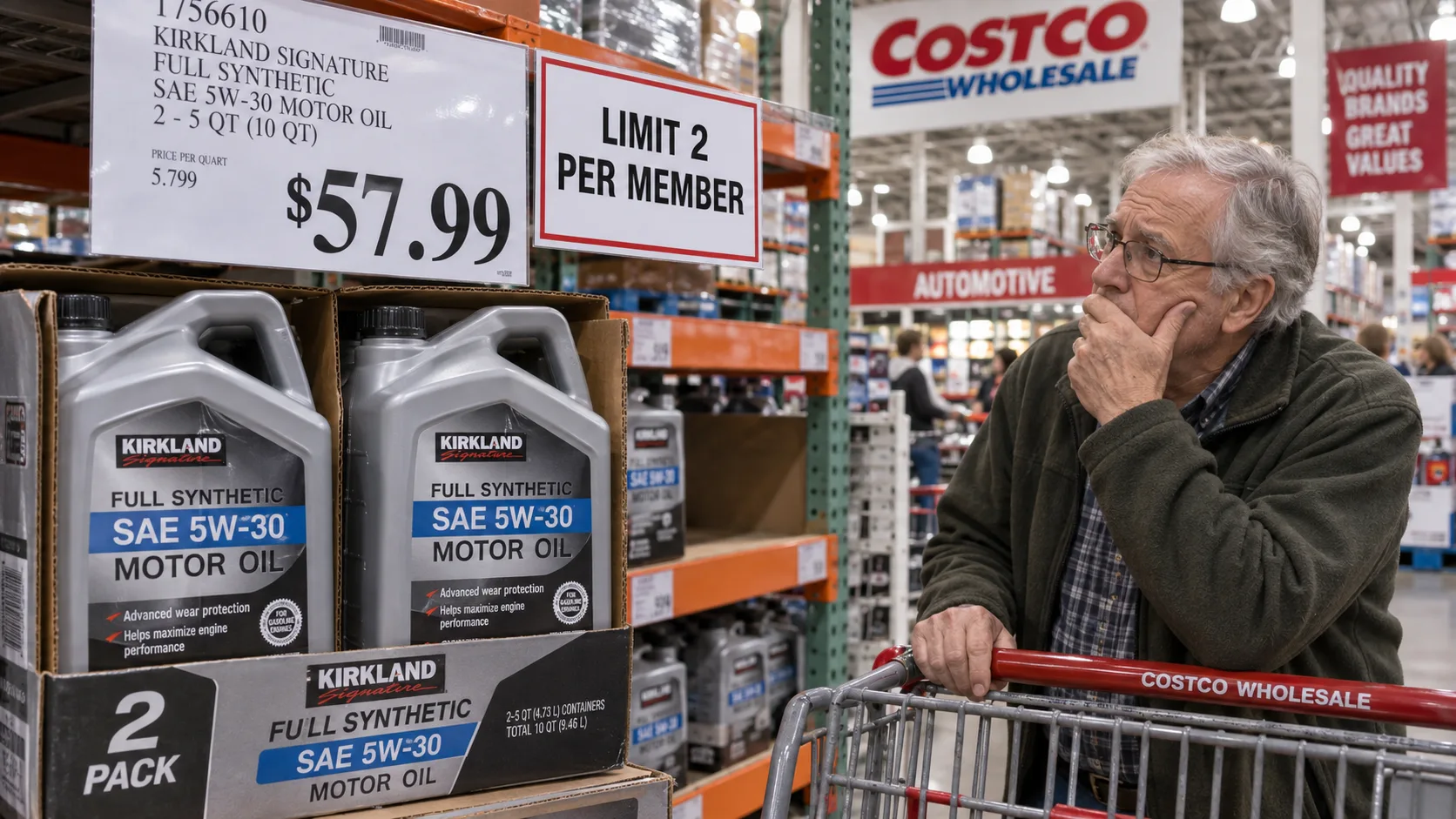
Costco has placed a purchase limit on Kirkland Signature synthetic motor oil after the price of a 10-quart case jumped from roughly $30 to $35 previously to $57.99 today. Yes, we are apparently rationing motor oil now.
Members can purchase no more than two cases per week. Costco has reportedly limited some Mobil 1 products as well, so this is bigger than one Kirkland item having a bad month.
Depending on what shoppers paid before the increase, the price has jumped somewhere between 65% and 90%. That is a serious increase for a product whose main selling point was getting a lot of perfectly good synthetic oil at a Costco price.
It is also another reminder that inflation rarely announces its return with a press conference. It usually sneaks into the economy through a fuel surcharge, a repair bill or, in this case, a black plastic jug sitting in a warehouse aisle.
Why Is Costco Limiting Motor Oil?
Costco has not offered a detailed public explanation for the new limit. The most likely answer is the obvious one: supplies are tight, replacement costs are rising and Costco does not want a handful of repair shops, fleet operators or resellers emptying the shelves.
Synthetic motor oil relies on highly refined base oils. One important category is known as Group III base oil, which is commonly used to manufacture lubricants capable of handling the heat and pressure inside modern engines.
The United States imports a meaningful amount of this material from the Persian Gulf. That arrangement works well when production is steady, shipping lanes are open and nobody is attacking energy infrastructure. It works considerably less well when conflict disrupts production and makes transportation through the region more expensive and uncertain.
Rising crude prices add another problem. Refiners can turn crude oil into gasoline, diesel, jet fuel, lubricants and several other products, and they naturally prefer producing whatever offers the most attractive return.
Lubricants account for only about 1% of U.S. refinery yield, according to the Energy Information Administration. Gasoline and distillate fuels occupy much larger shares, which means motor oil can quickly get pushed down the priority list when other products are generating better margins.
The industry does not produce products according to which one Costco shoppers would most like to see on sale. It follows the money.
Why This Price Increase Stands Out
Retail prices rise constantly, and most of the time nobody outside the affected industry notices. Costco is different because its entire business model is built around the belief that members are getting a better deal than they could find elsewhere.
The company generates a substantial portion of its profit from membership fees. That allows Costco to operate with relatively low merchandise markups while using its enormous purchasing power to negotiate prices that ordinary retailers cannot.
When a company with that much leverage raises the price of a basic automotive product from around $30 to nearly $58, it is reasonable to assume that something meaningful has changed upstream.
The purchase limit may be even more revealing than the price. A retailer raises a price when a product becomes more expensive, but it limits purchases when it is worried that inventory may disappear faster than it can be replaced.
Costco apparently believes $57.99 is still attractive enough for people to buy more than the company wants to sell them. That tells us something about the market.
This Will Not Stay in the Costco Aisle
One expensive package of motor oil will not derail the economy. The businesses purchasing oil by the pallet are a different story.
Trucking companies, delivery services, rental-car operators, construction firms, farms and municipal fleets perform oil changes across hundreds or thousands of vehicles. They cannot respond to higher prices by deciding that engine maintenance feels optional this quarter.
A household might absorb an extra $20 or $30 a few times per year. A large fleet can face thousands of higher-cost oil changes, along with higher prices for fuel, tires, replacement parts, insurance and labor.
Those expenses eventually go somewhere. Companies can absorb the additional cost and accept smaller margins, cut spending elsewhere or pass the expense to customers through higher delivery rates, maintenance charges and service fees. Most will attempt some combination of the three.
This is how an obscure shortage becomes part of a broader inflation problem. The price increase starts with a specialized petroleum product, reaches commercial fleets and repair shops, and then quietly appears in the price of moving goods around the country.
Nobody writes “synthetic motor oil shortage” on a grocery receipt. The consumer simply pays more.
What Investors Should Take From It
Costco motor oil will not determine the direction of the stock market. It may, however, provide an early look at a larger cost problem.
Investors should watch whether competing retailers introduce similar limits. Restrictions at Walmart, Amazon, AutoZone or national automotive chains would confirm that the shortage is widespread.
Oil-change prices deserve attention too. If service centers remove promotions or announce noticeable increases, wholesale lubricant inflation is reaching consumers.
Transportation companies could face pressure from both directions. Fuel raises the daily cost of operating a vehicle, while motor oil and replacement parts raise the cost of maintaining it. Businesses with strong pricing power can pass those expenses along, while companies competing mainly on price may have to absorb more of them.
Refiners and lubricant producers with reliable access to high-quality base oils could benefit from higher selling prices. Investors still need to examine the actual product mix, since owning shares in an oil company does not guarantee meaningful exposure to the specific part of the market experiencing a shortage.
Costco itself is unlikely to suffer significant financial damage from one automotive product. The real concern would be a broader pattern of similar increases across Kirkland Signature merchandise.
The private-label brand is one of Costco’s most valuable tools for reinforcing member loyalty. A few supply-driven price increases are manageable, but repeated increases across multiple categories would make the company’s value proposition harder to defend.
Costco May Be Doing Shoppers a Favor
The cynical response is that Costco has nearly doubled the price and is now pretending the product is too precious to sell freely.
There is a more practical explanation. Limits prevent commercial buyers and resellers from clearing available inventory, give ordinary members a better chance of finding the product and reduce the incentive to hoard it.
That can shorten the disruption by spreading inventory across more customers. Costco is also protecting itself because empty shelves look bad, and customers tend to blame the retailer standing in front of them rather than the distant refinery or damaged energy facility that caused the problem.
Both explanations can be true.
Keep an Eye on This One
Costco’s new rule is a small event with an uncomfortable message behind it. A popular product that previously sold for roughly $30 to $35 now costs $57.99, and supplies are tight enough that one of the country’s largest retailers is restricting purchases.
The same forces driving up energy costs are beginning to appear in maintenance products that households and businesses cannot simply stop using. The next question is whether the problem remains confined to motor oil.
If purchase limits spread, oil-change prices climb and transportation companies begin talking about higher maintenance expenses, Costco will have given investors an early warning.
That warning happens to cost $57.99.
About Author