For years, tariffs have been treated as an automatic inflation trigger. Raise import taxes, prices go up. That logic is simple, intuitive, and widely repeated. But new economic research suggests reality is more complicated, and in some cases, counterintuitive.
Despite the highest U.S. tariff levels in nearly a century, inflation has not surged in the way many economists predicted. Two major studies examining more than a century of economic data help explain why tariffs often fail to ignite sustained inflation, even as they impose real economic costs elsewhere.
For investors, the takeaway is not that tariffs are harmless. It is that their impact shows up in places markets often overlook, including growth, employment, and demand.
What Recent Studies Found About Tariffs and Inflation
Economists at the Federal Reserve Bank of San Francisco analyzed tariff data stretching from 1886 through 2017. Their conclusion runs against conventional wisdom. Historically, tariff increases did not lead to sustained inflation. In many cases, they coincided with slower price growth.
Their findings show that a one percentage point increase in tariffs was associated with roughly a 0.6 percentage point decline in inflation. That result challenges the standard assumption that higher import costs must translate into higher consumer prices.
A separate paper from economists at Northwestern University examined data from 1840 through 2024. That study did find a modest uptick in inflation following tariff increases, but the effect was small and short-lived.
Taken together, the research points to a pattern. Tariffs can raise prices at the border, but broader economic forces often prevent those increases from spreading through the economy.
Why Inflation Often Stays Contained
At a basic level, tariffs increase the cost of imported goods. That part is not disputed. But inflation is not just about prices. It is about demand.
When tariffs rise, they tend to slow economic activity. Businesses face uncertainty, supply chains become less efficient, and consumers pull back spending. That drop in demand offsets much of the upward pressure on prices.
The San Francisco Fed researchers found that higher tariffs frequently coincided with rising unemployment. When job growth slows and wages come under pressure, companies have less pricing power. Even if costs increase, firms struggle to pass those increases on to consumers.
The Northwestern study reached a similar conclusion. Import costs rose, but trade volumes declined. Manufacturing activity contracted. Exports weakened. The net effect was mild inflation paired with slower growth.
This is why tariffs often behave less like an inflation accelerator and more like an economic brake.
What Actually Happened After Trump’s Tariffs
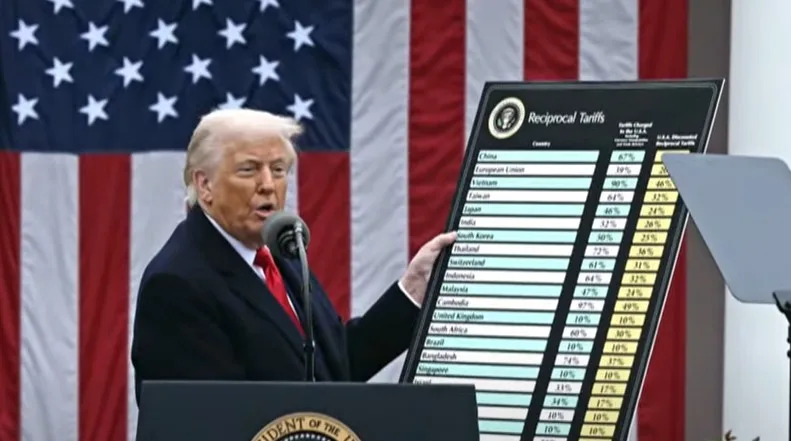
When President Trump announced sweeping tariffs last year, many economists warned of a sharp inflation spike, a stronger dollar, and a pronounced economic slowdown. So far, none of those outcomes has materialized in dramatic fashion.
Inflation has remained elevated and above the Federal Reserve’s 2 percent target, but it has not exploded. Hiring has slowed and unemployment has edged higher, yet the economy continues to expand. Manufacturing, meanwhile, has failed to deliver the renaissance promised by tariff advocates.
As one prominent economist put it, “Mainstream economics has something to answer for on this,” said Jonathan Ostry of the University of Toronto.
The data suggests that tariffs did not drive inflation higher in a meaningful way. Instead, they appear to have weighed on momentum, contributing to slower hiring and weaker industrial activity.
Why Growth and Jobs Take the Hit Instead
Tariffs create uncertainty. Businesses delay investment. Consumers postpone big purchases. Exporters lose access to foreign markets as retaliation sets in.
These forces combine to suppress demand. When demand falls, inflation struggles to gain traction, even when costs rise.
That trade-off is visible in recent data. Hiring slowed sharply after tariffs took effect. Manufacturing indicators slipped to multi-month lows. The Federal Reserve responded by cutting interest rates three times in the second half of 2025 to stabilize the economy.
From a policy standpoint, tariffs may appear inflation-neutral. From an economic standpoint, they are anything but cost-free.
The Role of “Real” Tariff Rates
Another reason inflation has remained muted is that companies often pay less than the headline tariff rate. Exemptions, loopholes, supply chain workarounds, and negotiated exclusions reduce the effective burden.
A recent working paper by economists at Harvard University and the University of Chicago found that while headline tariffs reached 27.4 percent, the real average tariff rate paid by firms was closer to 14.1 percent as of late September.
That gap matters. Lower effective rates mean less pressure on consumer prices and margins, even as trade volumes suffer.
Why History Is Not a Guarantee
It would be a mistake to assume tariffs can never fuel inflation. The structure of the global economy has changed dramatically since earlier tariff-heavy periods.
The last time U.S. import duties were this high was in the 1930s. At that time, the country operated under the gold standard and domestic manufacturing dominated the economy. Today’s system is global, service-driven, and deeply interconnected.
“The world is different today,” Ostry said.
Supply chains are more complex. Consumer behavior is more sensitive to price changes. Monetary policy operates under different constraints. Any of these factors could amplify tariff effects in the future.
What This Means for Investors
For investors, the lesson is straightforward. Tariffs are not a reliable inflation hedge or inflation trigger. Their primary impact shows up in growth, employment, and corporate margins.
Industries exposed to global trade, manufacturing, and exports tend to feel the pain first. Defensive sectors and domestically focused businesses often fare better. Rate cuts triggered by tariff-induced slowdowns can support asset prices in the short term but signal underlying economic fragility.
Tariffs may not be inflationary in the traditional sense, but they reshape the economic landscape in ways markets cannot ignore.
About Author