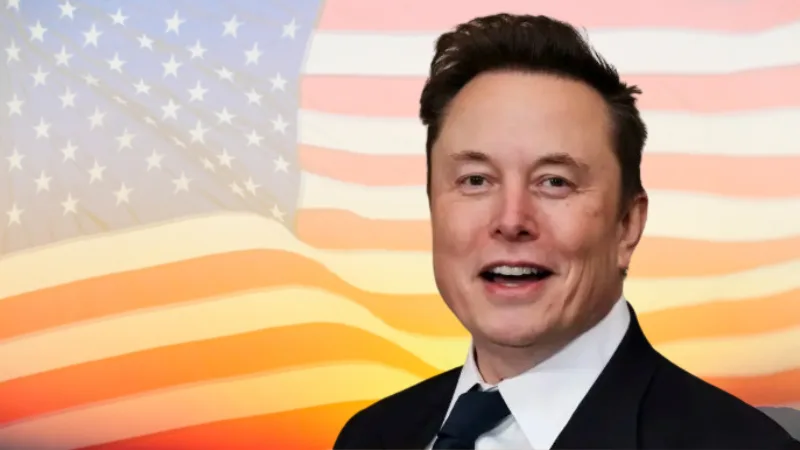
When Elon Musk makes a move, the world pays attention. From launching rockets to building self-driving cars, Musk has built an empire on defying convention. Now, he’s taking aim at one of America’s most entrenched systems — the two-party political status quo. Musk’s new political party, called the America Party, promises to reshape U.S. politics and has already ignited heated debates across Wall Street, Washington, and Silicon Valley.
The Birth of the America Party: What Happened?
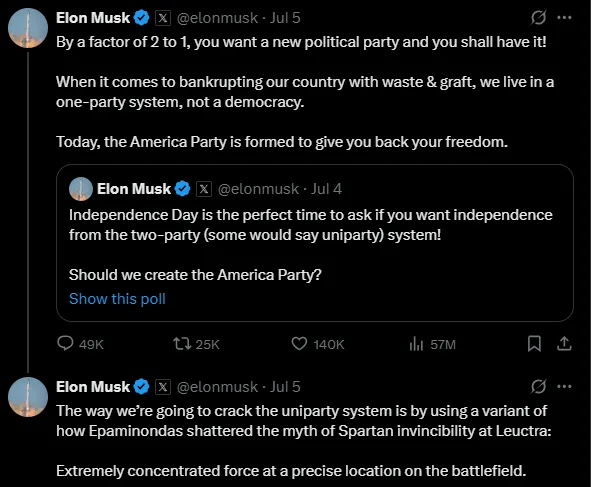
Musk announced the creation of his new political party — officially dubbed the America Party — on July 5, 2025. The announcement came just one day after President Donald Trump signed what Musk described as a “massively bloated” tax and spending bill, nicknamed the “Big, Beautiful” bill.
Musk, who has historically leaned libertarian and occasionally aligned himself with conservative causes, took to his social media platform X to blast the legislation as fiscally reckless. In a fiery post, Musk warned that the new spending bill would push the U.S. deficit from $2 trillion to $2.5 trillion — echoing criticisms he once leveled at the Biden administration.
In that same post, Musk declared:
“By a factor of 2 to 1, you want a new political party — and you shall have it. The America Party is here to give you back your freedom.”
The billionaire’s claim is backed by a snap poll he ran on X, which reportedly drew over 1.2 million votes, with roughly 65% saying they wanted a new political option. Musk’s followers — a mix of libertarians, disaffected centrists, and free-speech absolutists — quickly rallied behind the announcement.
Why Did Musk Break with Trump?
To understand the significance of the Elon Musk new political party saga, you need to look at the deeper split between Musk and Trump.
For years, Musk and Trump maintained an uneasy alliance. Musk served as an advisor early in Trump’s first term and generally praised his deregulatory stance. But as Trump’s policies shifted toward big spending — including the latest tax plan loaded with special interest carve-outs — Musk’s libertarian streak resurfaced.
In a Truth Social post on July 4, Trump boasted that the new spending bill would supercharge U.S. infrastructure and manufacturing. Musk fired back almost immediately, calling it “the same swamp politics that bankrupted past generations.”
Some insiders say the final straw came when Trump’s team floated tighter restrictions on autonomous driving and EV subsidies — moves that would hit Tesla directly. The feud quickly turned public, with Musk all but accusing Trump of abandoning his fiscal conservative base to buy votes ahead of the 2026 midterms.
What Is the America Party, Really?
Unlike other billionaire vanity runs, Musk insists the America Party is no mere ego project. He’s positioning it as a disruptive, populist-libertarian coalition aimed at two core goals:
- Fiscal Responsibility: Rolling back deficit spending and wasteful government programs.
- Individual Freedom: Musk says the America Party will defend free speech, limit government overreach, and promote personal autonomy in everything from technology to finance.
He’s described it as “a refuge for Americans who feel politically homeless.”
Early statements suggest the America Party won’t try to run a presidential candidate in 2028 — at least not yet. Instead, Musk’s strategy is surgical: focus resources on tight Senate and House races where even a small share of votes can swing the outcome.
Can a New Political Party Actually Succeed in the U.S.?
Here’s where the rubber meets the road. The U.S. political system is notoriously hostile to third parties. Ballot access laws vary by state and are designed to protect the Republican–Democrat duopoly. To get on the ballot in all 50 states for federal elections, a party must gather hundreds of thousands of valid signatures, navigate complex filing rules, and maintain voter interest through multiple election cycles.
History is littered with failed third-party efforts — from Ross Perot’s Reform Party to the more recent Forward Party by Andrew Yang. Despite occasional bursts of enthusiasm, most fizzle out once the organizational grind sets in.
So, does Musk stand a better chance?
Three Advantages Musk Has
- Money: With an estimated net worth north of $230 billion, Musk has the resources to hire ballot access lawyers, fund nationwide signature drives, and bankroll candidates who toe the America Party line.
- Platform: Unlike past third-party hopefuls, Musk owns the megaphone. With over 180 million followers on X, he can bypass traditional media and speak directly to potential voters daily.
- Brand: Love him or hate him, Musk commands the kind of cultural currency that few American CEOs have. His fan base is loyal, digital-first, and often shares his disdain for bureaucratic red tape.
Early Challenges for the America Party
Still, even Musk can’t engineer his way around some brutal realities:
- Ballot Access: Many states have spring filing deadlines, meaning the America Party must build infrastructure fast — or risk missing out on the 2026 midterms altogether.
- Candidate Pipeline: Beyond Musk himself, who runs under this new banner? Musk has hinted at supporting “like-minded independents” but hasn’t named names.
- Legal Exposure: As Tesla, X, and SpaceX remain heavily regulated, Musk risks regulatory retaliation. His critics warn that politicizing his companies could alienate shareholders and customers alike.
- Investor Reaction: Some Tesla investors have already raised red flags, concerned that Musk’s political ambitions could distract from core business operations. After all, Tesla’s stock price is notoriously tied to Musk’s image.
What Does This Mean for Trump’s 2026 and 2028 Hopes?
Here’s where it gets politically explosive. Even if Musk’s America Party only draws 3–5% of voters in swing districts, it could act as a spoiler for Republicans — especially in tight Senate races.
Analysts at Eurasia Group already warn that Musk’s new political party could fracture the fragile MAGA coalition at the worst possible time. For Trump and his allies, it’s an unwelcome reminder that the populist right is not a monolith.
What Should Investors Watch Now?
The launch of Musk’s new political party adds another layer of uncertainty for investors:
- Tesla and SpaceX: Expect questions about possible regulatory scrutiny, especially if Trump decides to retaliate through policy changes on EV credits or space launch contracts.
- Media and Tech Stocks: If Musk uses X to push political ads or campaign content, watch for potential legal battles over platform neutrality and election laws.
- Defense and Infrastructure: If the America Party somehow gains traction and blocks parts of Trump’s spending plan, sectors counting on new federal dollars could face setbacks.
Could Musk Actually Win Anything?
Political scientists say Musk’s best shot is not winning dozens of seats outright but making himself a kingmaker. By strategically funding America Party candidates in purple districts, Musk could force Republicans to negotiate with him on spending, tech regulation, and policy priorities.
This could amplify his personal influence far beyond what a single Senate seat would buy.
A Disruptor or Just Noise?
If you’re asking whether the Elon Musk new political party will take over Washington overnight, the honest answer is no. America’s political structure makes that nearly impossible.
But ignore Musk at your own risk. He’s betting that in an era of record voter dissatisfaction, technological reach, and personal branding, a billionaire with a message — and money — can bend the system enough to matter.
The next 18 months will be critical. Will the America Party field viable candidates? Can Musk keep his voter base energized? Will Trump retaliate — or cut a deal?
One thing’s for sure: if you thought the 2024 election cycle was messy, the 2026 midterms might make it look tame.
About Author