
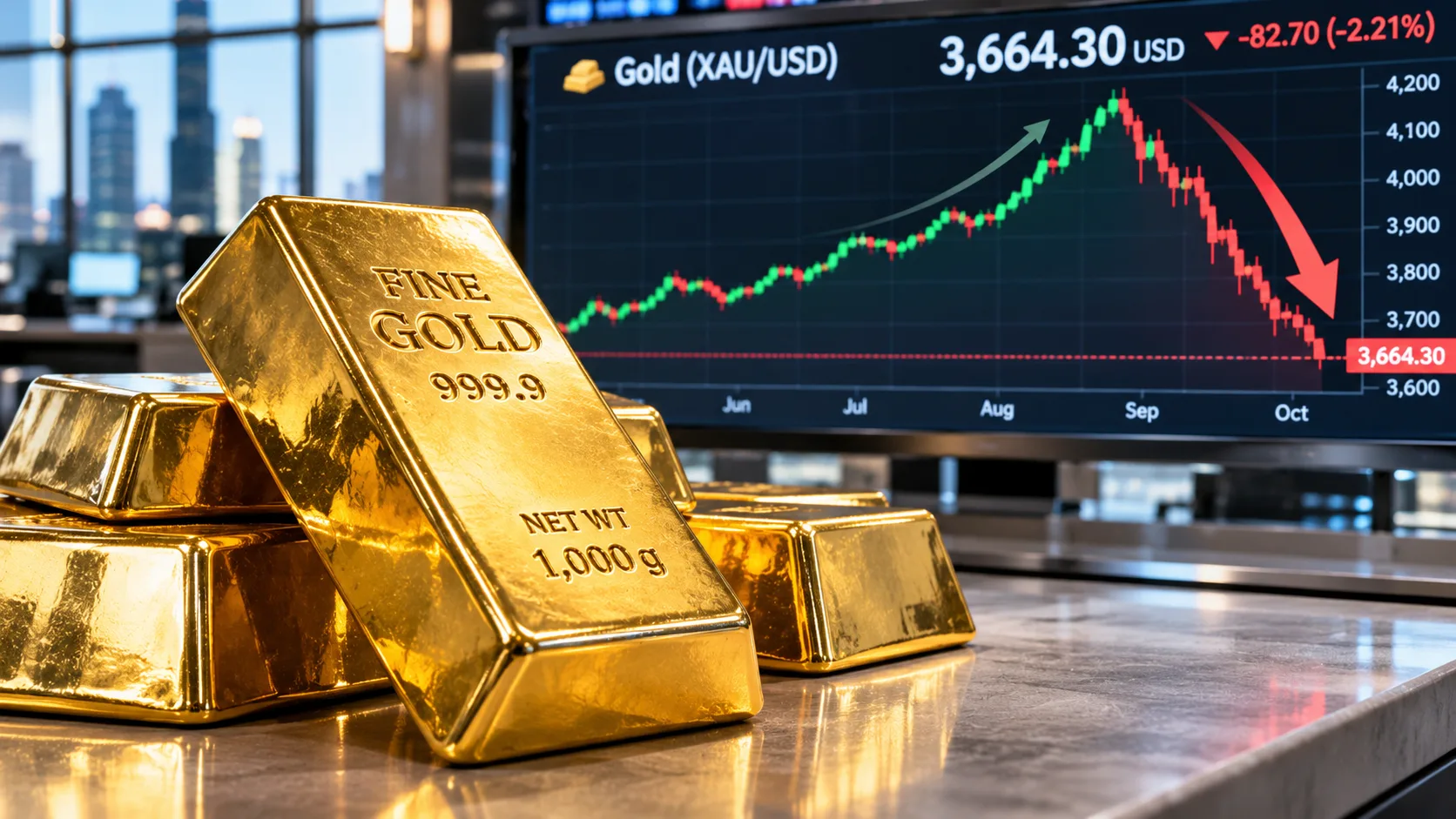
Gold has lost roughly a third of its value since January, wiping out an extraordinary rally and leaving investors facing a troubling question: How much further could the world’s most famous safe-haven asset fall?
On Thursday, November 19, gold briefly plunged below $3,700 an ounce, reaching its lowest level in approximately 14 months. Rising interest rates, a stronger U.S. dollar and growing uncertainty about Federal Reserve policy have created one of the most challenging environments for precious metals in years.
Yet the selloff is revealing something even more significant about how investors are positioning their money, and why some analysts believe gold could fall further before finding a sustainable bottom.
From Record Highs to a $1,900 Collapse
Gold entered 2026 following one of its strongest years in decades. The precious metal set 53 new record highs during 2025 as investors sought protection from inflation, geopolitical instability, government debt and uncertainty surrounding the global economy.
By January 28, 2026, gold had climbed to approximately $5,589 per ounce. The rally appeared unstoppable, supported by institutional investment, central bank buying and growing demand from individual investors. Then the market reversed.
Approximate spot gold prices. Figures reflect different trading dates and times.
Gold broke below $3,800 on Wednesday before extending its decline to approximately $3,693 during Thursday’s trading. Prices subsequently recovered somewhat, but the rebound offered little evidence that the broader downturn had ended.
The decline has erased nearly $1,900 per ounce from January’s peak. An investor who purchased $10,000 worth of gold near that high would have seen the market value fall to approximately $6,600 at Thursday’s low, excluding fees and transaction costs.
For an asset traditionally associated with protecting wealth, the magnitude of that decline has raised serious questions about what changed and whether the worst of the selling is over.
The Three Forces Pushing Gold Lower
1. Higher Interest Rates Are Making Gold Less Attractive
One of gold’s biggest disadvantages is that it produces no income. Unlike Treasury bonds, certificates of deposit or money market funds, physical gold does not pay interest. Investors depend entirely on the metal’s price increasing to generate a return.
That disadvantage becomes increasingly important when interest rates rise. Federal Reserve Governor Christopher Waller added to market concerns Wednesday when he suggested the central bank may need to become more aggressive in combating inflation, including potentially raising rates by 50 basis points at its December meeting.
The prospect of additional tightening has helped push Treasury yields higher, giving investors more attractive income-producing alternatives. For someone approaching retirement, the calculation can be particularly important. A relatively low-risk investment offering a competitive yield may look increasingly appealing compared with an asset that has already suffered a dramatic price decline.
2. The Dollar Is Getting Stronger
Gold is priced internationally in U.S. dollars, making the relationship between the metal and the currency especially important. When the dollar strengthens, gold generally becomes more expensive for buyers using other currencies, potentially weakening international demand.
On Wednesday, the dollar briefly reached its strongest level in approximately 19 months as investors increasingly anticipated tighter Federal Reserve policy. The combination of a stronger dollar and higher Treasury yields has created a particularly difficult environment for gold, undermining two of the conditions that helped fuel its historic rally.
3. Investors Are Selling Gold to Raise Cash
Perhaps the most revealing development is how gold has behaved during periods of market turmoil. Gold traditionally attracts investors looking for protection when financial markets become unstable. However, during the current downturn, some investors have sold gold alongside other assets.
The reason is liquidity. When investors face losses, margin calls or sudden cash requirements, they frequently sell assets that can be converted into cash quickly. Gold’s deep and liquid market makes it an attractive source of funds during periods of financial stress.
The conflict involving Iran has added to those pressures by contributing to energy-market volatility and renewed inflation concerns. Higher oil prices can increase expectations that inflation will remain elevated, encouraging the Federal Reserve to maintain restrictive monetary policy.
That creates an unusual situation in which the same geopolitical risks that once supported gold prices can contribute to selling pressure. Gold may eventually benefit from economic uncertainty, but in the near term, investors’ need for cash and expectations of higher interest rates have been more influential.
The $89 Billion Gold Rush That Helped Set Up the Decline
One of the less-discussed factors behind gold’s collapse is the extraordinary amount of investment capital that entered the market during its historic rally.
According to the World Gold Council, gold-backed exchange-traded funds attracted a record $89 billion in net inflows during 2025. By year-end, global gold ETF holdings had climbed to approximately 4,025 metric tons, while their combined assets under management reached $559 billion.
These flows helped fuel the rally as investors increasingly sought exposure to gold through financial markets. But they also changed the market’s dynamics, creating conditions that could amplify price movements in either direction.
As gold prices rose, additional investors entered the market, creating a cycle in which higher prices attracted more demand. That demand helped push prices even higher, reinforcing expectations of continued gains.
When conditions reversed, the same mechanism began working in the opposite direction. Investors reassessing their positions could sell ETF shares, reduce commodity exposure or liquidate leveraged holdings. Depending on fund flows and market positioning, those decisions can amplify downward pressure.
The result is a market where financial investment flows can have an enormous influence on price movements, sometimes overwhelming developments in physical gold demand. This helps explain why gold can experience severe declines even while central banks continue purchasing the metal for long-term reserves.
The Surprising Buyers Who Have Refused to Abandon Gold
Despite the sharp decline, some of the world’s largest gold buyers continue accumulating the precious metal.
Central banks reported purchasing a net 61 metric tons of gold in September, according to the World Gold Council. That represented their strongest monthly buying of 2026, with Poland and China among the largest purchasers alongside several emerging-market central banks.
Through September, central banks had acquired a reported 228 metric tons of gold, approximately 7% below the comparable period in 2025. China’s central bank also reported adding 26 tons during October, its largest monthly addition in three years and its 24th consecutive month of reported purchases.
There is another surprising development. Global gold-backed ETFs attracted another $2.7 billion during October, even as gold prices continued falling. Total holdings increased to approximately 4,275 tons, although declining prices reduced the value of those holdings.
North American investors were more cautious, withdrawing approximately $512 million during October, while European and Asian investors continued adding exposure.
This divergence is important because it suggests different types of investors are responding to the downturn in very different ways. Some speculative investors have been reducing exposure, while central banks and longer-term investors have continued buying.
That raises the possibility that gold’s recent weakness reflects a combination of changing interest-rate expectations, leveraged selling and short-term portfolio adjustments rather than a complete collapse in underlying demand. It also helps explain why analysts remain divided about where prices are headed.
Could Gold Fall to $3,500?
With gold already trading near $3,700, another decline toward $3,500 would represent a relatively modest additional percentage loss compared with the damage already suffered.
Marc Chandler, managing partner and chief market strategist at Bannockburn Capital Markets, sees gold potentially moving into the $3,500 to $3,600 range. His concern is that the market has yet to demonstrate a convincing reversal in its downward trend.
Key Gold Price Levels to Watch
A sustained move above this level could indicate improving momentum.
The latest breakdown makes this an important level to watch for stabilization.
An area identified in Chandler’s bearish outlook.
A further decline would put gold roughly 37% below its January high.
Illustrative price levels, not guaranteed support, resistance or price forecasts.
There is an important distinction between a market that has fallen sharply and one that is ready to recover. Gold could experience a substantial short-term rebound simply because investors have become excessively bearish or traders begin covering short positions.
But a lasting recovery may require something more fundamental, such as declining Treasury yields, a weaker dollar or renewed expectations that the Federal Reserve will eventually lower interest rates. Without those changes, any rebound could prove temporary.
What Gold’s Decline Means for Investors
Gold ETFs Face Continued Volatility
Investors holding gold through exchange-traded funds such as SPDR Gold Shares (GLD) remain exposed to movements in bullion prices.
These funds provide a convenient way to own gold exposure without purchasing and storing physical bars or coins. However, they offer little protection from a prolonged decline in the metal itself.
Investors should distinguish between holding gold as a long-term portfolio diversifier and purchasing it in anticipation of a quick recovery. Those are very different investment objectives and carry different expectations about risk, timing and potential returns.
Gold Mining Stocks Could Face Greater Pressure
For investors holding gold mining companies, the decline presents an additional challenge.
Mining businesses have operating expenses, including labor, equipment, energy and transportation. When gold prices decline while production costs remain elevated, profit margins can shrink rapidly.
Consider a hypothetical mining company producing gold at an all-in sustaining cost of $2,000 per ounce. At a gold price of $5,500, that would leave approximately $3,500 per ounce above the stated cost. At $3,700, the figure falls to $1,700.
That represents a decline of more than 50% in this simplified measure of operating margin, even though gold itself has fallen by roughly one-third.
Real mining economics are more complicated and vary considerably by company, but the example illustrates why mining shares can be particularly sensitive to falling bullion prices. Producers with low operating costs, manageable debt and strong balance sheets may be better positioned to withstand prolonged weakness than highly leveraged operators.
Cash and Treasuries Are Becoming More Competitive
Higher interest rates create an increasingly important alternative for investors seeking to preserve capital or generate income.
Treasury securities and money market funds can provide returns without requiring gold prices to appreciate. Of course, investors must still consider inflation, taxes, duration risk and the possibility that interest rates could eventually decline.
But for retirees and other income-focused investors, the ability to earn interest while maintaining relatively low portfolio volatility has become a meaningful competitive advantage over gold.
Why the Long-Term Bullish Case Has Survived
Although gold’s recent performance has disappointed investors, several forces supporting its longer-term appeal remain in place.
Government debt continues to be a concern, geopolitical instability has increased uncertainty, and central banks are still diversifying their reserve holdings. These forces could eventually provide renewed support for gold, particularly if interest-rate expectations shift.
Gold’s role in a portfolio can also extend beyond its immediate price performance. Unlike corporate bonds or stocks, physical gold carries no underlying issuer whose financial failure can eliminate the asset’s value. That characteristic can make it useful during certain periods of financial instability.
However, investors must balance those benefits against gold’s substantial price volatility, lack of income and storage or fund-management expenses.
The World Gold Council argued in its November market commentary that the conditions surrounding the current decline differ from those behind gold’s extended downturn following 2011. Its analysis suggested the market could be approaching an interim bottom, although subsequent price weakness has demonstrated how difficult that timing can be.
Some analysts therefore view the correction as a potential opportunity for patient long-term investors, while others believe the market may need to establish a much stronger foundation before the risks justify increasing exposure. Both perspectives depend heavily on the direction of U.S. monetary policy.
Four Developments That Could Determine Gold’s Next Move
Investors looking for evidence that gold is stabilizing should pay attention to four developments over the coming weeks.
1. The Federal Reserve’s December 8–9 Meeting
A larger-than-expected rate hike or signals of additional tightening could increase pressure on gold. A less aggressive outlook could provide some relief, particularly if investors begin anticipating lower interest rates later in 2027.
2. Treasury Yields and the U.S. Dollar
Falling yields and a weakening dollar would improve the environment for gold, potentially attracting investors who have recently shifted toward income-producing assets. Continued strength in either could make a recovery more difficult.
3. Gold ETF Investment Flows
Sustained buying would suggest renewed confidence, while accelerating withdrawals could indicate that investors are still reducing exposure. These flows will be particularly important given the extraordinary amount of capital that entered gold ETFs during the previous rally.
4. Central Bank Purchases and Physical Demand
Continued buying from major reserve holders could help support the market, although that demand may be insufficient to offset heavy speculative selling in the near term. Any meaningful slowdown in central bank purchases would also deserve attention.
The relationship between these factors will likely matter more than any single day’s price movement. Investors may need to see several of them improve simultaneously before concluding that the downturn has run its course.
The Bigger Question for 2027
Gold’s collapse has exposed a reality that investors sometimes overlook during powerful bull markets. Even assets with a reputation for preserving wealth can suffer dramatic losses when the economic environment changes.
The same declining interest rates, weaker dollar and strong investment inflows that helped push gold to record highs have largely reversed. Investors are now reassessing the value of holding an asset that pays no income while other investments offer attractive yields.
Yet continued central bank buying and persistent geopolitical uncertainty suggest the long-term investment case has not disappeared.
For investors considering buying the dip, patience may prove just as valuable as conviction. Gold’s next sustained rally will likely depend on whether the Federal Reserve’s tightening cycle begins to lose momentum and whether institutional investment demand strengthens again.
Until then, the biggest question is no longer whether gold has fallen enough to look attractive. It is whether the forces responsible for driving prices lower have finally begun to change.
About Author