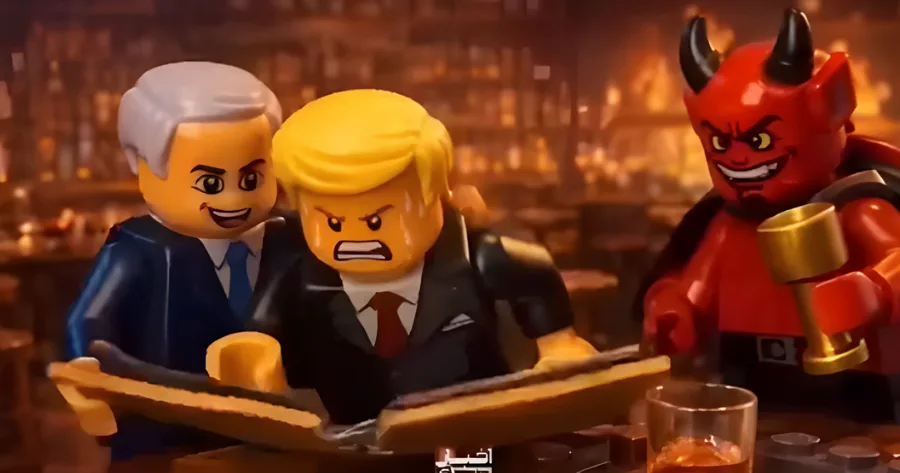
Iran has launched a wave of propaganda targeting President Donald Trump using AI-generated videos styled like Lego animations. It may sound absurd, but the strategy is calculated, modern, and potentially effective.
The Rise of “Lego Warfare”
As tensions escalate between the United States and Iran, both sides are not just exchanging threats and military action—they are competing for global attention.
Iran, in particular, has embraced a new form of digital propaganda that blends:
- AI-generated visuals
- Meme culture
- Pop entertainment formats
- Political messaging
Among the most striking examples are animated videos that resemble Lego-style cartoons.
These videos depict exaggerated scenarios involving Trump, U.S. military actions, and Israeli leadership. Some portray fictional battlefield victories. Others mock Trump directly, casting him in satirical or controversial narratives.
At first glance, it feels unserious.
That is exactly why it works.
Why Lego?
The choice of Lego-style visuals is not random.
It taps into something universal: familiarity and disarming simplicity.
Dan Butler, a political science professor, explained the logic clearly:
“The same reason it works in education is the reason actors would use it for propaganda: people like Legos and will tune in to watch Lego-based films.”
More importantly, the format lowers resistance.
“In fact if something is violent, using Legos might make people lower their defenses and also be more likely to share the material.”
That is the key.
Traditional propaganda often triggers skepticism. This does the opposite.
It entertains first. Then it delivers the message.
A Direct Hit at Trump
Iran’s messaging is not broad or vague. It is highly targeted.
President Trump is the central figure in much of this content, with videos and posts designed to:
- Undermine his leadership
- Highlight controversies
- Connect war decisions to domestic criticism
Iranian officials and state-linked media are amplifying these messages across global platforms like Facebook and X, ensuring they reach Western audiences.
According to propaganda expert Nancy Snow:
“What we’re seeing is not just a war of weapons, but it’s also a war of aesthetics. Whoever controls the meme controls the mood.”
That line explains everything.
This is not about convincing everyone. It is about shaping perception at scale.
The U.S. Fights Back—With Its Own Meme Strategy
The Trump administration has responded in kind, leaning into digital content that blends military messaging with internet culture.
Official accounts have shared:
- High-energy videos mixing real strike footage with sports and gaming clips
- Fast-cut highlight reels showcasing military operations
- Content designed to capture attention quickly and spread widely
The tone is clear: dominance, speed, and spectacle.
But not everyone is on board.
Critics, including former military officials, argue that this kind of content risks trivializing a conflict that has real human costs.
Still, the administration is doubling down.
A White House spokesperson said:
“The legacy media wants us to apologize for highlighting the United States Military’s incredible success, but the White House will continue showcasing the many examples of Iran’s ballistic missiles, production facilities, and dreams of owning a nuclear weapon being destroyed in real time.”
And from a reach standpoint, it is working.
Some posts have generated tens of millions of impressions in just days.
The Real Strategy: Attention Equals Power
This is where most people miss the point.
The goal of this content is not traditional persuasion. It is dominance of the attention economy.
According to Roger Stahl, modern propaganda is less structured and more chaotic by design.
“I don’t see any message discipline. I think they are all over the place,” he said. “Instead we get a series of memes.”
But in 2026, that is not a weakness.
That is the strategy.
Flood the zone. Capture attention. Shape perception.
Why Investors Should Care
It is easy to dismiss this as noise.
That would be a mistake.
This type of information warfare is already bleeding into financial markets.
1. Narrative Is Moving Markets
Iranian officials have begun directly commenting on stock market behavior, suggesting that political messaging itself can be used as a trading signal.
That is a major shift.
When geopolitical actors openly discuss markets, it introduces a new layer of volatility driven by narrative, not fundamentals.
2. Oil Prices Are Reacting in Real Time
The conflict has already contributed to rising oil prices, as traders react to:
- Supply risk
- Regional instability
- Escalation fears
Any viral moment, headline, or perceived shift in momentum can trigger immediate moves.
3. Social Media Is Accelerating Volatility
Platforms like X are now central to how information spreads.
That means:
- News travels faster
- Reactions happen instantly
- Algorithms amplify the most engaging content
And what is more engaging than a viral Lego-style war video?
4. Noise Is Becoming the Biggest Risk
The biggest danger for investors is not the conflict itself.
It is the distortion of reality.
When both sides are actively pushing content designed to influence perception, it becomes harder to:
- Identify what is real
- Gauge actual risk
- Make rational decisions
That is where mistakes happen.
The Bigger Shift: War Has Entered the Content Era
What we are seeing is not just a one-off tactic.
It is a preview of the future.
Warfare is evolving into something that looks more like:
- Viral marketing
- Entertainment content
- Algorithm-driven influence campaigns
Iran’s Lego-style propaganda may seem strange today.
In a few years, it may be standard.
Because in a world where attention drives everything—from elections to markets—the side that controls the narrative has a real advantage.
What to Watch Next
If this conflict continues, expect:
- More AI-generated propaganda
- Increased use of humor and entertainment formats
- Direct messaging aimed at Western audiences
- Greater crossover between geopolitics and market behavior
And most importantly, expect volatility driven not just by events—but by how those events are presented.
Because in this new kind of war, perception is no longer secondary.
It is the battlefield.
About Author