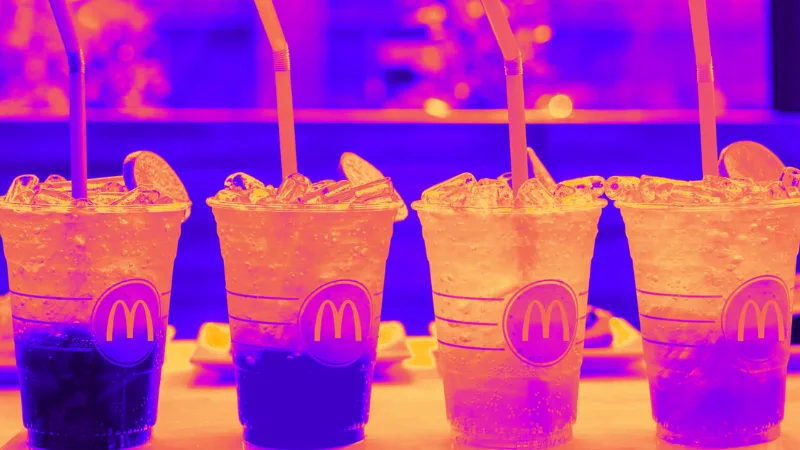
McDonald’s is making a move that, on the surface, looks like a simple menu update. In reality, it could be one of the most important strategic shifts the company has made in years.
The fast food giant is preparing to roll out energy drinks, customizable “dirty sodas,” and fruit-based refreshers across U.S. locations. While that might sound like a trend-chasing experiment, the bigger story is what this signals about where McDonald’s sees its next phase of growth coming from.
This is not about drinks. It is about traffic, margins, and long-term positioning in one of the most profitable categories in food service.
For investors watching McDonald’s (MCD), this move deserves a closer look.
What McDonald’s Is Actually Rolling Out
The new beverage lineup includes:
- Energy drinks, including combinations built around popular brands like Red Bull
- “Dirty sodas,” which are traditional soft drinks customized with syrups, cream, and flavor add-ons
- Refreshers with fruit flavors designed to compete with offerings from coffee chains
These products are not being introduced blindly. They come out of extensive testing through McDonald’s beverage-focused concept brand, CosMc’s, where the company experimented with high-margin, customizable drinks in a more flexible format.
Those tests reportedly exceeded internal expectations. Now, McDonald’s is taking what worked and scaling it into its core business.
Why McDonald’s Is Entering the Beverage Arms Race
This move is best understood as a response to three major shifts in consumer behavior and competition.
1. The Beverage Category Is Massive and Profitable
Drinks are one of the highest-margin items in the restaurant industry. While food requires more labor, preparation, and inventory management, beverages offer a simpler path to profit.
For McDonald’s, even a modest increase in beverage sales mix can have an outsized impact on margins.
This is especially important at a time when input costs and wage pressures continue to challenge restaurant operators.
2. Consumer Habits Are Changing
Consumers are increasingly looking for smaller, more frequent indulgences throughout the day.
Instead of just breakfast, lunch, and dinner, there is growing demand for:
- Mid-morning pick-me-ups
- Afternoon energy boosts
- Low-commitment “treat” purchases
These are exactly the occasions that energy drinks and customized sodas are designed to capture.
McDonald’s is not just adding products. It is trying to create new reasons for customers to visit outside traditional meal times.
3. Competitors Are Already Winning in This Space
Chains like Starbucks and Dutch Bros have built entire growth models around beverages.
They benefit from:
- High repeat purchase behavior
- Strong pricing power through customization
- Loyal customer bases driven by daily habits
McDonald’s has largely stayed out of this category beyond coffee. Now it is stepping in with scale and operational efficiency on its side.
The Real Strategy: Traffic + Margins
This is where most coverage misses the point.
The beverage push is not just about selling drinks. It is about strengthening two of the most important drivers of McDonald’s business.
1. Increasing Customer Frequency
McDonald’s core business is still built around meal occasions. That limits how often customers visit.
Beverages change that dynamic.
They create new occasions:
- A quick stop during the afternoon slump
- A standalone drink purchase without food
- A low-cost treat that feels discretionary but affordable
If McDonald’s can capture even a fraction of these incremental visits, it can meaningfully increase same-store sales.
2. Expanding Margins
Beverages are significantly more profitable than food items.
That means:
- Higher profit per transaction
- Better overall restaurant-level economics
- Stronger franchisee incentives to push these products
Even small changes in the mix can improve margins across the system.
How This Fits Into McDonald’s Bigger Growth Playbook
To understand the importance of this move, you need to see how it fits into the broader strategy.
McDonald’s is currently driven by four key levers:
Pricing Power
The company has raised prices aggressively over the past few years, helping protect margins during inflation. But there are limits to how far that can go before consumers push back.
Traffic
This is the most important metric to watch. If customer visits decline, pricing alone cannot carry the business.
Digital and Loyalty
McDonald’s app and rewards ecosystem are quietly becoming one of its biggest advantages, driving repeat visits and personalized promotions.
Beverage Expansion
This is the newest lever, designed to support both traffic and margins without over-relying on price increases.
Together, these form a coordinated strategy:
- Digital brings customers in
- Beverages increase visit frequency
- Pricing supports margins
- Scale amplifies everything
The Risks Investors Should Not Ignore
For all the upside potential, this strategy is not without risks.
Operational Complexity
McDonald’s is built on speed and consistency. Adding customizable drinks introduces complexity.
If preparation times increase or service slows down, it could hurt the overall customer experience.
Execution Risk
Competing in the beverage space is not easy. Brands like Starbucks and Dutch Bros have spent years refining their offerings and customer experience.
McDonald’s will need to execute at a high level to win share.
Consumer Weakness
The biggest risk is not the drinks themselves. It is the consumer.
If lower-income customers pull back spending:
- Traffic declines
- Pricing power weakens
- Incremental strategies like beverages may not be enough to offset the slowdown
This is the scenario that would put real pressure on the stock.
What This Means for McDonald’s Stock
From an investor standpoint, this development should be viewed in context.
Short Term
This will not materially move the stock on its own. It is still early, and there are no meaningful financial results tied to it yet.
Medium to Long Term
If the beverage strategy scales successfully, it could:
- Increase same-store sales through higher traffic
- Improve margins through better product mix
- Strengthen McDonald’s competitive positioning
That combination has the potential to support higher valuation over time.
Bull vs. Bear Case for MCD
Bull Case
- Traffic stabilizes or grows
- Beverage rollout drives incremental visits
- Digital and loyalty continue gaining traction
- Margins remain strong
In this scenario, McDonald’s maintains its premium valuation and sees steady upside.
Bear Case
- Consumers pull back spending
- Traffic declines accelerate
- Pricing power fades
- Beverage initiative fails to gain traction
In this case, the stock could see meaningful downside as the “defensive growth” narrative weakens.
Base Case
The most likely outcome is somewhere in between:
- Modest traffic growth
- Incremental gains from beverages
- Slower pricing increases
This would likely result in steady but unspectacular stock performance.
The Bottom Line
McDonald’s move into energy drinks and craft sodas may look like a small menu tweak, but it is part of a much larger strategy.
The company is trying to evolve from a meal-based business into a more frequent, habit-driven destination.
If it works, the upside is not just in selling more drinks. It is in:
- Increasing how often customers visit
- Improving profitability across the system
- Expanding into a faster-growing category
For investors, the key question is not whether these drinks are popular.
It is whether they meaningfully change customer behavior.
If they do, this could become one of the more important growth drivers for McDonald’s over the next several years.
If they do not, the company will still be what it has always been: a highly efficient, globally dominant fast food chain, but one facing the same growth challenges as the rest of the industry.
Either way, this is a development worth watching closely.
About Author