Michael Burry, the investor immortalized in The Big Short for calling the 2008 housing collapse, has officially deregistered his investment firm, Scion Asset Management. The update appeared in the Securities and Exchange Commission database showing Scion’s registration status as “terminated” on November 10, marking a significant shift for one of the most closely watched contrarian investors in modern markets.
The move has fueled intense speculation among traders, analysts, and fans of Burry’s unconventional style.
Scion Deregistration and What It Means
Deregistering with the SEC suggests that Scion Asset Management is no longer required to file regulatory disclosures, including its well known Form 13F reports. These quarterly filings offered a rare window into Burry’s portfolio and often triggered huge market reactions, especially when he made large short bets or accumulated concentrated long positions.
Scion managed roughly 155 million dollars in assets as of March. While small compared to large institutional funds, the firm’s positions have always attracted outsize attention because of Burry’s history of spotting distortions in housing, tech stocks, and more recently, the artificial intelligence boom.
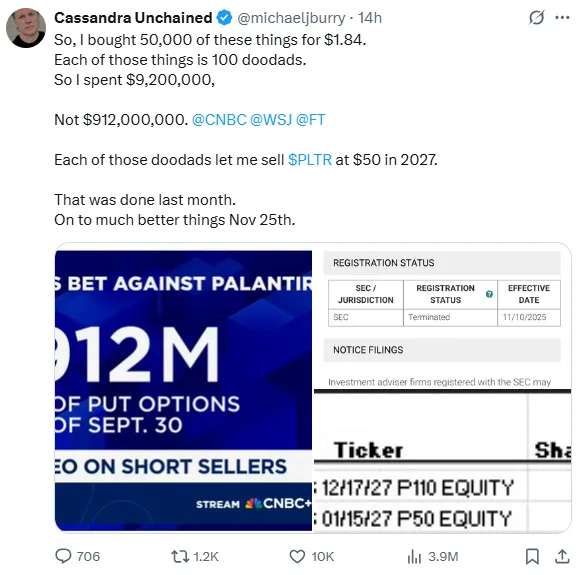
On social media platform X, Burry hinted at a coming shift, writing, “On to much better things Nov 25th.” Scion did not respond to a Reuters request for comment.
Burry’s Recent Battles With the Tech and AI Titans
In the months leading up to Scion’s deregistration, Michael Burry has been vocal about what he sees as growing excesses in the technology sector. He has targeted Nvidia, Palantir, and other companies at the center of the AI explosion, arguing that the sector is becoming detached from real underlying profitability.
Burry believes major tech companies are inflating their earnings by extending depreciation schedules on costly data center hardware. As Microsoft, Google, Oracle, and Meta pour billions into Nvidia powered infrastructure, Burry has suggested that reported profits are being buoyed by creative accounting. He estimated that between 2026 and 2028, depreciation could be understated by roughly 176 billion dollars, creating a smoother but misleading earnings picture.
Bruno Schneller, managing director at Erlen Capital Management, said the market should not assume Burry is stepping away entirely. “Burry’s decision feels less like ‘calling it quits’ and more like stepping away from a game he believes is fundamentally rigged.”
He added that a private structure may serve Burry better. “Do not count him out, just expect him to operate off the grid for a while. He may simply pivot to a family office setup and run his own capital.”
Why Deregister Now
Investment advisers with more than 100 million dollars under management are required to register with the SEC. Moving below that threshold or reorganizing into a smaller, private investment operation would free Burry from federal reporting requirements. For someone who prefers privacy and unconventional strategies, that freedom may be the point.
The change also comes at a moment when the market is tough on short sellers, a group Burry is often associated with. Technology stocks have surged on AI enthusiasm, speculative momentum, and a retail trading base that dismisses bearish warnings.
Short Sellers Face a Hostile Market
Michael Burry is not the only prominent bear reconsidering how to operate in today’s environment. Short sellers have struggled as bullish sentiment has overwhelmed fundamental analysis.
Hindenburg Research closed earlier this year despite high profile investigations into companies like India’s Adani Group and US based Nikola. Veteran short seller Jim Chanos, famous for exposing Enron, has also run into opposition and intense criticism. Chanos recently clashed with Michael Saylor over the valuation of Strategy, Saylor’s bitcoin focused company.
Like Burry, many in this cohort have found that skepticism has gone out of style in a market driven by enthusiasm for AI, crypto, passive investing, and constant inflows into mega cap tech.
A Look Back at Burry’s Legacy
Burry’s most famous trade, his short position against subprime mortgage securities in the mid 2000s, became the centerpiece of Michael Lewis’s book The Big Short and the Academy Award winning film of the same name. His knack for identifying structural flaws has since created a cult following among investors seeking clues from his public moves.
His profile on X carries the title “Cassandra Unchained,” a reference to the Greek mythological figure cursed with the ability to predict the future but doomed to have no one believe her. Fans see this as a reflection of Burry’s worldview and tendency to warn of risks long before they become obvious to the broader market.
What Comes Next for Michael Burry
Burry’s cryptic “Nov 25th” message suggests he has immediate plans beyond Scion’s public structure. Whether those plans involve a new investment vehicle, a family office, a private strategy shielded from public filings, or something completely different remains to be seen.
What is clear is that interest in Michael Burry is not fading. If anything, his decision to take Scion Asset Management off the grid has amplified curiosity about his next move.
For investors trying to understand the direction of markets, Burry’s actions continue to carry more weight than most. His track record demands that his decisions are taken seriously, even if he decides to operate more quietly from here.
About Author