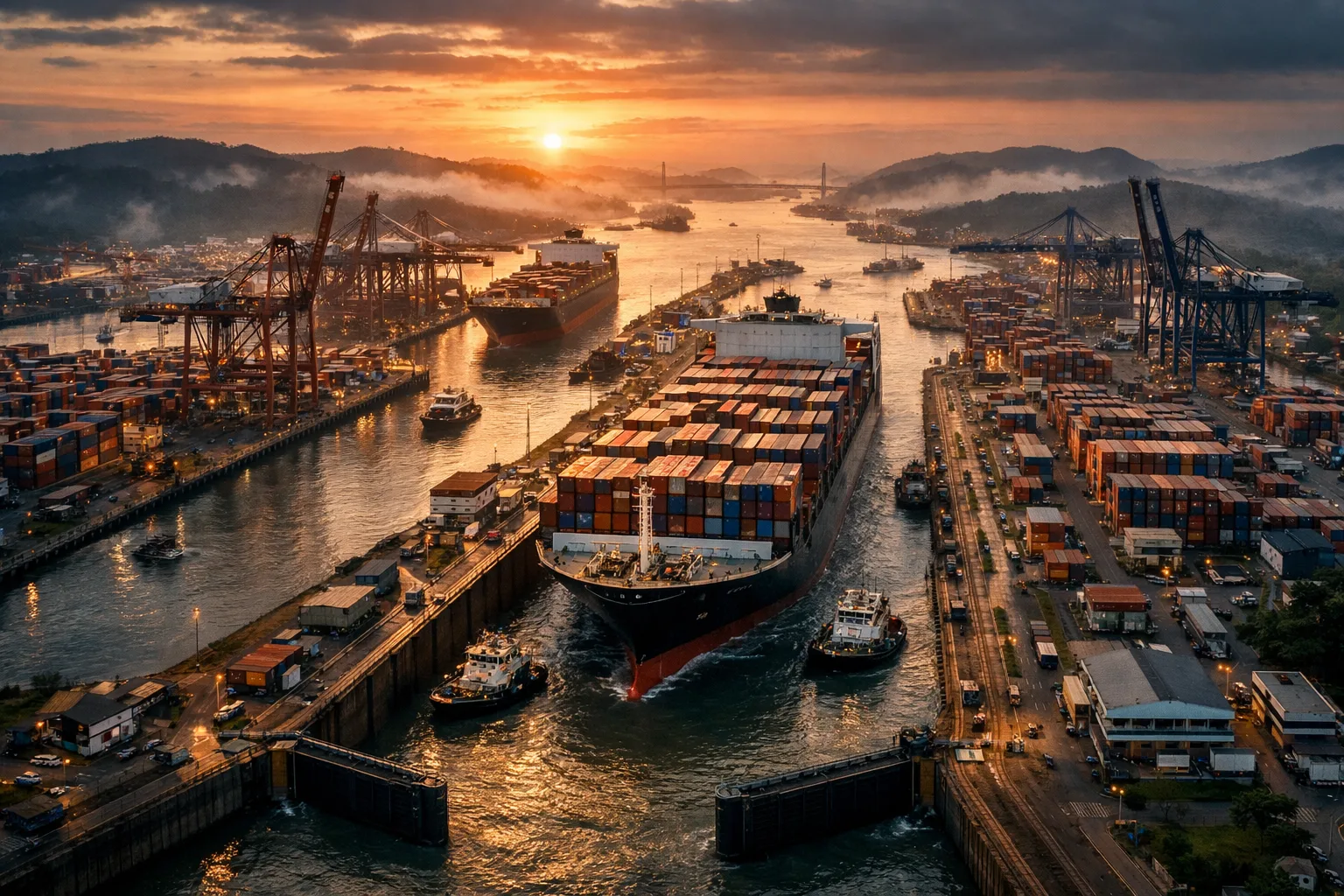
The Panamanian government officially canceled a long-standing port concession held by Hong Kong-based CK Hutchison and seized control of two strategic ports located at the entrances to the Panama Canal. The move does not affect ownership or operation of the canal itself, but it changes who controls critical logistics infrastructure surrounding one of the most important trade chokepoints in the world.
This decision is not just about ports. It reflects a growing global struggle over supply chains, strategic infrastructure, and influence between the United States and China. The consequences will ripple across shipping, markets, and international investment for years.
What Actually Happened
Panama seized control of the Balboa port on the Pacific side and the Cristóbal port on the Atlantic side after the country’s Supreme Court ruled that the long-standing concession held by CK Hutchison was unconstitutional. The Hong Kong-based company had operated the ports since the late 1990s, but a court decision invalidated both the original concession and a later extension, stripping the company of its legal authority to operate the terminals.
The government authorized its maritime authority to take control of all assets within the ports, including cranes, vehicles, and operational systems, citing urgent national interest. CK Hutchison was forced to halt operations and criticized the move as unlawful, initiating arbitration proceedings against Panama.
Despite the dramatic takeover, Panama made clear that canal operations continue normally. The ports are separate from the canal itself, which remains under the Panama Canal Authority.
Who Runs the Ports Now
To avoid disruption to global trade, Panama installed temporary operators while it prepares a new long-term concession.
Operational control has been transferred to:
- APM Terminals, part of Danish shipping giant Maersk
- Terminal Investment Limited (TIL), linked to Mediterranean Shipping Company (MSC)
This transition is expected to last up to 18 months while Panama designs a new concession process. The government described the takeover as a legal step to maintain continuity rather than expropriation.
The immediate goal is stability. However, the long-term objective appears to be reducing China-linked control over strategic infrastructure near the canal.
Why This Matters Globally
The Panama Canal carries roughly five percent of global maritime trade, making it one of the most important shipping routes in the world. Control over surrounding logistics infrastructure carries enormous strategic value.
This decision shifts the balance of influence in several ways:
1. Strategic Infrastructure Shift
The transfer of port operations away from a China-linked company toward Western-aligned operators changes control over a critical trade gateway. It signals that ports are no longer just commercial assets but geopolitical ones.
2. U.S. vs China Competition
The ruling came amid rising pressure from the United States to curb Chinese influence around the canal. The move is widely seen as part of a broader geopolitical realignment in the Western Hemisphere.
3. Legal and Investment Risk
A decades-long concession being canceled sends a strong signal to infrastructure investors worldwide that political and legal risk must be priced into long-term global port deals.
China’s Reaction and Escalation Risk
China responded sharply. Officials warned they would protect the rights of the affected company and criticized the ruling for undermining contract stability and international trade norms.
More importantly, China reportedly instructed state firms to halt talks on new projects in Panama and reconsider investment exposure. This could jeopardize billions in infrastructure and development financing.
Possible escalation scenarios include:
- Slower Chinese investment in Panama and Latin America
- Trade and logistics pressure through regulatory or commercial tools
- Extended legal battles through international arbitration
This is not a short-term conflict. It is part of a longer strategic competition over global supply chains.
Impact on Global Trade and Shipping
Short-Term Impact
Shipping disruption appears limited for now. Panama ensured a rapid transition to maintain operations, and both Maersk and MSC have the operational capacity to manage the ports.
However, forced handovers, staff removal, and system transitions always create some operational friction, which could produce temporary delays.
Medium-Term Impact
The bigger shift is structural. The canal ecosystem is moving toward Western-aligned operators, potentially reshaping logistics flows and shipping alliances.
Long-Term Impact
Global shipping is increasingly shaped by geopolitics. Strategic chokepoints like the Panama Canal, Suez Canal, and key ports are becoming instruments of national influence rather than purely commercial assets.
Market and Investment Implications
This event is not an immediate market shock, but it has deep implications for investors.
Infrastructure Risk Premium Rising
The cancellation of a decades-long concession increases perceived political risk in global infrastructure investments, especially in emerging markets.
Shipping and Logistics Winners
Maersk and MSC gain strategic positioning by temporarily managing key canal terminals. Strong performance during this period could lead to long-term advantages.
CK Hutchison Faces Major Loss
The Hong Kong conglomerate loses operational control and faces legal and financial uncertainty, including arbitration and potential asset impairment.
BlackRock and Global Port Deal Fallout
The seized ports were tied to a broader global port sale involving a consortium that included BlackRock and MSC. Political complications could impact valuation and deal certainty across global port assets.
Broader Geopolitical Realignment
This move fits into a larger shift in Panama’s strategic direction. The country has been distancing itself from China’s Belt and Road Initiative while strengthening alignment with Western partners.
The Panama Canal is no longer just a trade route. It is a geopolitical asset at the center of global power competition.
What Investors Should Watch Next
- Arbitration outcomes between CK Hutchison and Panama
- Whether China escalates economically or diplomatically
- The structure and transparency of Panama’s new port concession
- Long-term positioning of Maersk and MSC in global shipping networks
- Impact on global infrastructure deal confidence
This story is far from over. The next phase will determine whether this was a contained legal decision or the beginning of a larger geopolitical and economic shift.
Sources
- https://apnews.com/article/110af98b3782a08c242ecb5edb512614
- https://apnews.com/article/a1aa9ad15afed0233c85dbaa24b3fece
- https://www.reuters.com/business/autos-transportation/panama-officially-scraps-ck-hutchison-contracts-handing-canal-ports-maersk-2026-02-23/
- https://www.ft.com/content/a2a97a04-b8bd-4088-8f58-ac17adb9bf85
- https://www.aljazeera.com/news/2026/1/30/panama-court-rules-chinese-control-of-canal-ports-unconstitutional
- https://www.aljazeera.com/news/2026/1/31/shipping-giant-maersk-to-take-over-panama-canal-ports-after-court-ruling
- https://www.reuters.com/world/asia-pacific/china-said-halt-panama-deals-after-ports-operation-nulled-bloomberg-news-reports-2026-02-05/
- https://finance.yahoo.com/news/china-halts-panama-project-talks-134102783.html
About Author