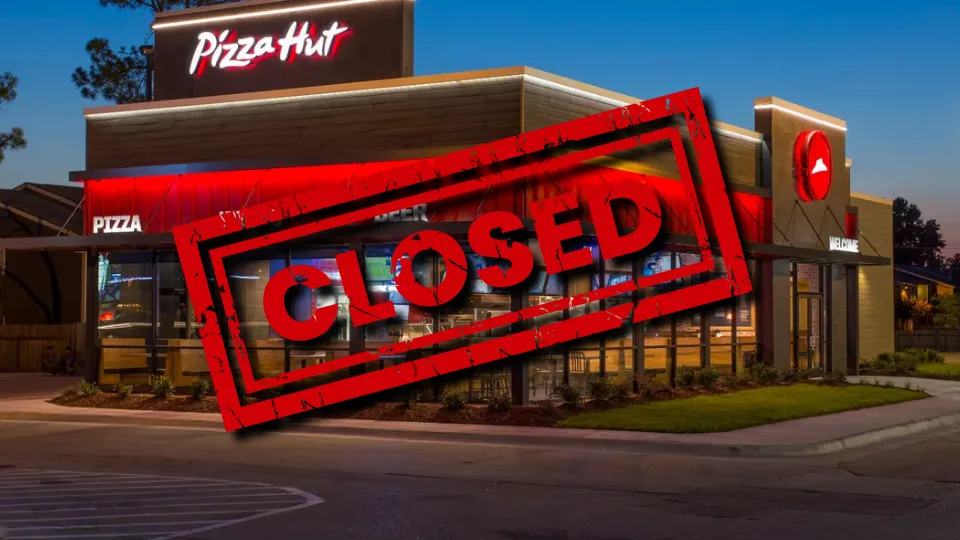
Pizza Hut is preparing to shut down roughly 250 underperforming locations across the United States during the first half of 2026 as its parent company, Yum! Brands, pushes forward with a broader turnaround strategy aimed at reviving the struggling pizza chain.
The closures are part of a long-term restructuring effort called “Hut Forward,” which focuses on marketing upgrades, digital transformation, and franchise modernization. Company leadership says the move is designed to strengthen the brand rather than signal its decline. But the decision also highlights deeper challenges facing one of the most recognizable names in fast food.
Why Pizza Hut Is Closing Locations
During a February earnings call, Yum! Brands leadership explained that the closures are tied to an ongoing performance review of the brand and its franchise system. Chief Financial Officer Ranjith Roy emphasized that the company is working closely with franchise operators to improve both short-term sales and long-term competitiveness.
“While we don’t share specific details of franchise agreements, we are pleased to be working in partnership with our franchisees on increased efforts to deliver near-term sales while advancing long-term strategy,” the company said in a statement.
The locations being shut down represent a small portion of Pizza Hut’s roughly 20,000 global restaurants. However, the closures are concentrated in weaker markets where declining traffic and shifting consumer habits have pressured profitability.
Sales Declines Trigger Strategic Review
Pizza Hut’s struggles did not emerge overnight. The brand has faced slowing sales growth for several years as competition intensified and consumer preferences shifted toward delivery-focused and fast-casual concepts.
In the fourth quarter of 2025, Pizza Hut’s same-store sales in the United States fell 3 percent. That contrasted sharply with stronger performance at Yum! Brands’ other major chains, including Taco Bell, which reported a 7 percent increase during the same period.
Earlier in 2025, Pizza Hut’s U.S. sales had dropped even more sharply, prompting Yum! Brands to begin a formal review of strategic options for the brand. That review includes the possibility of spinning off or selling Pizza Hut entirely.
Yum! Brands CEO Chris Turner acknowledged the need for stronger action, stating that Pizza Hut’s performance shows “the need to take additional action to help the brand realize its full value.”
The Real Challenge Facing Pizza Hut
The issue is not just store performance. The broader pizza market has changed dramatically over the past decade.
Consumers increasingly prefer digital ordering, delivery-only formats, and convenience-driven dining. Competitors such as Domino’s invested heavily in technology and delivery logistics, giving them a major advantage in speed, efficiency, and customer experience.
Pizza Hut, historically known for dine-in locations and family-style service, has struggled to fully adapt to this shift. Many of the locations being closed are older, dine-in heavy stores that no longer match current consumer demand.
The Hut Forward strategy is intended to modernize the brand by:
- Upgrading digital ordering and loyalty systems
- Increasing marketing effectiveness and brand positioning
- Improving franchise profitability
- Shifting toward more delivery and carryout-focused formats
Restaurant Industry Closures Are Rising in 2026
Pizza Hut is not alone. Several major restaurant chains have also announced closures in early 2026 as companies prioritize efficiency and profitability over rapid expansion.
Among them:
- Noodles & Company plans to close 30 to 35 underperforming locations
- Red Robin continues reviewing weaker restaurants for potential shutdowns
- Wendy’s has signaled ongoing evaluation of low-performing stores
These moves reflect a broader trend across the restaurant industry. Rising labor costs, inflation, shifting consumer behavior, and the growing dominance of digital ordering are forcing chains to restructure.
Companies are increasingly focusing on fewer, stronger locations rather than maintaining large networks of marginally profitable stores.
Technology and Delivery Are Reshaping Fast Food
One of the biggest forces behind Pizza Hut’s restructuring is the digital transformation of the restaurant industry.
Today, a growing percentage of fast food orders are placed through apps, websites, or third-party delivery platforms. Brands that invested early in technology have gained significant market share, while slower adopters are now racing to catch up.
Pizza Hut’s modernization effort includes:
- Improved mobile and online ordering systems
- Faster delivery logistics
- Data-driven marketing campaigns
- Enhanced loyalty and personalization programs
These investments are critical for long-term survival in a market where convenience and speed dominate consumer choice.
Could Pizza Hut Be Sold?
Yum! Brands has not ruled out a potential sale or spin-off of Pizza Hut. The company launched a strategic review in late 2025 to evaluate the brand’s future, including whether it might perform better as a standalone business.
While no final decision has been announced, analysts believe several outcomes are possible:
- Continued restructuring under Yum! Brands
- Partial sale of international or domestic operations
- Full spin-off or divestiture
- Strategic partnership with a private equity buyer
Any move would depend on whether the Hut Forward strategy successfully stabilizes sales and improves franchise economics.
What This Means for Investors
From an investor perspective, the closures are not necessarily negative. In many cases, shutting underperforming locations improves overall margins and strengthens long-term profitability.
Yum! Brands has historically delivered strong shareholder returns, largely driven by Taco Bell’s growth and its franchise-heavy business model. The restructuring at Pizza Hut could unlock additional value if the brand stabilizes or becomes a viable divestiture candidate.
Investors should watch:
- Same-store sales trends at Pizza Hut in upcoming quarters
- Franchise profitability and store-level margins
- Progress of digital and delivery initiatives
- Any updates on strategic review outcomes
- Relative performance of Taco Bell and KFC
If Pizza Hut’s turnaround gains traction, it could remove a drag on Yum! Brands’ overall performance and potentially boost shareholder value.
The Bottom Line
Pizza Hut’s decision to close 250 locations in 2026 is part of a broader effort to reposition the brand for a rapidly changing restaurant landscape. The closures reflect shifting consumer behavior, rising operational costs, and increasing competition in the digital-first food market.
While the move highlights ongoing challenges, it also represents a strategic attempt to strengthen the business rather than abandon it. The success or failure of the Hut Forward transformation will likely determine whether Pizza Hut can regain momentum or eventually be sold.
For now, the closures mark another sign that the restaurant industry is entering a new phase where efficiency, technology, and adaptability matter more than size alone.
About Author