OpenAI CEO Sam Altman found himself in damage-control mode this week after comments from his chief financial officer, Sarah Friar, sparked a wave of headlines suggesting the company wanted the U.S. government to backstop its massive data-center expansion.
Friar’s remark — made at a financial event earlier this month — referenced the possibility of government loan guarantees to support domestic chip and infrastructure projects.
That single word — “backstop” — lit up social media, raising fears that the world’s most hyped AI company might be quietly positioning itself for taxpayer support.
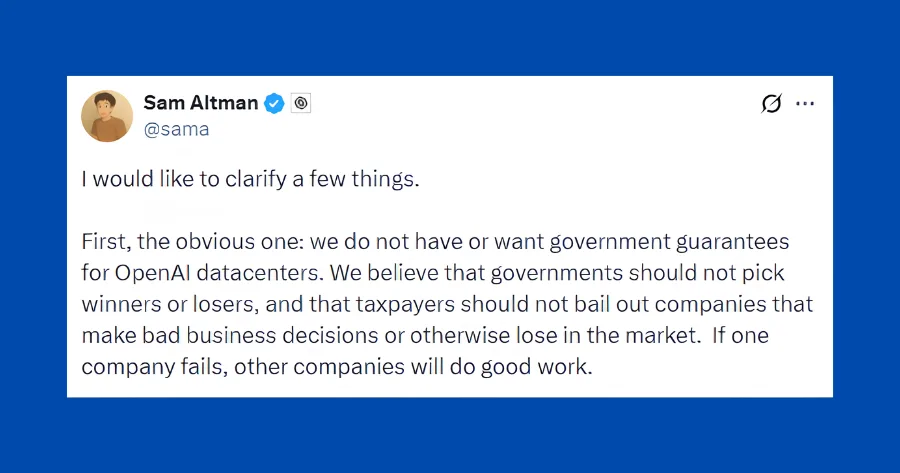
Altman responded publicly, saying:
“We do not have or want government guarantees for OpenAI datacenters. Taxpayers should not bail out companies that make bad business decisions or otherwise lose in the market.”
— Sam Altman, via SCMP
Friar later clarified her statement, admitting:
“OpenAI is not seeking a government backstop for our infrastructure commitments. I used the word ‘backstop,’ and it muddied the point.”
— Sarah Friar, via Quartz
$1.4 Trillion and Counting
The controversy stems from OpenAI’s jaw-dropping infrastructure ambitions.
According to Reuters, Altman and his team are planning a $1.4 trillion build-out over the next eight years — an effort to secure roughly 30 gigawatts of computing capacity.
That’s comparable to building the energy infrastructure of an entire industrial nation.
This isn’t just about bigger servers. OpenAI’s next phase involves:
- Constructing AI-specific data centers that consume more power than entire cities.
- Partnering with chipmakers like Nvidia (NVDA), AMD (AMD), and Broadcom (AVGO).
- Negotiating power-purchase agreements (PPAs) to ensure long-term electricity access.
- Possibly launching an “AI Cloud” platform to sell compute power directly to enterprises.
In short: OpenAI is no longer a software company. It’s evolving into a capital-intensive infrastructure operator — a shift that changes the investment calculus completely.
What Altman Actually Meant
Altman’s X post wasn’t just a denial — it was a repositioning.
He emphasized that OpenAI does not want a government safety net for its data centers, but also said that governments building and owning their own AI infrastructure could make sense.
That’s a subtle but crucial distinction.
If governments finance and own AI data centers — as Altman suggests — companies like OpenAI could lease or share access rather than bear the full cost of ownership.
That’s effectively a “public utility” model for compute power.
It also signals a possible shift in profit dynamics: private firms might earn less on infrastructure, but face less balance-sheet risk. It’s a win-win narrative Altman likely hopes will calm investors without triggering anti-corporate backlash in Washington.
Washington Says “No Bailouts”
Adding to the intrigue, David Sacks, now serving as an informal AI and crypto advisor to President Trump, made the administration’s stance clear:
“There will be no federal bailout for AI. The U.S. has at least five major frontier model companies. If one fails, others will take its place.”
— David Sacks, via TechCrunch
That’s a firm line in the sand — no backstops, no guarantees, no “too big to fail” protection for the AI sector.
Still, Washington could indirectly support the build-out by funding domestic chip plants, fast-tracking energy projects, or offering tax credits to data center operators. So while Altman may reject direct guarantees, the ecosystem could still benefit from federal tailwinds.
Who Wins, Who Loses
The infrastructure scale here puts traditional tech investing in new territory.
Potential Winners
- Chipmakers and Foundries: Nvidia, AMD, TSMC, and Broadcom could see sustained demand from OpenAI and its rivals.
- Cloud & Data Center Operators: Microsoft, Amazon, and Oracle benefit from capacity partnerships.
- Energy Infrastructure: Power suppliers, utilities, and PPA facilitators stand to gain as AI compute becomes the new oil.
Potential Losers
- Pure Software Players: Without tangible infrastructure, firms built solely on AI APIs could see margin compression.
- Over-Leveraged AI Startups: Rising cost of compute could squeeze companies without access to power or chips.
- Governments Without Policy Alignment: Regions slow to approve AI infrastructure could fall behind in the next industrial revolution.
Why Altman’s Post Matters
This isn’t just PR cleanup. Altman’s statement marks a defining moment in the AI sector’s evolution:
- AI companies are morphing into energy and infrastructure players.
- The era of “free money” and speculative AI valuations is ending — real assets, power, and regulation now matter.
- The U.S. government wants AI to scale but without moral hazard — no bailouts, no guarantees.
For investors, that means the smart money will chase suppliers, not speculators.
Those who bet on power, chips, and infrastructure capacity — not just hype — are positioned for real gains.
The Takeaway
Altman’s clarification might calm political optics, but it highlights the true risk and opportunity ahead:
AI is no longer a lightweight software play. It’s a trillion-dollar industrial build-out, dependent on compute, chips, and power.
If OpenAI succeeds, it becomes the Nvidia of infrastructure — a core provider of the next digital utility.
If it stumbles, it’ll serve as a cautionary tale that AI innovation doesn’t erase the laws of capital.
About Author