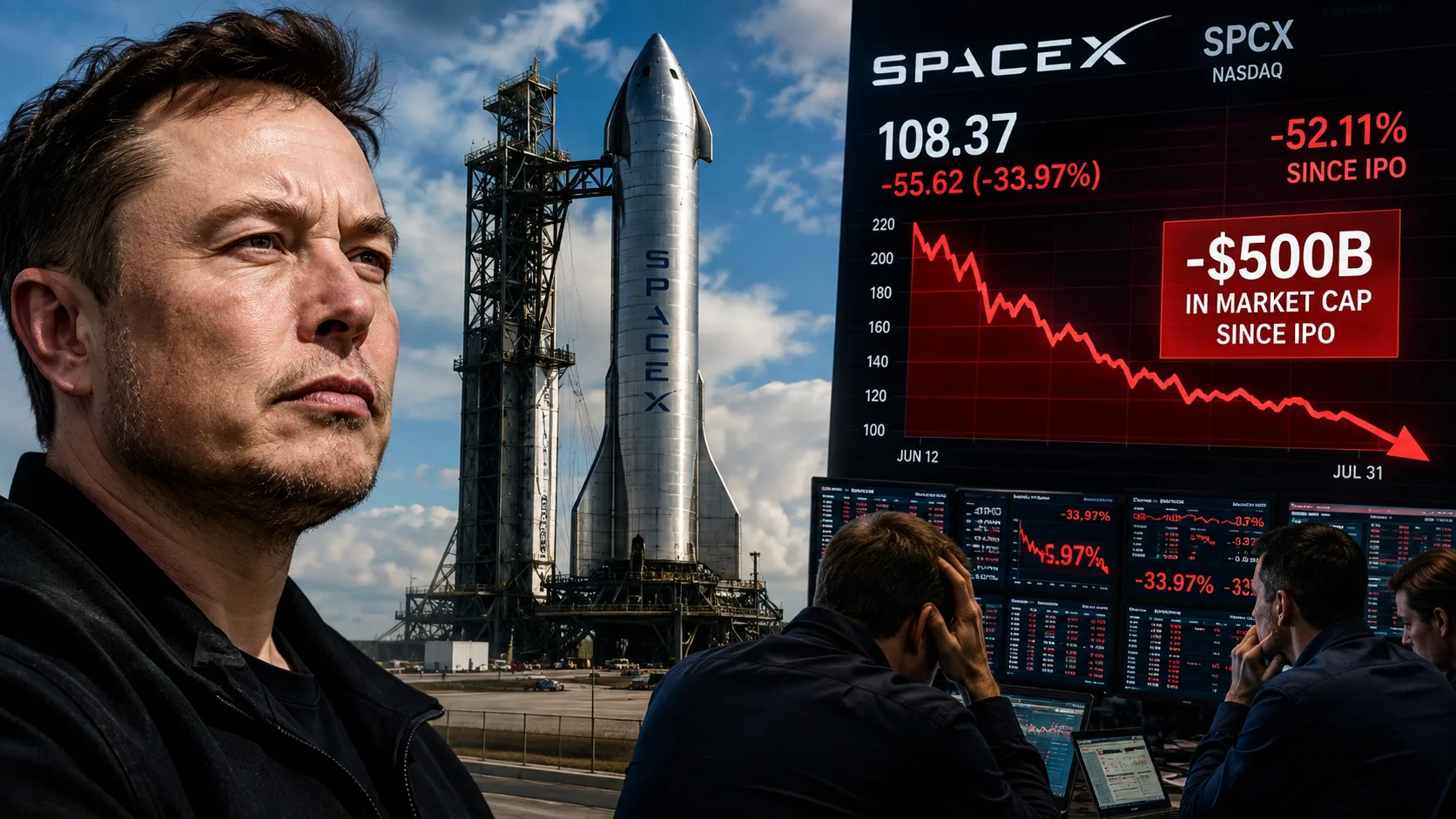
SpaceX’s highly anticipated stock market debut was supposed to be one of the defining investment stories of 2026. Instead, it has become one of Wall Street’s biggest disappointments.
Since beginning trading on June 12, SpaceX (NASDAQ: SPCX) has lost more than $500 billion in market value, with shares falling over 50% from their post-IPO high. The decline has erased hundreds of billions in shareholder wealth and left many retail investors wondering whether they bought into Elon Musk’s next great company… or the next great bubble.
Now all eyes turn to Tuesday afternoon, when SpaceX reports earnings as a public company for the first time.
The results could become one of the most closely watched earnings releases of the year.
A $1.4 Trillion Company With Sky-High Expectations
Unlike established technology giants, SpaceX isn’t being valued on today’s profits.
It’s being valued on what investors believe it could become.
At roughly $1.4 trillion, SpaceX trades at an estimated price-to-sales ratio in the 70s, while continuing to burn billions of dollars each quarter and carrying significantly more debt than cash.
That’s because investors aren’t simply buying a satellite company.
They’re buying Elon Musk’s vision.
That vision includes:
- Massive orbital AI data centers
- A dominant satellite internet business through Starlink
- Artificial intelligence services competing with OpenAI, Google and Anthropic
- Eventually sending humans to Mars
It’s one of the most ambitious corporate roadmaps ever presented to public investors.
The question is whether Wall Street is willing to keep paying for promises.
Tesla’s Earnings Didn’t Help Confidence
Investor nerves have only intensified after Musk’s recent appearance on Tesla’s earnings call.
Tesla shares fell sharply following disappointing results that featured:
- Rising operating costs
- Negative free cash flow
- A cautious outlook for Robotaxi expansion
That disappointing performance has increased scrutiny surrounding every Musk-led company.
Now investors want proof that SpaceX’s enormous valuation can eventually be supported by real financial performance.
The Biggest Risk May Arrive After Earnings
Tuesday’s report isn’t the only concern.
Another major overhang is approaching.
Rolling IPO lock-up restrictions are expected to begin expiring within days, allowing early investors and insiders their first opportunity to sell shares.
If significant selling emerges, additional pressure could hit a stock that’s already fallen more than 50%.
Meanwhile, short sellers have been some of Wall Street’s biggest winners.
According to S3 Partners, bearish investors have generated approximately $8.3 billion in paper profits betting against SpaceX since its IPO.
One analyst described it as one of the fastest bearish buildups ever seen in a newly public mega-cap stock.
Everything Comes Back to Starship
If there’s one technology that could ultimately justify SpaceX’s valuation, it’s Starship.
The next-generation fully reusable rocket sits at the center of virtually every long-term growth forecast.
If successful, Starship could dramatically lower launch costs while enabling:
- Faster Starlink satellite deployment
- Larger orbital AI infrastructure
- Expanded government and defense contracts
- Commercial space tourism
- Future Mars missions
Even SpaceX acknowledged the importance of Starship in its IPO filing.
The company warned investors that failure to achieve rapid reusability could result in:
- Higher launch costs
- Slower revenue growth
- Increased capital requirements
- Damage to the company’s competitive position
The stakes could hardly be higher.
AI Has Become Just as Important as Rockets
While SpaceX built its reputation in aerospace, investors increasingly see it as an artificial intelligence company.
Following its merger with xAI, the company has been aggressively expanding AI infrastructure.
Recent developments include:
- A $920 million-per-month AI compute agreement with Google
- Hosting compute capacity for Anthropic
- Additional infrastructure agreements with Reflection AI
- A planned $60 billion acquisition of AI coding startup Cursor
- Expansion of Grok AI, including major U.S. Defense Department contracts
Those hosted-compute agreements have created an entirely new revenue stream that many analysts believe could become one of SpaceX’s fastest-growing businesses.
However, AI expansion also comes with enormous capital requirements.
Investors will likely focus on:
- Future data center spending
- Semiconductor availability
- AI profitability
- Infrastructure expansion timelines
- Capital funding needs
Wall Street Remains Surprisingly Bullish
Despite the brutal selloff, many analysts continue recommending the stock.
Several firms argue that the recent decline reflects excessive pessimism rather than deteriorating fundamentals.
Current analyst targets include:
| Firm | Price Target |
|---|---|
| Bernstein | $239 |
| Cantor | $246 |
| New Street Research | $165 |
With shares recently closing near $108, those targets imply substantial upside if management can restore investor confidence.
Most analysts say quarterly revenue itself matters less than management’s long-term outlook.
What Investors Will Be Watching Tuesday
SpaceX’s first earnings report is expected to answer several critical questions:
- Is Starship still on schedule for commercial deployment?
- How quickly is AI revenue growing?
- Are hosted-compute agreements becoming meaningful profit drivers?
- How much cash is the company burning?
- Will management address upcoming insider share sales?
- Can Musk convince investors that today’s valuation remains justified?
Given how dramatically expectations have shifted since the IPO, management’s guidance may ultimately matter more than the numbers themselves.
The Takeaway
SpaceX has gone from Wall Street’s hottest IPO to one of its biggest post-offering disappointments in less than two months.
Yet history shows early IPO struggles don’t always define great companies. Meta (then Facebook) lost more than half its value after going public in 2012 before eventually becoming one of the market’s biggest winners.
Whether SpaceX follows that path depends on one thing: convincing investors that its massive ambitions in reusable rockets, satellite communications, and artificial intelligence can translate into sustainable profits.
Tuesday’s earnings report may not settle that debate, but it could determine whether investors view the recent collapse as the beginning of a much larger problem—or a rare opportunity to buy one of the market’s most ambitious companies at a steep discount.
About Author