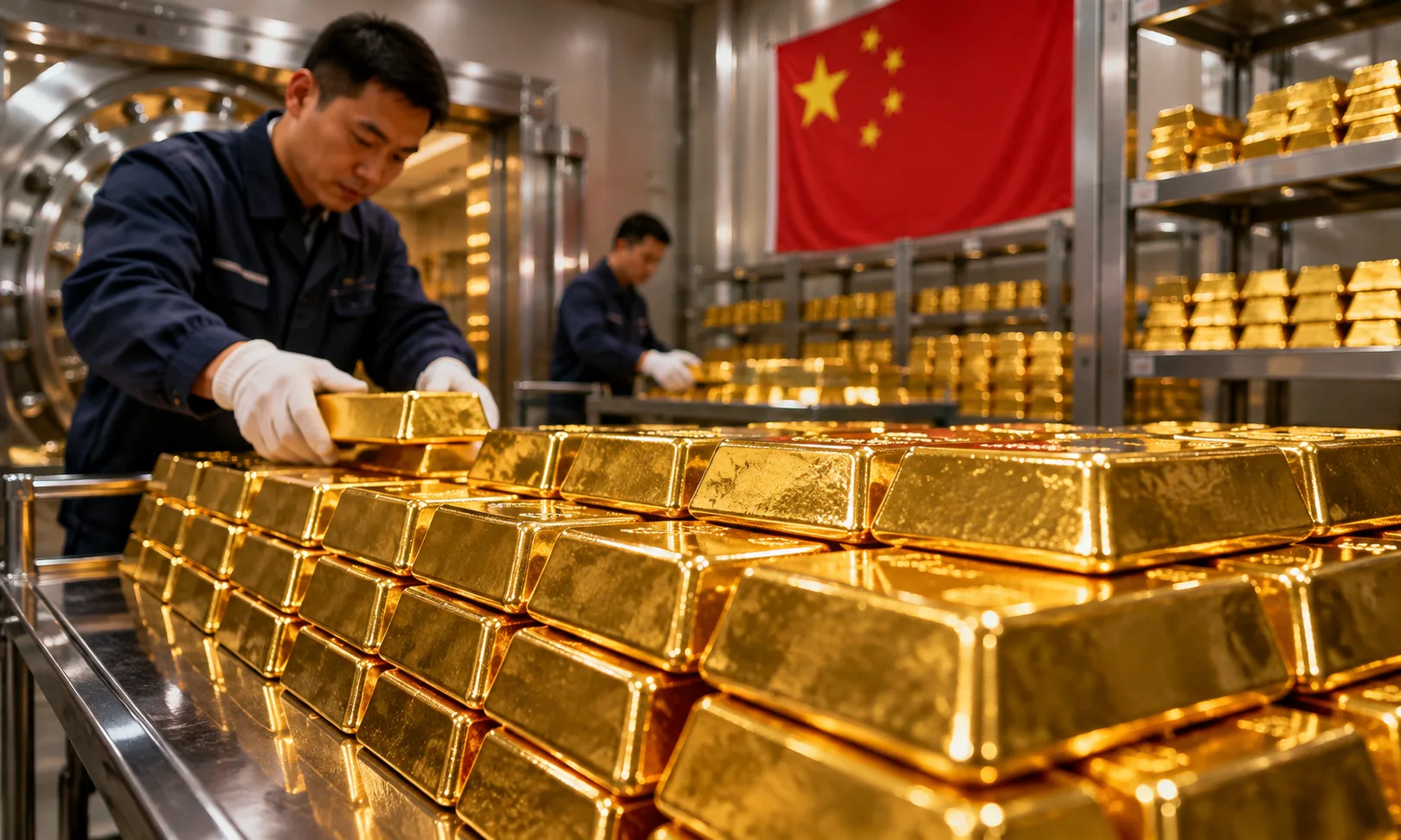
Gold has already stunned investors with one of the strongest rallies in decades. According to Deutsche Bank, the move may not be over.
Despite gold pulling back roughly 5% so far this year, Deutsche Bank strategist Michael Hsueh believes the precious metal remains in what he calls an “explosive price behavior” phase and is maintaining his year-end price target of $4,600 per ounce.
With gold recently trading around $4,118, that implies roughly 12% upside from current levels.
Gold’s Rally May Just Be Catching Its Breath
After more than doubling over the past two years, some investors have questioned whether gold’s historic run has finally peaked.
Deutsche Bank isn’t convinced.
Hsueh argues that the powerful advance that began in August 2024 has not yet fully played out. While short-term volatility has shaken out some bullish sentiment, his research suggests the broader uptrend remains intact.
According to the bank, there are increasing reasons to believe gold may have already established its low for 2026.
Why Deutsche Bank Still Expects Higher Prices
Hsueh examined gold using three different valuation approaches.
The first compared gold’s long-term inflation-adjusted growth rate with other major commodities including oil, copper, and even bread.
By that measure alone, gold appears significantly overvalued, implying a price closer to $2,600 per ounce.
However, Deutsche Bank says that traditional comparison fails to capture periods when markets enter speculative or momentum-driven phases.
A Bubble Model Suggests Gold Could Have Gone Much Higher
Hsueh also applied a statistical model commonly used by economists to identify speculative bubbles, known as the Backward Supremum Augmented Dickey-Fuller (BSADF) test.
Using that framework, the model suggests:
- Gold’s speculative peak could have reached $6,400 per ounce
- The likely correction bottom would have been approximately $3,700
Since gold has remained above that projected floor, Deutsche Bank believes the recent weakness looks more like a normal consolidation than the beginning of a prolonged bear market.
Fair Value Points To Nearly $4,700
Perhaps the most important part of Deutsche Bank’s analysis is its broader valuation model.
Rather than relying solely on historical commodity prices, the model incorporates several macroeconomic variables, including:
- S&P 500 performance
- U.S. Treasury yields
- Currency exchange rates
- Central bank gold purchases
Although the bank slightly reduced its fair-value estimate because central banks have slowed their buying, the model still produces a year-end valuation of roughly $4,700 per ounce.
That closely aligns with Deutsche Bank’s standing forecast of $4,600, which the firm left unchanged.
Gold Has Consistently Beaten Inflation
One finding Deutsche Bank believes investors often overlook is gold’s long-term performance.
Looking back to 1957, the bank found gold has delivered an average real (inflation-adjusted) annual return of approximately 2.5% through 2023.
That means gold has historically done more than simply preserve purchasing power. It has actually increased wealth after accounting for inflation over extended periods.
Those returns would be even stronger if the extraordinary rally since 2024 were included.
Why Investors Are Paying Attention
Gold continues to attract interest from investors looking to diversify portfolios amid elevated government debt, persistent geopolitical tensions, central bank policy uncertainty, and concerns about the long-term purchasing power of fiat currencies.
While Deutsche Bank acknowledges gold has become expensive relative to many traditional valuation measures, it believes macroeconomic conditions continue to support higher prices.
The bank’s research suggests that even after one of the biggest rallies in modern history, the precious metal’s longer-term trend may still have room to run.
What Investors Should Watch
Whether gold ultimately reaches Deutsche Bank’s $4,600 target will likely depend on several key factors over the coming months, including interest rate expectations, central bank buying activity, inflation trends, and investor demand for safe-haven assets.
For investors, the takeaway is clear: one of Wall Street’s largest banks believes gold’s remarkable rally may not be finished yet, even after its historic surge over the past two years.
About Author