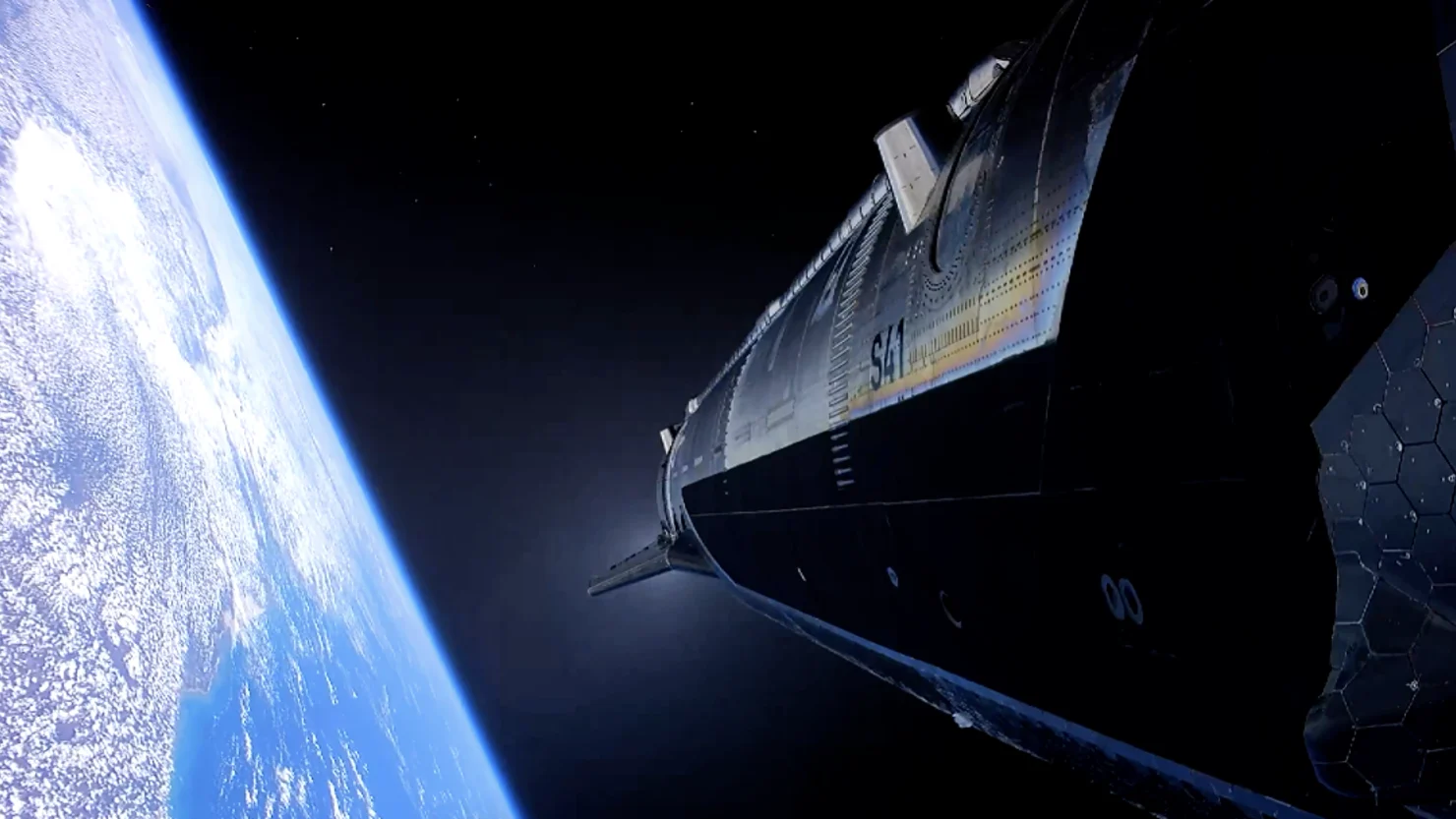
SpaceX has crossed one of the biggest milestones in the history of its Starship program, sending the massive rocket into orbit for the first time and deploying 26 next-generation Starlink satellites along the way.
The successful flight Monday moves Starship beyond experimental launches and closer to becoming a working transportation system capable of dramatically expanding SpaceX’s satellite network, lowering launch costs and eventually supporting everything from lunar missions to data centers in space.
For investors, the most important part of the flight may have been what Starship carried with it.
Starship Finally Reaches Orbit
Starship lifted off from SpaceX’s Starbase facility in Texas at 8:48 a.m. ET Monday on the rocket system’s 14th integrated test flight.
Previous Starship missions had intentionally followed suborbital trajectories. Flight 14 became the first to successfully place the spacecraft into orbit, according to launch tracking services.
SpaceX also successfully deployed 26 Starlink V3 satellites, marking the first time Starship has carried an operational batch of Starlink spacecraft into orbit.
The Super Heavy booster performed a controlled splashdown in the Gulf of Mexico. The Starship portion of the mission was shortened after a vacuum Raptor engine shut down early during ascent, but the spacecraft still reached orbit and deployed its payload.
That makes Monday’s flight an important technical success, although SpaceX still has considerable work ahead before Starship achieves the rapid reusability envisioned by Elon Musk.
The Bigger Story Is Starlink
Getting Starship into orbit matters. Getting Starlink V3 satellites there may matter even more financially.
SpaceX has said each V3 satellite is designed to provide roughly 1 terabit per second of downlink capacity, while a fully utilized Starship could eventually carry as many as 60 V3 satellites at once.
According to SpaceX’s own investor materials, a single Starship loaded with V3 satellites could deploy approximately 20 times as much Starlink downlink capacity as a Falcon 9 launch.
That changes the economics of SpaceX’s satellite business.
Falcon 9 helped SpaceX build Starlink into a massive global constellation. Starship is designed to allow the company to scale that network much faster by putting larger and more powerful satellites into orbit in far greater numbers.
Monday’s 26-satellite deployment is essentially the first real-world demonstration of that strategy.
Why Investors Should Care
Starlink Could Scale Much Faster
Starlink is already one of SpaceX’s most important businesses. Starship potentially removes one of its biggest constraints: how much satellite capacity the company can put into orbit at one time.
Instead of relying primarily on frequent Falcon 9 launches carrying smaller satellites, SpaceX could eventually launch dozens of significantly more capable V3 satellites aboard each Starship.
If SpaceX can establish reliable Starship operations, the company could increase network capacity while potentially reducing the cost of adding each incremental unit of bandwidth.
That matters for subscriber growth, service quality and margins.
SpaceX Is Building More Than a Rocket
Starship is increasingly becoming the infrastructure layer behind several of SpaceX’s largest ambitions.
The company has identified potential uses including Starlink V3 deployments, heavy cargo missions, lunar transportation, AI compute satellites and eventually interplanetary missions.
SpaceX’s website now also explicitly highlights development of orbital AI compute, another potentially enormous market if companies begin moving power-intensive computing infrastructure off Earth.
The common denominator is Starship.
Without a cheap, high-capacity launch system, many of those projects remain economically difficult. A functioning Starship makes them considerably more plausible.
One Successful Flight Doesn’t Solve Everything
Investors should be careful about treating Monday’s mission as proof that the Starship program is finished.
It isn’t.
SpaceX still needs to demonstrate that it can fly Starship repeatedly, recover both stages reliably and eventually reuse them quickly enough to produce the dramatic cost savings the system was designed to deliver.
The early shutdown of a vacuum Raptor engine during Monday’s mission is a reminder that Starship remains a developing system even after reaching orbit.
That distinction matters because reusability may ultimately be more important economically than simply reaching orbit.
SpaceX became dominant in commercial launch partly because Falcon 9 boosters can fly repeatedly. Starship’s long-term economics depend on taking that concept much further.
The Next Milestone Matters Even More
There are now three numbers investors should watch: payload, reuse and cadence.
Payload asks whether Starship can consistently carry large commercial payloads into orbit.
Reuse asks whether SpaceX can recover and rapidly fly the same vehicles again.
Cadence asks whether Starship can eventually launch frequently enough to transform the economics of Starlink and other space-based businesses.
Monday delivered a major win on the first test.
The next phase will determine whether SpaceX can deliver the other two.
The Takeaway
Starship reaching orbit is much bigger than another successful rocket launch.
SpaceX has now demonstrated that its largest launch system can carry operational satellites into orbit, opening the door to a dramatic expansion of Starlink and potentially an entirely new generation of businesses built around cheap access to space.
The biggest question has therefore changed.
For years, it was whether Starship could reach orbit.
Now investors need to watch how quickly SpaceX can turn Starship into a reusable, high-frequency commercial machine.
About Author