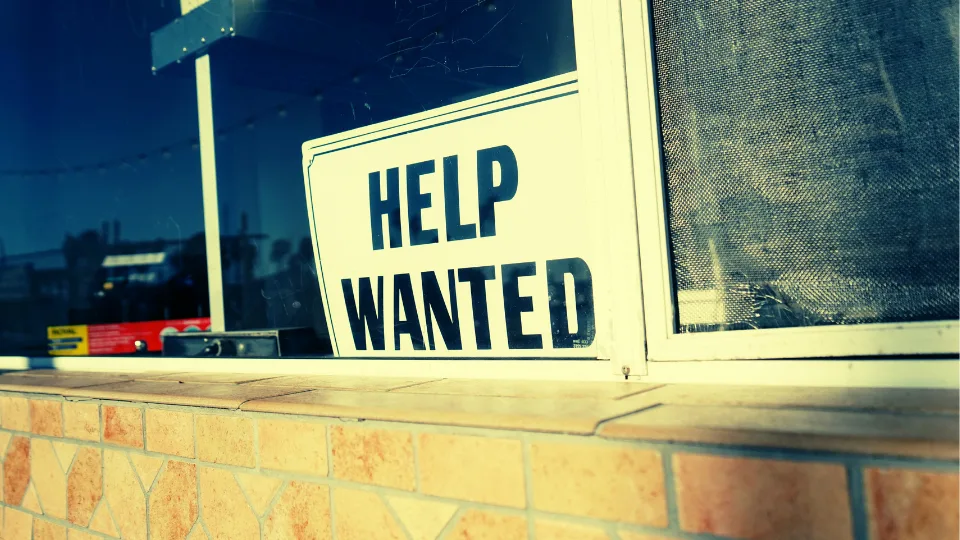
The U.S. labor market has developed an unusual problem: Americans who have jobs are mostly keeping them, while people looking for work are finding fewer places willing to hire.
New government data released Tuesday shows job openings fell to roughly 7.1 million in August while hiring remained subdued. At the same time, layoffs stayed low, creating a labor market that appears stable from the outside but feels increasingly difficult for anyone trying to change jobs or enter the workforce.
And several forces working against hiring, including high interest rates, expensive energy, geopolitical uncertainty and artificial intelligence, could keep that stalemate in place.
The Great American Job Freeze
The Labor Department reported 7.1 million job openings in August, down from a revised 7.3 million in July. Employers hired about 5.2 million workers during the month, while the hiring rate stood at just 3.3%.
Those numbers are a long way from the frantic labor market that followed the pandemic, when openings briefly topped 12 million and companies competed aggressively for workers.
Workers are responding by staying put. About 3.1 million Americans voluntarily quit their jobs in August, leaving the quits rate at 1.9%. That is an important signal because quitting usually rises when workers believe they can easily find something better.
Today, many employees apparently do not have that confidence.
The result is what economists increasingly describe as a low-hire, low-fire economy. Companies are reluctant to expand payrolls, while they also see little reason to conduct widespread layoffs.
Why 4.1% Unemployment Doesn’t Tell the Whole Story
At first glance, there appears to be little reason for concern. The unemployment rate remained at 4.1% in August, while employers added a surprisingly strong 162,000 jobs.
The underlying numbers are less comfortable.
Layoffs and discharges totaled about 1.6 million in August, with the layoff rate at just 1.0%. That helps explain why unemployment remains relatively low. Companies are holding onto existing employees even as they become cautious about adding new ones.
That distinction matters.
A healthy labor market normally has movement. Workers quit for better positions, employers compete for talent, companies expand and new graduates have multiple paths into the workforce.
Much of that churn has disappeared.
For established workers, that can feel relatively secure. For someone who loses a job, wants a raise through job hopping or is graduating from college, the same labor market can feel dramatically worse.
Four Brakes Are Hitting Hiring at Once
There is no single culprit behind the slowdown. Businesses are confronting several uncertainties simultaneously.
Higher energy prices increase transportation, manufacturing and operating costs. The conflict involving Iran has added another layer of uncertainty to oil markets and corporate planning.
Interest rates are another obstacle. The Federal Reserve recently raised rates as renewed inflation pressures complicated the outlook, making borrowing more expensive for businesses and consumers. The Conference Board said consumers increasingly expect interest rates to rise further over the coming year.
Companies facing more expensive capital have less incentive to aggressively expand payrolls, particularly when economic growth is uncertain.
Then there is AI.
Companies are spending heavily on artificial intelligence partly because the technology promises higher productivity. If a business believes software can allow 10 employees to accomplish what previously required 12, the first response does not necessarily have to be layoffs. Management can simply stop filling vacancies.
That may help explain one of the defining characteristics of this economy: technological disruption can reduce hiring long before it produces obvious job losses.
Workers Are Starting to Feel It
Perhaps the most revealing numbers Tuesday came from consumers themselves.
The Conference Board’s Consumer Confidence Index fell 6.7 points in September to 81.9, its lowest level in years. Consumers’ assessment of both current conditions and the future deteriorated during the month.
Only 14% of Americans surveyed expect more jobs to become available over the next six months, down from 14.8% in August. Meanwhile, 28.4% expect fewer jobs to become available.
Views of the current job market weakened as well. Just 23.6% said jobs were plentiful, while 21.9% said they were hard to get. The gap between those two figures has narrowed dramatically.
That matters beyond the labor market.
Consumers worried about employment tend to become more cautious about buying homes, cars, vacations and other discretionary purchases. The Conference Board reported weakening plans for several major purchases and another decline in expected services spending.
A weak hiring market can therefore become a consumer-spending problem even without a surge in unemployment.
The Market’s Awkward Scenario
Ordinarily, weakening employment would increase expectations that the Federal Reserve could cut interest rates.
This time is more complicated.
Oil prices and renewed inflation have pushed the Fed in the opposite direction. Consumers’ average 12-month inflation expectations climbed to 6.1% in September, while 68.4% expect interest rates to increase over the next year.
That creates an uncomfortable combination for markets: slower hiring without easier monetary policy.
For investors, that environment deserves attention. Consumer-facing companies could face softer demand if employment anxiety increases. Highly leveraged businesses remain exposed to elevated borrowing costs. Companies able to increase productivity without significant hiring could have an advantage, especially those successfully deploying automation and AI.
It also places greater importance on earnings quality. Revenue growth produced through genuine demand and productivity becomes more valuable when businesses cannot rely on cheap financing or aggressive workforce expansion.
AI May Change the Recovery Playbook
The most important longer-term question is whether hiring rebounds normally once economic uncertainty fades.
AI makes that assumption less certain.
Historically, companies that became more confident about the economy eventually reopened positions and expanded payrolls. Today, managers have another option: invest in technology and attempt to expand output without expanding headcount at the same pace.
That doesn’t mean AI will eliminate broad categories of employment overnight. It does mean the relationship between economic growth and hiring could gradually change.
A company may grow sales, invest heavily and report healthy profits while hiring far fewer people than it would have a decade ago.
If that becomes widespread, job openings could recover more slowly than investors accustomed to previous economic cycles expect.
Friday Will Test the August Bounce
The next major test comes with Friday’s September employment report.
August produced an unexpectedly strong gain of 162,000 jobs, breaking temporarily from months of weaker employment growth. Yet one strong month does not establish a new trend, particularly when job openings, hiring and quits remain subdued.
Investors should watch three signals together: payroll growth, unemployment and wage growth. Strong payrolls combined with stable unemployment would suggest the labor market still has more resilience than the JOLTS data implies.
A sharp slowdown would reinforce the picture emerging from Tuesday’s report: employers have entered a holding pattern.
The more consequential signal may come from hiring itself. Until businesses begin competing for workers again, a low unemployment rate can hide just how difficult the job market has become.
A Stable Number Can Hide an Unstable Economy
The U.S. labor market isn’t collapsing. That is precisely what makes today’s environment unusual.
Layoffs remain low enough to keep unemployment near 4%, yet job openings, hiring and worker confidence have deteriorated considerably from the post-pandemic boom. Businesses appear willing to keep the employees they already have while remaining reluctant to add many more.
For Wall Street, the risk is that this labor-market freeze lasts longer than expected. High rates, elevated energy costs, geopolitical uncertainty and rapid AI adoption all give companies reasons to postpone hiring.
And until those incentives change, the hardest job in America may increasingly be finding a new one.
About Author