For years, investors could largely ride a handful of mega-cap technology stocks to strong returns. In 2026, that playbook is starting to change.
Market gains are broadening, international stocks are outperforming the S&P 500, and one actively managed fund is taking an unusual approach to capitalize on the shift.
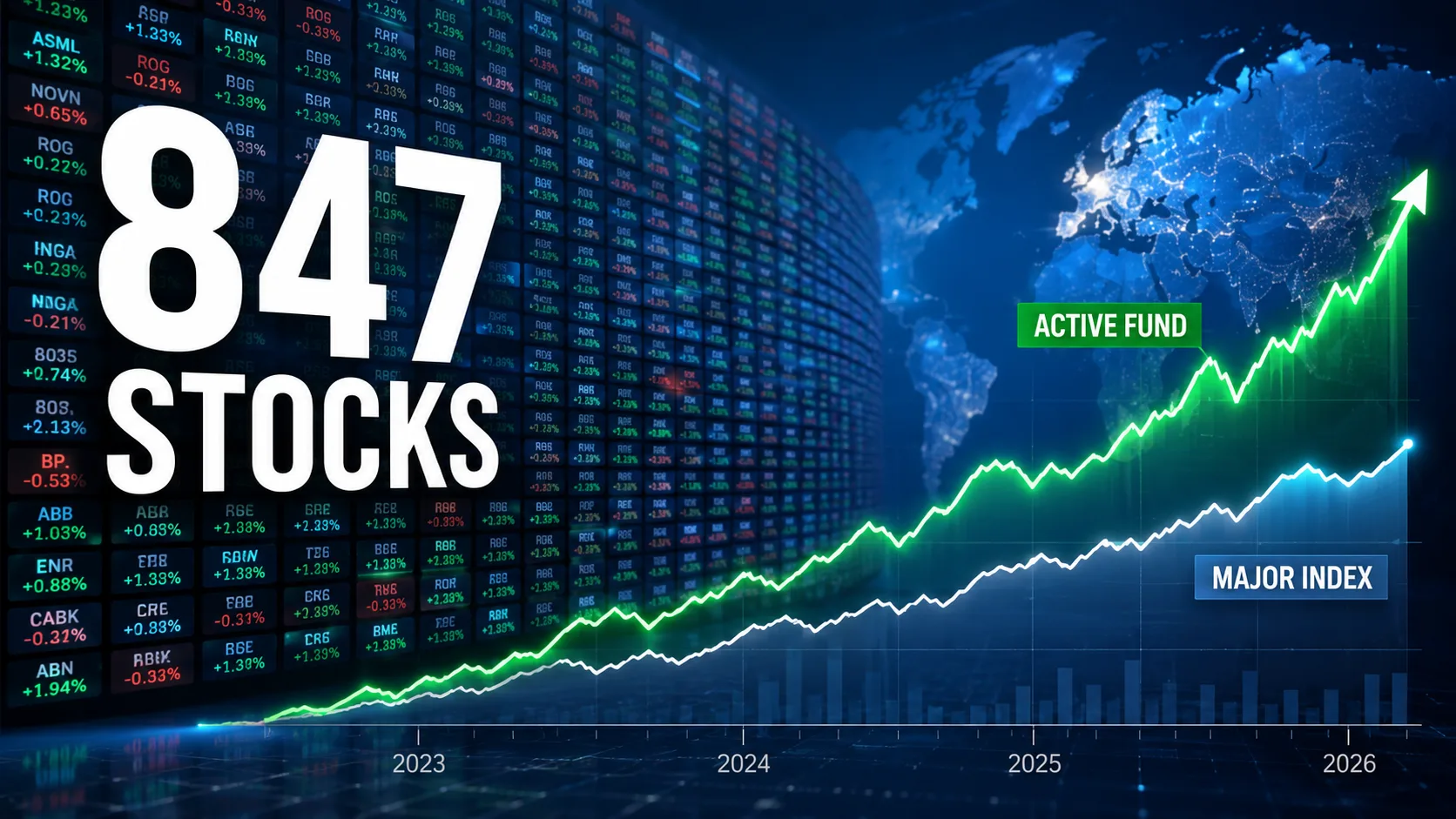
The Harbor International Core Fund (HAOSX) held a staggering 847 stocks as of June 30, nearly eight times the typical number held by comparable international funds.
Yet this isn’t diversification for diversification’s sake. The fund uses a highly active quantitative strategy that analyzes more than 30,000 stocks every day, incorporates machine learning and other AI techniques, and continuously adjusts its portfolio based on factors ranging from valuation and momentum to suppliers, customers and industry relationships.
So far, the strategy has delivered.
Through July 31, the fund’s institutional shares had returned 30.7% over the previous year, compared with 24.7% for the iShares Core MSCI EAFE ETF (IEFA). Its average annual return over three years was an even more impressive 21.9%.
The Market Is Finally Getting Broader
The fund’s performance comes as one of the biggest trends on Wall Street begins to change.
The market-cap-weighted S&P 500 remains heavily influenced by its largest companies, with its 10 biggest stocks accounting for roughly 40% of the index.
But those giants aren’t doing all the work anymore.
The S&P 500 has returned approximately 13.7% this year, while the equal-weighted S&P 500, which gives the index’s companies roughly equal influence, has returned 16.3%, according to FactSet.
The number of individual S&P 500 stocks outperforming the index has also reached a four-year high.
That matters because it suggests investors are finding opportunities beyond the handful of mega-cap companies that dominated returns during the AI-driven market rally.
The trend becomes even more apparent when looking overseas.
International Stocks Are Beating the S&P 500
The MSCI EAFE Index, which tracks developed markets outside the U.S. and Canada, has returned about 15.5% this year, ahead of the S&P 500.
International stocks also remain considerably cheaper.
The iShares Core MSCI EAFE ETF trades at roughly 15.6 times forward earnings, according to LSEG, compared with about 20 times earnings for the SPDR S&P 500 ETF Trust (SPY).
That valuation gap is helping draw attention back to markets that many American investors largely ignored while U.S. technology stocks dominated.
The Harbor International Core Fund is designed specifically to search for opportunities across that much larger universe.
And its portfolio looks nothing like the typical actively managed fund.
Why Does One Fund Own 847 Stocks?
According to Morningstar research covering nearly 3,000 domestic and international mutual funds, the median foreign large-blend fund holds about 109 stocks.
The Harbor International Core Fund held 847 as of June 30.
Its strategy is also unusually active.
Annual portfolio turnover has been approximately 123%, meaning the equivalent of more than the fund’s entire portfolio can change over the course of a year.
For comparison, the median turnover among global large-cap funds was just 28%, according to Morningstar.
The difference comes down to how the fund is managed.
Harbor Capital Advisors partnered with Acadian Asset Management to launch the fund in 2019. Rather than relying primarily on a team of managers selecting a limited number of favorite stocks, Acadian uses a systematic quantitative model to evaluate more than 30,000 companies.
The model examines fundamentals, valuations, stock-price momentum, analyst coverage and other technical and market factors.
It then attempts to identify stocks capable of generating excess returns without taking excessive risk.
“We are not trying to increase returns at the expense of risk,” Harbor Capital Advisors Managing Director Gabriel McNerney told MarketWatch.
AI Is Helping Find Relationships Humans Could Miss
The investment process has also evolved with artificial intelligence.
Acadian has incorporated natural-language processing and machine learning into its analysis, helping its models identify relationships among companies that aren’t always obvious from traditional financial statements.
That can include common suppliers, customers and competitors, as well as companies that frequently appear together inside passive investment funds.
Those connections matter.
A company’s prospects can depend heavily on what is happening elsewhere in its supply chain. Machine learning can potentially identify those relationships across thousands of companies much faster than a human analyst could.
The system also takes macroeconomic and country-specific differences into account.
A bank in India, for example, cannot simply be evaluated using exactly the same assumptions as a bank in China. Different regulatory systems, economies, interest-rate environments and competitive landscapes can dramatically change the outlook.
Acadian’s quantitative system has evolved repeatedly as markets have changed. McNerney said the firm was already on the 41st version of its model.
Hundreds of Small Bets, With Bigger Bets at the Top
Owning more than 800 stocks doesn’t mean every position is tiny.
The fund had roughly 23% of its assets concentrated in its 10 largest holdings as of June 30.
Those represented the managers’ highest-conviction ideas, with pharmaceuticals and banks particularly prominent.
The rest of the portfolio is spread across hundreds of smaller positions.
McNerney described the approach as making “a lot of little bets,” increasing the number of opportunities for the quantitative strategy to generate excess returns while reducing the damage that can come from being wrong about a single company.
Among the fund’s largest positions were:
| Company | Country | Portfolio Weight* |
|---|---|---|
| Novartis | Switzerland | 3.6% |
| Roche Holding | Switzerland | 3.5% |
| ASML Holding | Netherlands | 2.8% |
| ABB | Switzerland | 2.4% |
| ING Groep | Netherlands | 2.3% |
| Siemens Energy | Germany | 1.8% |
| Tokyo Electron | Japan | 1.7% |
| BP | U.K. | 1.7% |
| CaixaBank | Spain | 1.7% |
| ABN Amro Bank | Netherlands | 1.6% |
*Holdings as of June 30 and subject to change.
Novartis was one company McNerney highlighted as scoring strongly across the model’s major factors. He pointed to demographic trends supporting the pharmaceutical industry and the ability of large international drug companies to sell into the lucrative U.S. market.
He also highlighted Dutch banking giant ING.
According to McNerney, investors can buy ING at a cheaper valuation than major American banks such as JPMorgan Chase and Wells Fargo despite ING growing more quickly.
The Performance Has Been Strong
The Harbor International Core Fund’s institutional shares have produced impressive results relative to many international competitors.
Through July 31, the fund generated a 30.7% one-year total return, according to LSEG.
Its average annual returns were:
- 21.9% over three years
- 11.3% over five years
Among 102 mutual funds benchmarked against the MSCI EAFE Index, Harbor ranked eighth for one-year performance, second for three-year performance and 13th for five-year performance, according to LSEG.
For comparison, the iShares Core MSCI EAFE ETF returned 24.7% over one year, with average annual returns of 16.0% over three years and 8.9% over five years.
The iShares MSCI ACWI ex U.S. ETF (ACWX), which also provides broader international exposure, returned 28.5% over one year and averaged 17.1% annually over three years.
Past performance, of course, doesn’t guarantee future results.
There Is a Price for Active Management
Investors considering the fund also have to account for fees.
The institutional shares carry a current net expense ratio of 0.85%, equivalent to about $85 annually for every $10,000 invested.
That’s dramatically higher than the 0.07% expense ratio charged by the iShares Core MSCI EAFE ETF.
The Harbor fund’s full expense ratio is 0.94%, with a temporary 0.09 percentage-point expense reimbursement scheduled to remain in place until at least Feb. 28, 2027.
That means the active strategy needs to generate enough additional performance over time to compensate investors for its higher costs.
Access can also vary because many institutional mutual-fund share classes are distributed through financial advisers, although Harbor’s institutional shares are available through some brokerage platforms. Minimum investment requirements can differ.
A Different Way to Diversify Beyond Big Tech
The Harbor International Core Fund is an unusual example of what active management can look like in an era increasingly dominated by passive investing.
Instead of betting heavily on a small group of stocks, its managers are using quantitative models to spread capital across hundreds of companies while continuously searching for small advantages.
That approach may be particularly relevant now.
U.S. mega-cap technology stocks remain enormously important, but market leadership is expanding. More S&P 500 companies are participating in the rally, international markets are outperforming, and overseas stocks continue to trade at a significant valuation discount to their U.S. counterparts.
For investors who have spent years watching the same handful of American technology giants dominate their portfolios, 2026 is offering a reminder of an old investing principle:
Sometimes the biggest opportunities emerge when the market finally starts looking beyond its biggest stocks.
This article is for informational purposes only and does not constitute investment advice. Fund holdings, performance and expenses can change. Investors should conduct their own research and consider their objectives and risk tolerance before investing.
About Author