President Donald Trump says he is nearing a decision on whether to restart massive attacks against Iran, describing the choice in unusually stark terms as new tanker attacks raise the stakes in the Strait of Hormuz.
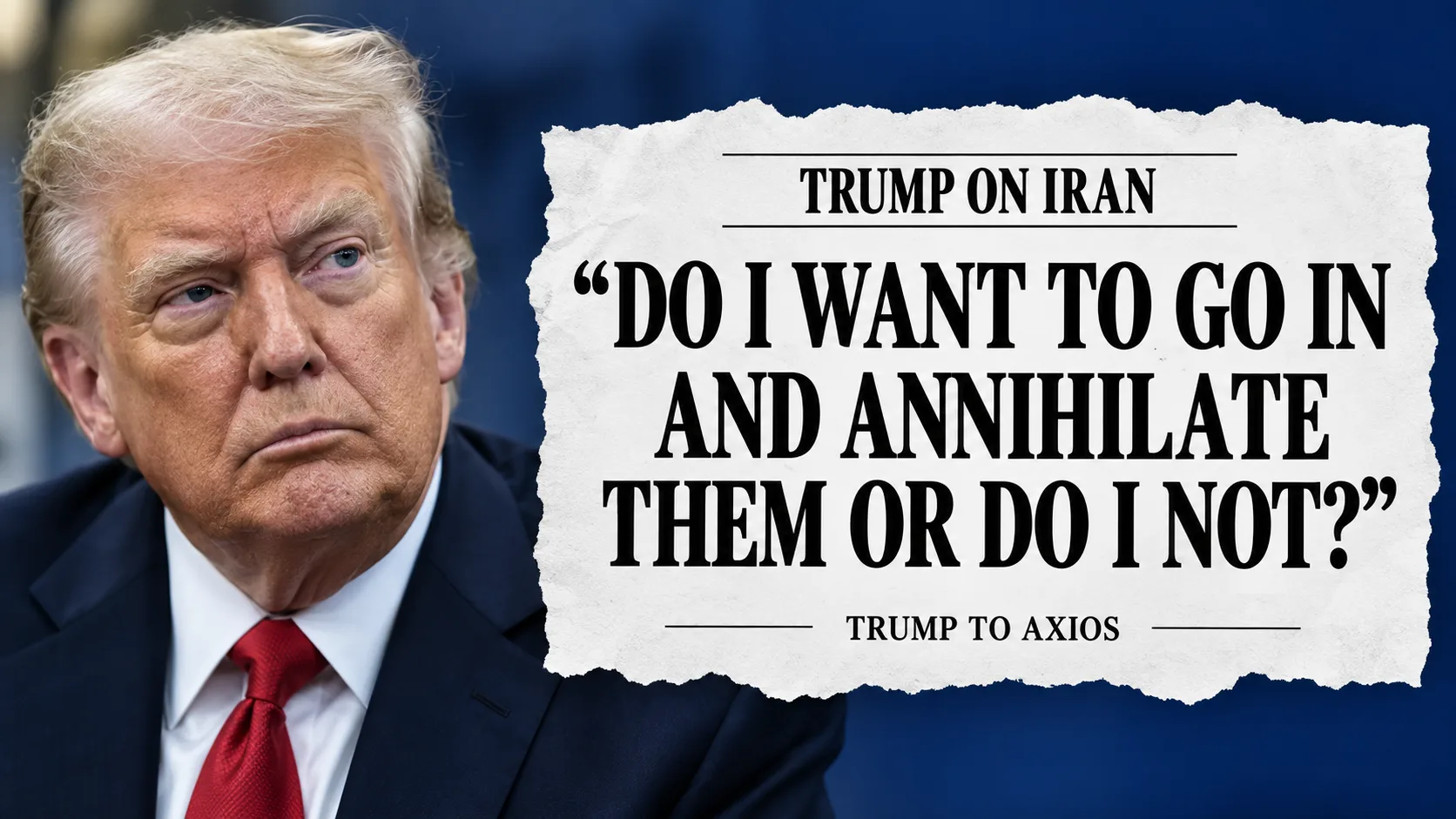
“Do I want to go in and annihilate them or do I not?” Trump told Axios on Thursday. “It’s a big decision.”
The comment does not mean a new offensive has been ordered. It does confirm that the White House is reconsidering the current strategy of sanctions, a naval blockade and limited military action as the war enters its seventh month.
For investors, the decision could affect far more than defense stocks. Another large-scale attack could quickly move oil prices, inflation expectations, interest rates and the cost of transporting goods around the world.
Trump Is Reconsidering the War’s Next Phase
Trump told Axios that he is approaching a critical point in the conflict and could decide whether to resume major combat operations. He is expected to meet Tuesday with leaders from Saudi Arabia, the United Arab Emirates, Qatar, Bahrain, Kuwait and Oman during the United Nations General Assembly in New York.
That meeting could determine whether the United States makes another diplomatic push or intensifies the war. The Gulf countries host American forces, control a large share of the world’s energy supply and would face immediate danger if Iran retaliated against regional military bases or oil infrastructure.
Trump said he wants to hear directly from those leaders before deciding how to proceed. He also left open the possibility of meeting Israeli Prime Minister Benjamin Netanyahu in New York.
The timing matters because the U.S. military cannot remain in its current holding pattern indefinitely. American forces have been ordered to maintain their Middle East presence through the end of the year, according to Axios. That keeps the United States prepared for another offensive, but it also requires money, equipment and personnel without resolving the central conflict.
The Pressure Campaign Has Reached a Stalemate
Trump stepped back from a larger offensive in early August after Saudi Arabia and Qatar expressed concern that Iran could retaliate against oil and gas facilities. The administration instead suspended negotiations, tightened sanctions, continued its naval blockade and focused on reopening the Strait of Hormuz.
That approach has placed enormous pressure on Iran. The White House launched Operation Economic Outcast in August, expanding sanctions across shipping, gold, technology, aviation and digital assets. Trump also says the naval blockade has prevented Iran from exporting oil.
Yet the pressure has not produced a durable agreement or fully restored commercial shipping. Traffic through the Strait of Hormuz remains below prewar levels, and oil prices remain elevated.
The danger became clearer Friday when maritime authorities reported that a tanker had been hit by an unknown projectile in the strait. Iran’s Revolutionary Guard separately claimed that it struck a Togo-flagged ship for making what it called an unauthorized crossing. Authorities also disclosed that another tanker had been struck Wednesday.
The crews were reported safe, and it remains unclear whether every incident was carried out by Iran. The attacks still demonstrate how quickly the conflict can threaten the narrow waterway at the center of the global energy market.
There Is Still a Diplomatic Opening
Trump’s language was severe, but other developments suggest diplomacy has not been abandoned.
The president told Axios that Iran remains in direct contact with the United States and still wants an agreement. His administration has also approved visas for Iranian President Masoud Pezeshkian, Foreign Minister Abbas Araghchi and a limited delegation to attend the United Nations meetings in New York.
The State Department said the visas were issued under America’s obligations as the host country for the United Nations. Iranian officials will face travel and purchasing restrictions, and the delegation will be smaller than last year’s.
Their presence in New York does not guarantee negotiations. It does create an unusual opportunity for communication while senior American, Iranian, Israeli and Gulf officials are in the same city.
That is why Trump’s statement should be read as both a military warning and a negotiating tactic. A public threat can increase pressure on Iran before the United Nations meetings. It can also reassure Gulf allies that the United States is willing to escalate if diplomacy fails.
The uncertainty is intentional. Trump’s additional comment that “anything could happen” makes it harder for Iran and regional governments to know whether he is establishing leverage or preparing the public for a new attack.
Iran Is Showing It Will Resist
Iran answered the pressure Friday with its largest government-organized rally since the war began. State media estimated that more than 300,000 people took part in Tehran, while Iranian officials claimed more than 600,000 people have registered for basic military training.
Those numbers cannot be independently verified, and a state-organized demonstration is not the same as a free measure of public support. The event still served an important purpose for Iran’s leadership. It displayed military equipment, mobilized loyalists and presented the government as capable of resisting additional American attacks.
This creates a risk that another U.S. offensive could strengthen nationalist support for the regime, at least temporarily. Economic pressure may be weakening Iran internally, while an external attack could give its leaders a powerful tool for rallying the population and suppressing dissent.
That does not mean military action would fail. It means the political effect inside Iran may be more complicated than the physical damage to military facilities.
The Biggest Market Risk Still Runs Through Oil
Brent crude remained above $100 a barrel Friday after rising roughly 20% during September. Prices eased as Saudi Arabia worked to restore part of its disrupted supply, but the market continues to carry a large geopolitical premium.
A new American offensive could affect markets through several channels.
Oil and Gasoline
Iran could respond by intensifying attacks on tankers, Gulf production facilities or alternative export routes. Even a limited disruption could send crude prices higher because inventories have already been drawn down and major Middle Eastern producers are operating below normal levels.
The U.S. Energy Information Administration estimated in June that Middle Eastern producers had cut output by more than 11 million barrels per day because of the Hormuz disruption. It also projected that Brent would average $95 in 2026, although prices have recently moved above that forecast.
Higher crude prices eventually flow into gasoline, diesel, jet fuel and shipping costs. That would place additional pressure on household budgets and corporate profit margins.
Inflation and Interest Rates
Energy prices are already complicating the fight against inflation. The Federal Reserve raised interest rates this week for the first time since 2023, while other major central banks have also been responding to war-related price pressure.
Another oil surge could keep rates higher for longer or force additional increases. That would affect bonds, mortgages, credit cards and the valuations of interest-rate-sensitive stocks.
Defense and Transportation
Extended combat would support demand for missiles, air-defense systems, drones, surveillance equipment and replacement munitions. The potential benefits for defense contractors would come with a larger fiscal cost and growing questions about weapons inventories.
Airlines, trucking companies and manufacturers would face the opposite pressure through higher fuel and freight expenses. Companies able to pass those costs to customers would be better positioned than businesses operating with thin margins and fixed prices.
The Threat May Be Part of the Negotiation
The most dramatic interpretation is that Trump is preparing to launch a campaign aimed at destroying Iran’s government. The available evidence does not establish that a final decision has been made.
Trump has issued severe warnings before and then paused military action when allies raised concerns or negotiations appeared possible. This time, he made the threat shortly before meeting Gulf leaders and while Iranian officials are preparing to travel to New York.
That sequence may be deliberate. Trump can use the possibility of overwhelming force to pressure Iran while asking regional allies what level of escalation they are prepared to support.
The strategy carries its own danger. Threats can create leverage only if the other side believes they may be carried out. Once a president publicly raises the possibility of “annihilating” a regime, backing away without obtaining concessions can make future threats less effective.
What Investors Should Watch
Tuesday’s meeting with the six Gulf leaders is the clearest immediate signal. Public support for a tougher approach would make renewed U.S. strikes easier to carry out. Visible resistance from Saudi Arabia, Qatar or the United Arab Emirates would strengthen the case for another diplomatic pause.
The United Nations meetings will provide a second test. Any direct or indirect contact between American and Iranian officials would show that negotiations remain possible despite the public threats.
Shipping through the Strait of Hormuz is the most important real-time market indicator. A sustained increase in tanker attacks, insurance costs or vessel diversions would matter more to oil prices than another round of rhetoric.
Investors should also watch whether the U.S. changes its force posture. New bomber deployments, additional air defenses, evacuation orders or unusual naval movements would provide stronger evidence of impending action than political statements alone.
The Decision Is Bigger Than Iran
Trump has framed the choice as a decision about whether to deliver a potentially decisive blow against Iran’s ruling regime. The consequences would extend far beyond Tehran.
The Gulf states could face retaliation. Oil prices could rise again. Inflation could become harder to control. American military costs would increase, and the United States could move from a prolonged stalemate into a much wider regional conflict.
The threat may still produce negotiations. If it does not, the next phase of the war could be determined in New York next week, with financial markets reacting long before the public knows which direction Trump has chosen.
About Author