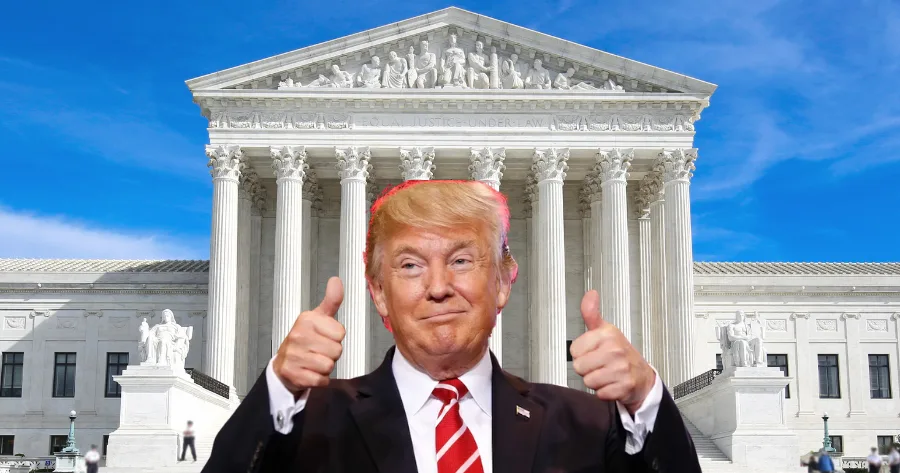
In a move that breaks long-standing presidential norms, Donald Trump made history this week by attending oral arguments at the Supreme Court of the United States. The case centers on one of the most consequential constitutional questions in decades: whether birthright citizenship, as interpreted under the 14th Amendment, can be restricted by executive action.
While the legal battle itself is significant, the broader implications stretch far beyond constitutional law. For investors, this moment touches something deeper: confidence in U.S. institutions, the rule of law, and ultimately the stability of the dollar and financial markets.
A Rare Presidential Presence Inside the Courtroom
Presidents have historically avoided attending Supreme Court proceedings. The reasoning is simple: maintaining a clear separation between the executive and judicial branches reinforces institutional independence.
Trump’s decision to appear in person signals a shift. It underscores how central this case is to his administration’s broader agenda and reflects an increasingly confrontational stance toward the judiciary.
Joining him was Attorney General Pam Bondi, as the Court heard arguments in a case challenging a January 2025 executive order aimed at limiting automatic citizenship.
The order itself never took effect, but the legal challenge has now escalated into a constitutional showdown.
The Core Legal Question: Who Qualifies for Citizenship?
At the heart of the case is a debate over a key phrase in the 14th Amendment: “subject to the jurisdiction thereof.”
The amendment states:
“All persons born or naturalized in the United States, and subject to the jurisdiction thereof, are citizens of the United States.”
The administration argues that this clause allows for a narrower interpretation of citizenship, suggesting that individuals born in the U.S. are not automatically citizens unless they are fully subject to U.S. jurisdiction and allegiance.
Opponents argue that this interpretation contradicts more than a century of legal precedent and constitutional understanding.
During oral arguments, several justices appeared skeptical of the administration’s position. Even Amy Coney Barrett, a Trump appointee, questioned why the authors of the amendment did not explicitly include parental citizenship if that was their intent.
This line of questioning suggests the Court may be reluctant to dramatically reinterpret one of the Constitution’s most established provisions.
Escalating Tensions Between the White House and the Judiciary
This case does not exist in isolation. It is unfolding against a backdrop of growing friction between Trump and the judicial system.
In recent weeks, Trump has publicly criticized court rulings and judges in unusually direct terms. On social media, he described the U.S. court system as “laughingstock” material and accused judges of harming the country through their decisions.
He has also pushed for legislation targeting what he calls “rogue judges,” signaling a willingness to reshape the judicial landscape if given the opportunity.
This escalating rhetoric mirrors earlier tensions between Trump and the Federal Reserve, particularly his criticism of monetary policy leadership.
For investors, this pattern matters.
Why This Case Matters for Markets
At first glance, a constitutional dispute over citizenship might seem disconnected from financial markets. That would be a mistake.
Markets are built on trust. Not just in earnings or economic data, but in institutions.
The strength of the U.S. dollar, the attractiveness of Treasury bonds, and the global dominance of U.S. capital markets all depend on one core assumption: that the United States operates under a stable and predictable rule of law.
If that assumption begins to weaken, the ripple effects can be significant.
1. Confidence in the Rule of Law
Investors rely on courts to enforce contracts, protect property rights, and provide a neutral arbiter in disputes.
When political leaders openly challenge judicial authority, it introduces uncertainty.
Even the perception of instability can lead to higher risk premiums. That means:
- Higher yields on U.S. government debt
- Increased volatility in equity markets
- Potential downward pressure on the U.S. dollar
2. Impact on U.S. Treasuries
U.S. Treasuries are considered the safest assets in the world largely because of institutional credibility.
If investors begin to question the independence of U.S. courts or the durability of constitutional norms, demand for Treasuries could weaken.
That would push yields higher, increasing borrowing costs across the economy.
3. Dollar Dominance at Stake
The U.S. dollar’s status as the world’s reserve currency is not guaranteed. It is earned through stability, transparency, and trust.
Geopolitical rivals have already been exploring alternatives to the dollar in trade and reserves.
Any sign that U.S. institutions are becoming politicized or unstable could accelerate those efforts.
4. Policy Uncertainty and Business Investment
Businesses thrive on predictability.
If legal frameworks around citizenship, immigration, and labor markets become uncertain, companies may delay investment decisions.
That hesitation can slow economic growth and weigh on corporate earnings.
A Pattern Investors Cannot Ignore
This is not the first time markets have had to grapple with institutional tension.
Trump’s previous clashes with the Federal Reserve raised similar concerns about independence and stability.
Now, with the judiciary in focus, investors are once again being forced to evaluate how political dynamics intersect with economic fundamentals.
The key difference this time is the scope.
While monetary policy disputes affect interest rates, challenges to constitutional interpretation strike at the foundation of the legal system itself.
What Happens Next
The Supreme Court’s decision is expected later this year, and it could go in several directions:
- Uphold existing precedent and reaffirm broad birthright citizenship
- Allow limited reinterpretation of the 14th Amendment
- Dismiss the executive authority argument entirely
Each outcome carries different implications for markets, but the broader issue of institutional stability will remain in focus regardless of the ruling.
Investor Takeaways
For investors, this is not about taking sides in a political debate. It is about understanding risk.
Here is what matters:
- Institutional trust is a core driver of market stability
- Political pressure on courts can increase volatility
- Global investors are watching closely for signs of structural change
- U.S. assets still dominate, but that dominance depends on credibility
In the short term, markets may shrug off the headlines.
But over the long term, repeated challenges to institutional norms can reshape how global capital views the United States.
That is where the real risk lies.
About Author