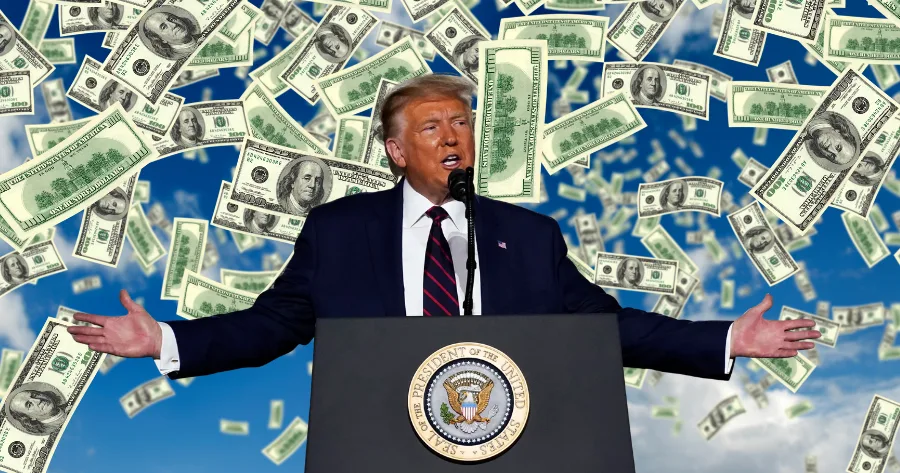
President Donald Trump has sparked a new wave of discussion over a potential $2000 dividend for most Americans. The proposal, which would be funded by revenue from tariffs, could reshape the way the government redistributes trade income and approaches healthcare costs. While the administration insists it is still “brainstorming,” the market implications are already significant.
What the Trump $2000 Dividend Proposal Actually Is
In a series of Truth Social posts over the weekend, President Trump floated the idea of giving Americans direct cash payments. One post read,
“A dividend of at least $2000 a person (not including high income people!) will be paid to everyone.”
He also linked the plan to his broader tariff policy, claiming the U.S. is collecting record sums from international trade.
“We are taking in Trillions of Dollars and will soon begin paying down our ENORMOUS DEBT, $37 Trillion. Record Investment in the USA, plants and factories going up all over the place.”
At the same time, Trump proposed changing how healthcare dollars are distributed, suggesting that funds currently going to insurance companies under the Affordable Care Act should be sent directly to citizens.
“I am recommending to Senate Republicans that the Hundreds of Billions of Dollars currently being sent to money sucking Insurance Companies … BE SENT DIRECTLY TO THE PEOPLE SO THAT THEY CAN PURCHASE THEIR OWN, MUCH BETTER, HEALTHCARE.”
According to Treasury Secretary Scott Bessent, no official legislation has been submitted. He told ABC’s This Week,
“We don’t have a formal proposal. We’re not proposing it to the Senate right now, no.”
The administration has signaled that reopening the government remains the first priority before any such initiative moves forward.
Why Trump Is Talking About It Now
The idea of a Trump $2000 dividend is not entirely new, but the timing matters. The U.S. government is deep in a 41-day shutdown, and economic frustration is growing. By floating direct payments, Trump appears to be appealing to households who feel squeezed by inflation and rising insurance premiums.
This also fits Trump’s political strategy: turning tariffs from a geopolitical tool into a domestic dividend. By doing so, he links his “America First” trade agenda to direct financial benefit for working- and middle-class Americans.
“People that are against Tariffs are FOOLS! We are now the Richest, Most Respected Country In the World, With Almost No Inflation, and A Record Stock Market Price. 401k’s are Highest EVER.”
The statement underscores Trump’s belief that tariffs are not just a negotiation tactic but a revenue source that can strengthen household balance sheets. It’s a bold political message and a potentially market-moving concept if investors start pricing in new consumer-driven stimulus.
What It Means for Everyday Americans
If enacted, the Trump $2000 dividend would represent one of the largest direct cash transfers in U.S. history. For an adult population of roughly 150 million, the total payout could exceed $300 billion. The administration has not yet specified eligibility, though Trump indicated that “high income people” would be excluded.
For now, Treasury officials are emphasizing flexibility. Bessent said the dividend “could come in lots of forms,” noting that it might be tied to existing tax breaks such as the proposed elimination of taxes on tips, overtime, and Social Security benefits.
The challenge is revenue. While Trump claims the government is “taking in trillions” from tariffs, independent estimates put total tariff receipts closer to $90 billion after accounting for offsetting effects on imports and tax collections. That leaves a significant funding gap that could widen the federal deficit if the dividend were enacted without offsetting cuts.
Still, the psychological impact could be powerful. Americans remember the COVID-era stimulus checks that boosted consumer spending and temporarily lifted confidence. Another round of direct payments could generate similar short-term enthusiasm—especially if markets interpret it as a political preview of Trump’s second-term economic vision.
Market Implications for Investors
Even if the Trump $2000 dividend never becomes law, investors should take note of what the proposal signals. It highlights the administration’s willingness to consider unconventional fiscal policy and direct consumer support tied to tariff revenue. That narrative can influence several areas:
- Consumer Stocks – Retail and discretionary sectors could see an uptick if investors believe consumers will soon have more disposable income.
- Inflation Expectations – Direct payments can stoke inflation, especially if the labor market remains tight. The Federal Reserve may react with caution, affecting bond yields and rate expectations.
- Trade Policy – Treating tariffs as a revenue engine rather than a deterrent changes global dynamics. Foreign partners could retaliate or adjust trade flows, impacting manufacturers and exporters.
- Deficit and Debt – A $2000 payment per person would be politically popular but fiscally costly. With national debt now exceeding $38 trillion, deficit spending could become a renewed concern for credit markets.
For investors, this means the Trump $2000 dividend discussion is not just political chatter. It is a potential signal of how aggressive fiscal populism could influence interest rates, consumer demand, and market volatility in the months ahead.
From Brainstorm to Policy Signal
Administration officials have downplayed the idea as “brainstorming,” but that does not mean it lacks influence. National Economic Council Director Kevin Hassett said on Face the Nation:
“He’s brainstorming and trying to help the Senate come up with a deal that can get the government open.”
He added that the concept of sending money directly to households is simple:
“Everybody believes that people should have health care, and so why not take the people who have higher health care premiums and just mail them a check and let them decide.”
While the mechanics remain uncertain, the message is clear: Trump wants voters to associate tariffs and Republican policy with direct financial benefits. That framing could shape campaign rhetoric and market sentiment heading into 2026.
Investor Takeaway
For now, the Trump $2000 dividend remains an idea, not an official plan. But ideas can move markets. If the concept gains political traction, it could change assumptions about fiscal stimulus, consumption, and inflation.
Investors should monitor any developments out of the Senate, updates on tariff revenue figures, and signs that the administration is preparing legislative text. A realistic analysis suggests the dividend would require either substantial borrowing or new trade surcharges to fund.
Still, the prospect of direct payments tied to tariff income signals a shift in how Washington thinks about redistribution—and how investors should think about the intersection of politics and markets.
About Author