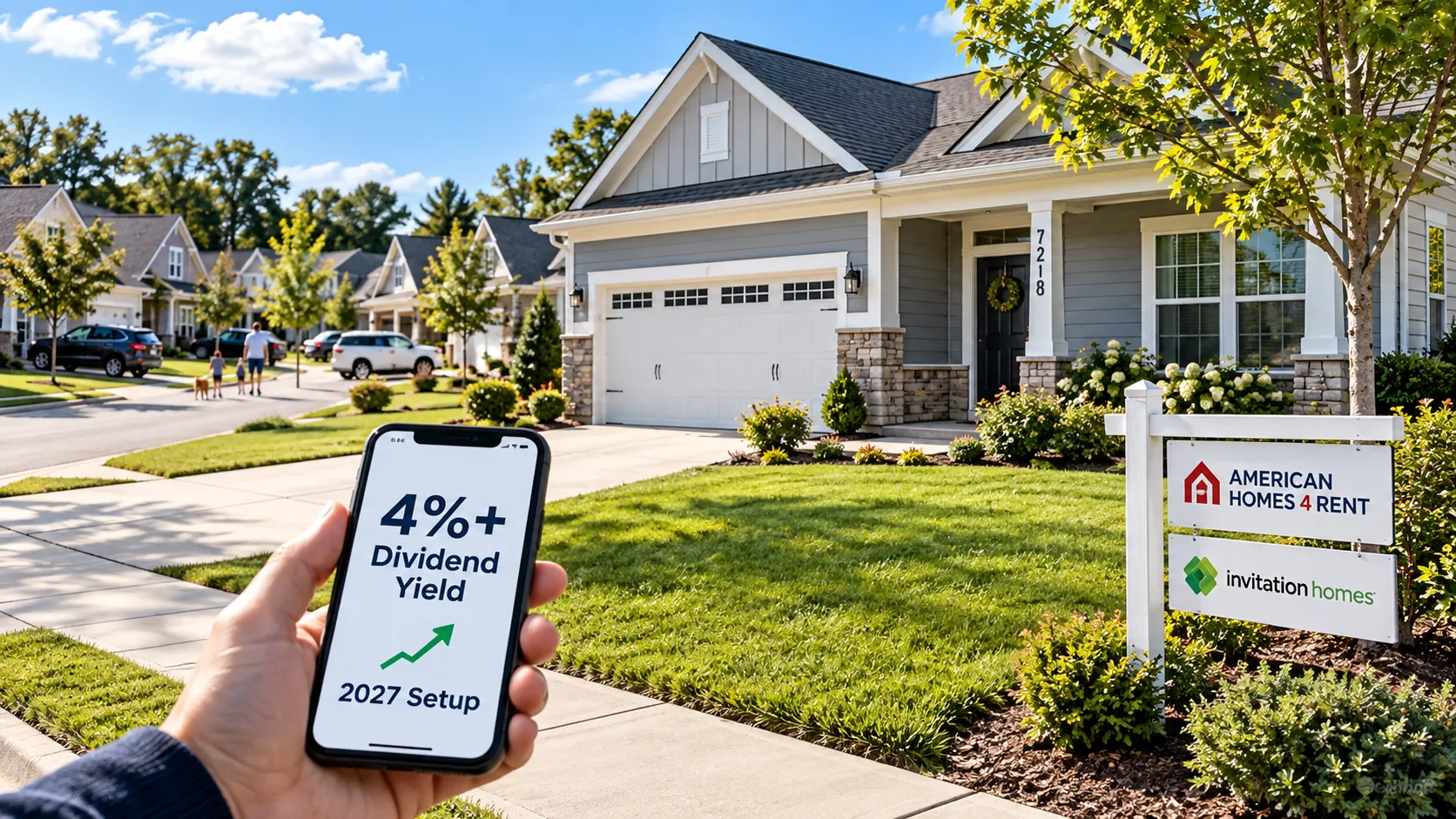
Treasury yields are crushing rate-sensitive stocks again, but Mizuho believes the selloff has created an unusually attractive setup in two housing REITs that now yield more than 4% and could enter 2027 with improving fundamentals.
Real estate investors have had few places to hide as long-term interest rates climb. The 10-year Treasury yield recently pushed above 5%, reaching levels last seen before the financial crisis, while concerns about inflation, oil prices and growing federal borrowing have kept pressure on the bond market.
That environment has weighed heavily on real estate investment trusts because investors can suddenly earn attractive yields from Treasurys without accepting the volatility associated with stocks.
Yet Mizuho believes the market may be overlooking an important distinction.
Some real estate businesses remain highly exposed to rising financing costs and weakening demand. Single-family rental operators, however, could benefit from the same high mortgage rates that are hurting their stock prices.
That is why the firm recently upgraded American Homes 4 Rent (NYSE: AMH) and Invitation Homes (NYSE: INVH) from Neutral to Outperform, arguing that both companies could enter 2027 with improving occupancy, attractive valuations and a favorable housing backdrop. Mizuho lifted its price target on AMH to $36 and its target on Invitation Homes to $32.
High Mortgage Rates Could Actually Help These Landlords
The central argument is surprisingly straightforward.
A 5% Treasury yield creates trouble for REIT valuations because investors demand higher returns from dividend stocks. At the same time, the mortgage rates associated with today’s high-rate environment are making homeownership increasingly difficult for millions of households.
That creates a powerful tailwind for companies renting single-family houses.
Someone who wants a three-bedroom suburban home may be perfectly capable of paying $2,500 or $3,000 per month in rent while still struggling to justify the monthly payment required to purchase a comparable property at today’s mortgage rates.
The financial gap between renting and owning therefore becomes increasingly important.
Single-family rental companies also serve a somewhat different customer than apartment landlords. Families, dual-income households and renters with children frequently value additional bedrooms, yards, garages and access to suburban school districts. Those tenants can also be less inclined to move frequently, giving landlords opportunities for stronger retention and rental renewals.
Mizuho believes those characteristics could give single-family rental REITs one of the more attractive growth and risk profiles within residential real estate heading into 2027.
And operating numbers from the two companies are beginning to support that argument.
American Homes 4 Rent: A 4% Yield With Occupancy Holding Up
American Homes 4 Rent owns and operates tens of thousands of single-family rental properties across the United States.
Shares have struggled during 2026 as investors moved away from interest-rate-sensitive real estate stocks, pushing the dividend yield to roughly 4.2%.
Operationally, however, the business has remained relatively resilient.
During the second quarter, AMH reported a 96% same-home average occupancy rate while same-home net operating income increased 2.7% from the previous year. Core funds from operations increased 5.2%, while adjusted FFO rose 8.3%.
The company has also been returning capital aggressively.
AMH repurchased approximately $123 million of its own shares during the second quarter, buying 4.1 million shares at an average price of $29.88. Management has indicated that repurchases remain one of several capital-allocation options when it believes the stock is attractively valued.
That matters because buybacks can become particularly powerful when a REIT trades below management’s estimate of the underlying value of its properties.
Instead of purchasing another rental house at full market value, management can effectively purchase pieces of its existing portfolio at a discount through stock repurchases.
Mizuho’s $36 price target would represent meaningful appreciation from the stock’s recent trading level, in addition to the roughly 4% dividend yield investors collect while waiting.
Invitation Homes: Bigger Buybacks and a 4.5% Yield
Invitation Homes presents a similar story.
The company is one of America’s largest owners of single-family rental houses, with properties concentrated heavily in Sun Belt and Western markets.
Its stock has fallen during 2026 while its dividend yield has risen to approximately 4.5%.
Yet occupancy remains strong.
Invitation Homes reported same-store occupancy of approximately 96.4% across July and August, along with blended rental-rate growth of 3.2%. The company also reported renewal rates of 76.7% during the second quarter, suggesting many existing residents continue choosing to stay rather than move.
The more interesting number may be the company’s share repurchases.
Invitation Homes has spent roughly $700 million buying back stock since December 2025, representing approximately 4.3% of shares outstanding. Those purchases have largely been funded through property dispositions.
There is an interesting valuation signal buried inside those transactions.
According to company investor materials cited in recent analysis, Invitation Homes has been selling properties at an average price near $460,000 while the stock market has valued the company’s portfolio at a substantially lower implied amount per home.
That does not automatically mean the stock is cheap. Property quality, debt, corporate expenses and geographic mix all matter. Still, the gap helps explain why management may see repurchasing shares as an attractive use of capital.
Mizuho’s $32 target represents more than 20% potential appreciation from the level referenced in its research, before considering the dividend.
The Market Is Pricing Two Different Interest-Rate Effects
This is where the investment story gets more interesting.
Higher interest rates affect these companies in two competing ways.
Effect No. 1: Higher Yields Hurt REIT Valuations
When Treasury securities yield around 5%, investors have less incentive to buy a REIT yielding 4% unless they expect meaningful dividend growth or stock-price appreciation.
That pushes REIT valuations lower.
Higher borrowing costs can also make acquisitions and new development less profitable.
Effect No. 2: Higher Mortgage Rates Keep More People Renting
The same interest-rate environment dramatically increases the cost of buying a house.
Higher monthly mortgage payments can prevent renters from becoming homeowners, particularly when home prices remain elevated.
That can increase tenant retention and extend the period during which households rent single-family properties.
This creates an unusual situation where the factor depressing the stocks can simultaneously strengthen the underlying businesses.
For long-term investors, that disconnect is worth watching.
The Rental REIT Pressure Test
Investors evaluating AMH, INVH or other residential REITs can simplify the story into three numbers.
1. Occupancy
As long as occupancy remains around the mid-90% range, there is little evidence of widespread demand deterioration.
2. Renewal rent growth
Strong renewal pricing shows landlords retain some pricing power even when new lease growth slows.
3. Capital allocation
Buybacks become increasingly interesting when companies can sell individual houses at attractive prices and repurchase their own portfolios through the stock market at lower implied valuations.
If all three remain healthy, falling share prices could eventually create opportunity rather than signal deteriorating fundamentals.
The Biggest Risk May Be Different Than Investors Expect
The obvious threat to these stocks appears to be persistently high interest rates.
There is another scenario worth considering.
A meaningful drop in mortgage rates could eventually make purchasing a home affordable again for more renters, potentially increasing move-outs as households transition into homeownership.
That means the perfect environment for single-family rental REITs may actually be somewhere in the middle: mortgage rates high enough to preserve the rent-versus-buy advantage, while Treasury yields stabilize enough for REIT valuations to recover.
That combination could explain why Mizuho is focusing on the 2027 setup rather than simply calling these stocks immediate beneficiaries of higher rates.
The timing matters.
Three Things Investors Should Watch Into 2027
Treasury yields: A sustained retreat in the 10-year yield could remove one of the largest valuation pressures facing the entire REIT sector. If yields remain near 5% or climb further, investors may continue demanding cheaper valuations from dividend stocks.
Occupancy and renewal rates: These may be more important than headline rent growth. Stable occupancy would indicate that high homeownership costs continue supporting rental demand.
Buyback activity: Both companies have demonstrated a willingness to purchase their own shares. Continued repurchases at depressed valuations could meaningfully reduce share counts and increase each remaining shareholder’s ownership of the underlying portfolio.
Investors should also watch property dispositions. Selling houses at strong prices while buying discounted shares can be highly accretive, but the strategy depends on management maintaining discipline and avoiding excessive leverage.
The Investor Takeaway
American Homes 4 Rent and Invitation Homes sit directly in the middle of one of the market’s strangest interest-rate trades.
High Treasury yields have made their dividends less attractive relative to bonds and pressured their share prices. Yet high mortgage rates are simultaneously making homeownership harder, potentially keeping more families inside the single-family rental market.
AMH now offers a dividend yield above 4%, while Invitation Homes yields roughly 4.5%. Both companies are maintaining high occupancy, buying back stock and positioning themselves for what Mizuho believes could be an improving operating environment in 2027.
Investors should still recognize the tradeoff. A 4% dividend yield alone is hardly extraordinary when Treasurys yield around 5%.
The opportunity becomes more interesting if the current yield comes with improving fundamentals, continued buybacks and eventual valuation recovery.
That is the bet Mizuho is making.
And if Treasury yields finally stabilize while America’s housing affordability problem remains unresolved, these two beaten-down landlords could find themselves in a considerably better position than their recent stock performance suggests.
About Author