America’s fiscal problems took another sharp turn in July.
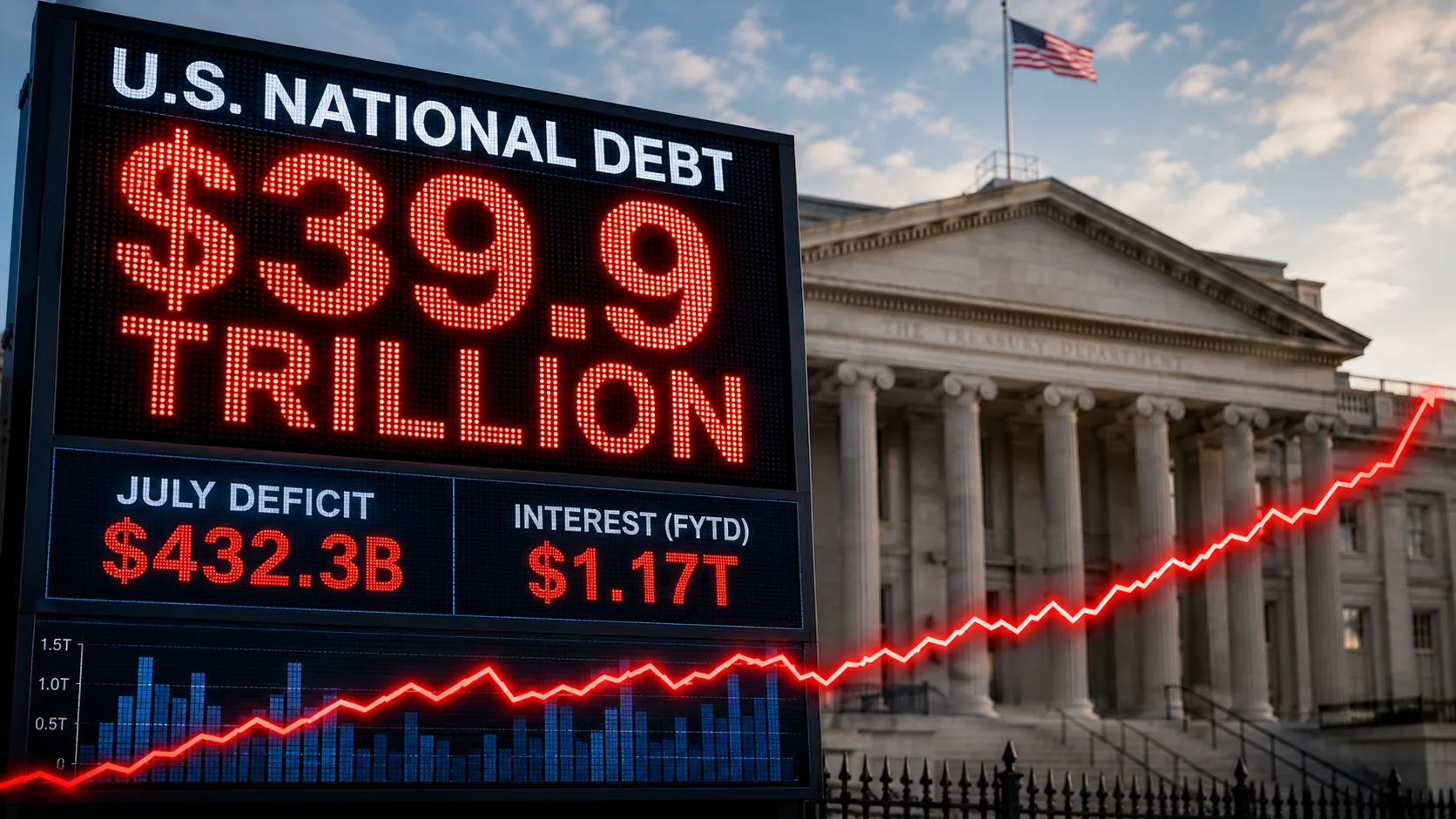
The federal government posted a $432.3 billion budget deficit, the largest monthly shortfall since March 2021, as rising Medicare spending and the enormous cost of financing the national debt pushed government expenses higher.
The July deficit was roughly 48% larger than a year earlier, according to the Treasury Department. More troubling, the federal government has now accumulated nearly $1.8 trillion in deficits through the first 10 months of the fiscal year, surpassing the comparable period in 2025.
And one number buried inside the report may be particularly important for investors: America has already spent $1.17 trillion on interest on the national debt this fiscal year.
The Deficit Just Jumped to $432 Billion
July’s $432.3 billion shortfall was the biggest monthly deficit in more than five years.
Part of the increase resulted from calendar effects. Because the first of the month fell on a nonbusiness day, roughly $99 billion in government payments were accelerated, including Medicare and Supplemental Security Income expenditures.
But even accounting for timing distortions, the broader trend remains difficult to ignore.
The federal government continues to spend substantially more than it collects, and the cumulative deficit for the fiscal year has climbed to nearly $1.8 trillion with two months still remaining.
That means Washington is once again on pace for an enormous annual shortfall despite an economy that is not currently in a deep recession.
Medicare Costs Surge
One of the biggest contributors in July was Medicare.
Medicare spending jumped to $174 billion for the month, up sharply from $103 billion in June. That made it the federal government’s single largest expenditure in July.
For comparison, Washington spent approximately:
- $174 billion on Medicare
- $141 billion on Social Security
- $104 billion on net interest on the national debt
Medicare spending has now reached approximately $955 billion for the fiscal year, highlighting the growing financial pressure created by an aging U.S. population and rising healthcare costs.
Those pressures are unlikely to disappear anytime soon.
As more Americans reach retirement age, spending on Medicare and Social Security is expected to remain one of the largest structural challenges facing the federal budget.
America’s Interest Bill Is Becoming Enormous
The other major problem is the cost of servicing the national debt.
The federal government has paid approximately $1.17 trillion in gross interest during the first 10 months of the fiscal year, up from about $1.01 trillion during the same period last year.
Net interest, which subtracts interest income received by the Treasury, totaled approximately $931 billion.
That puts debt financing behind only Social Security and Medicare among the federal government’s largest expenses.
The reason is straightforward: Washington is carrying an enormous amount of debt at substantially higher interest rates than it enjoyed for much of the decade following the financial crisis.
The national debt has climbed to approximately $39.9 trillion, with roughly $32.1 trillion held by the public.
As older, lower-yielding government debt matures and is refinanced, higher borrowing costs can continue filtering into the federal budget.
The $40 Trillion Threshold Is Getting Close
The latest Treasury figures put the national debt within striking distance of $40 trillion, a psychological milestone that could draw renewed attention to Washington’s fiscal trajectory.
The challenge is that deficits and interest expenses can reinforce each other.
Large deficits require the Treasury to issue additional debt. More debt creates additional interest expense. Those interest payments then increase future government spending, potentially requiring still more borrowing.
That cycle becomes particularly expensive when interest rates remain elevated.
For investors, the question increasingly becomes how long the government can continue running massive deficits without producing consequences elsewhere in financial markets.
Tariff Refunds Added Another $33 Billion
July’s deficit also received an unusual boost from $33 billion in tariff refunds.
The administration has been issuing rebates for levies that the Supreme Court ruled illegal, creating another temporary expense for the Treasury.
Combined with the $99 billion calendar-related shift in benefit payments, these factors exaggerated July’s headline deficit.
But they do not explain away the longer-term numbers.
The fiscal-year deficit is still running ahead of last year, while interest costs and major entitlement spending continue climbing.
Interest Rates Could Make a Huge Difference
The Federal Reserve has increasingly become part of the fiscal discussion because interest rates have a direct impact on Washington’s borrowing costs.
President Donald Trump had repeatedly pushed the Fed to lower benchmark rates, arguing in part that lower borrowing costs would reduce the government’s enormous interest bill.
He has largely refrained from publicly criticizing the central bank since Kevin Warsh became Fed chairman in May.
Until recently, investors had been focused on the possibility that persistent inflation could force the Fed to raise rates further. But softer inflation readings and weaker payroll data have tempered those expectations.
Markets still are not expecting meaningful rate relief anytime soon.
That matters because every year that borrowing costs remain elevated increases the amount of federal debt that must be refinanced at relatively expensive rates.
Why Investors Should Pay Attention
Federal deficits can feel distant from the day-to-day movements of stocks and bonds, but the numbers are becoming large enough to have significant implications for markets.
Heavy Treasury borrowing can put upward pressure on bond yields as the government competes for capital. Higher Treasury yields can, in turn, raise borrowing costs throughout the economy, affecting mortgages, corporate debt and business investment.
Persistent deficits can also complicate the Federal Reserve’s job if government spending contributes to economic demand while policymakers are attempting to keep inflation under control.
And with interest expenses approaching the scale of America’s largest entitlement programs, Washington has less flexibility to absorb future recessions, financial crises or geopolitical shocks without borrowing even more.
For now, July’s $432 billion deficit contains some temporary distortions.
The bigger story is harder to dismiss.
The United States is approaching $40 trillion in national debt, has accumulated nearly $1.8 trillion in deficits in just 10 months, and has already spent more than $1 trillion this fiscal year simply paying interest on what it owes.
That combination is turning America’s debt burden from a long-term political argument into an increasingly important issue for financial markets.
About Author