

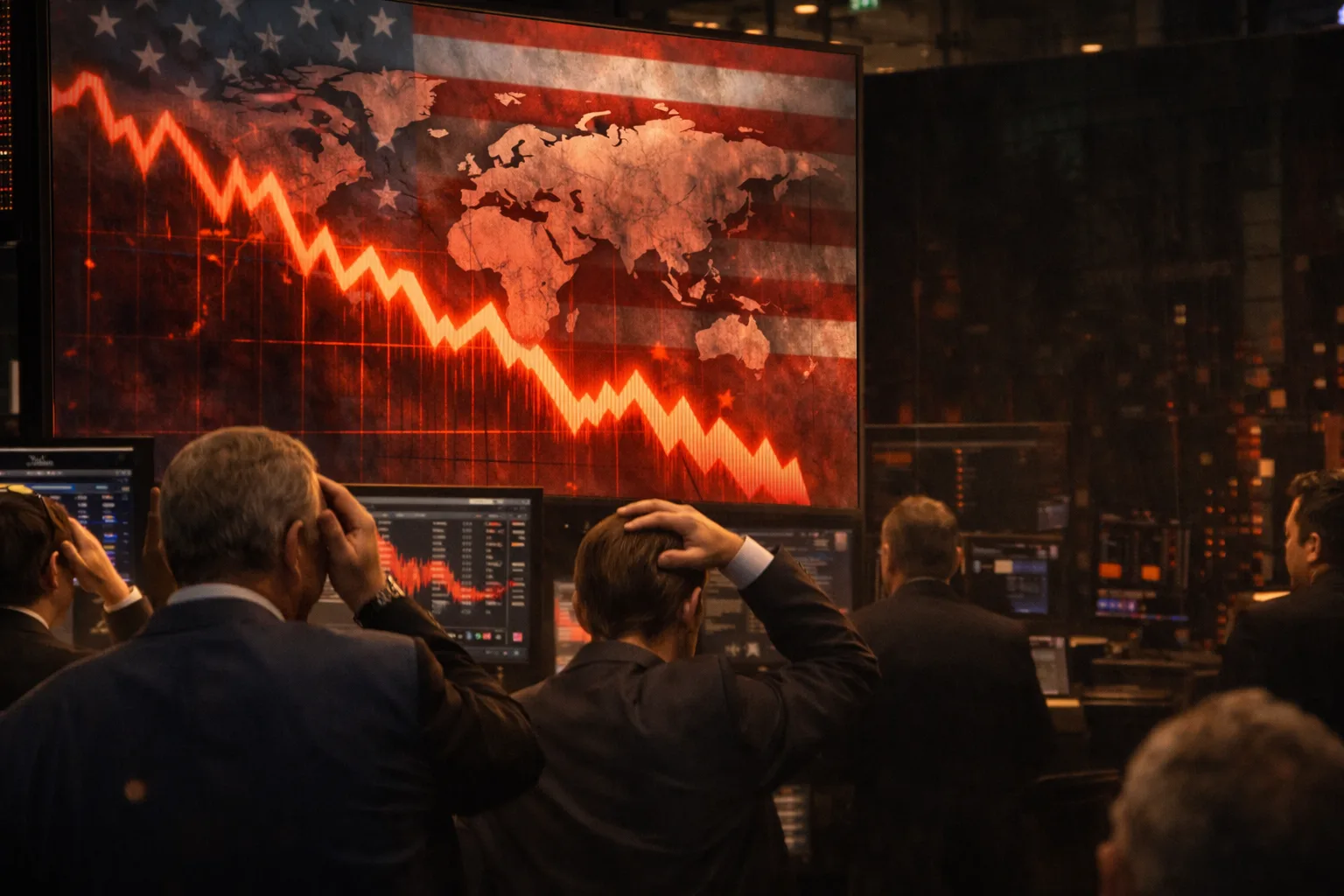
Wall Street’s post-election rally is unraveling. The Nasdaq plunged more than 4% Thursday morning, entering correction territory as investors dumped artificial intelligence stocks, semiconductor companies and some of the market’s biggest technology names. The Dow Jones Industrial Average tumbled nearly 800 points, raising fresh concerns about how much further the selloff could spread.
The reversal comes just one day after the Dow surged more than 1,500 points in a historic post-election rally. Investors who celebrated Wednesday’s gains are now confronting a potentially significant shift in market leadership.
The biggest damage is concentrated in companies tied to the artificial intelligence boom, where fears of new government restrictions, expensive valuations and slowing infrastructure development are triggering aggressive selling.
Nasdaq Enters Correction Territory as Tech Stocks Collapse
The Nasdaq Composite sank approximately 1,076 points to 24,661, putting the technology-heavy index more than 10% below its October record. A decline of that magnitude meets Wall Street’s commonly used definition of a market correction.
The S&P 500 dropped 2.6%, while the Dow lost roughly 780 points. The selling erased a substantial portion of Wednesday’s spectacular rally, when investors initially welcomed the results of the midterm elections.
The speed of the reversal is especially concerning because some of the hardest-hit companies have been major drivers of the stock market’s gains in recent years.
Nvidia and Broadcom each declined approximately 7%, while Oracle lost nearly 5%. Qualcomm dropped roughly 9% after its earnings outlook disappointed investors, despite reporting results that exceeded expectations.
The iShares Semiconductor ETF (SOXX), which tracks major chipmakers, plunged approximately 9%.
Meanwhile, Tesla and SpaceX each fell around 9%, extending the losses that followed this week’s political developments.
The Political Shock Hitting the Artificial Intelligence Boom
Tuesday’s midterm elections delivered Democrats control of both the House of Representatives and Senate, creating a major shift in Washington’s political balance.
Investors initially responded enthusiastically. The Dow jumped more than 1,500 points Wednesday, its largest one-day point gain of the year.
By Thursday, however, the market was reassessing what the election results could mean for the technology industry.
The concern centers on the rapid expansion of artificial intelligence data centers, which require enormous quantities of electricity, land, water and computing equipment.
Opposition to new data center construction has been growing in several states, particularly over electricity costs and the strain these facilities can place on local infrastructure.
Democratic victories in key states have increased expectations that future projects could face tougher environmental reviews, additional restrictions and political resistance.
For companies supplying the chips, servers and computing infrastructure behind the AI boom, delays in construction could translate into slower revenue growth.
That possibility is forcing investors to reconsider the premium valuations they have assigned to many AI-related businesses.
The Biggest Warning Sign Is Coming From AI Infrastructure Stocks
Some of Thursday’s steepest declines occurred in companies that provide computing capacity and infrastructure for artificial intelligence.
| Company | Intraday Decline |
|---|---|
| Nebius | -17% |
| Iren | -15% |
| CoreWeave | -12% |
| Qualcomm | -9% |
| Tesla | -9% |
| SpaceX | -9% |
| Nvidia | -7% |
| Broadcom | -7% |
Approximate intraday moves reported around 10:41 a.m. ET. These are snapshots, not closing prices.
The scale of these declines highlights an important vulnerability in the AI investment boom.
Many companies have committed billions of dollars to building computing infrastructure based on expectations of rapidly expanding demand. Those commitments depend on continued financing, reliable electricity supplies, regulatory approvals and customers willing to pay for expensive computing services.
When investors begin questioning any part of that expansion, the impact can spread rapidly across the industry.
Chipmakers face the possibility of slower equipment orders. Data center developers face higher project risks. Companies dependent on outside financing may encounter additional pressure if lenders and investors become less willing to fund expansion.
These risks can reinforce one another, creating selling pressure well beyond the companies directly affected by potential regulatory changes.
Why the Rest of the Stock Market Is Holding Up Better
Despite the sharp declines in the major indexes, Thursday’s selling is showing significant differences across sectors.
Consumer staples stocks gained more than 1%, while healthcare and utilities also moved higher.
Chevron and Johnson & Johnson were among the companies providing support to the Dow, although their gains were insufficient to overcome losses elsewhere.
This divergence is important because the Nasdaq and S&P 500 are heavily influenced by a relatively small group of large technology companies.
When those companies fall sharply, major indexes can suffer significant losses even while other parts of the market remain stable or advance.
For investors, the distinction matters.
A market decline concentrated in richly valued technology companies can create different risks and opportunities than a broad downturn driven by deteriorating economic conditions.
Thursday’s trading suggests money is moving toward businesses with more predictable earnings, established cash flows and less direct exposure to the AI infrastructure boom.
That does not guarantee defensive stocks will remain insulated if the selling intensifies. It does, however, show that investors are becoming more selective about where they are willing to take risk.
What This Means for Your Retirement and Investment Portfolio
The selloff carries consequences for investors with substantial exposure to technology stocks, particularly through retirement accounts, index funds and growth-oriented portfolios.
1. S&P 500 Investors May Have More Tech Exposure Than They Realize
The largest technology companies represent a substantial portion of the S&P 500’s total market value.
As a result, investors holding broad index funds may be more exposed to the AI selloff than they expect.
Even diversified portfolios can experience sharp declines when several of their largest holdings fall simultaneously.
2. Semiconductor Stocks Face a Major Test
Companies such as Nvidia and Broadcom have benefited from expectations of sustained spending on AI infrastructure.
If investors begin reducing their forecasts for data center construction, chipmakers could face additional pressure even if their current earnings remain strong.
The central question is whether future AI spending will continue growing quickly enough to justify the valuations investors have already assigned.
3. Defensive Stocks Are Attracting Attention
Thursday’s gains in consumer staples, healthcare and utilities demonstrate that investors are seeking areas of the market traditionally associated with steadier demand.
These businesses can offer some protection during periods of uncertainty, although they remain sensitive to interest rates, earnings expectations and broader economic developments.
For investors approaching retirement, the selloff is also a reminder of the importance of understanding how much portfolio volatility they can withstand without disrupting near-term withdrawal plans.
Oil Prices Reverse as Washington’s Political Shift Adds Uncertainty
The stock market is also navigating renewed volatility in energy prices.
U.S. crude oil fell below $90 per barrel Wednesday as investors considered whether the Democratic takeover of Congress could increase political pressure to end the war with Iran.
Oil prices reversed Thursday.
West Texas Intermediate crude futures rose more than 1%, trading just below $90 per barrel, while Brent crude advanced more than 2% to approximately $97.
The rebound reflects continuing uncertainty surrounding the conflict and global energy supplies.
Higher oil prices could complicate the outlook for inflation and interest rates, adding another potential obstacle for technology stocks whose valuations depend heavily on expectations of future earnings.
Three Signals That Could Determine What Happens Next
Investors should pay particular attention to three developments as Wall Street attempts to stabilize.
First, watch whether semiconductor stocks stop falling. Nvidia, Broadcom and the broader semiconductor sector have become important indicators of confidence in the AI investment cycle. Continued heavy selling could signal that investors are still reducing exposure.
Second, watch whether the weakness spreads to defensive sectors. Consumer staples, healthcare and utilities have shown relative strength. If those sectors begin falling sharply alongside technology, it would suggest the selloff is becoming more widespread.
Third, watch for concrete policy changes affecting data centers. Election results have raised expectations of tougher oversight, but the actual financial impact will depend on legislation, state-level decisions, permitting requirements and the ability of companies to continue their expansion plans.
Investors will also be closely watching upcoming employment data, Treasury yields and corporate earnings for additional signs of pressure on the economy and financial markets.
The Bigger Concern for Wall Street
The most significant development Thursday is the sudden change in how investors are valuing the artificial intelligence boom.
For much of the past several years, expectations of enormous AI investment helped push technology shares to increasingly expensive valuations.
Now investors are beginning to price in the possibility that political resistance, financing costs and infrastructure limitations could slow the pace of that expansion.
The fact that many AI stocks are suffering much larger declines than the broader market suggests that investors are reassessing how much future growth they are willing to pay for today.
The Nasdaq’s move into correction territory represents a significant warning for investors who have benefited from the technology-led rally.
With the Dow falling nearly 800 points and some of the market’s most prominent technology companies suffering steep losses, Wall Street faces a critical test: whether Thursday’s selloff is a temporary reset in AI valuations or the beginning of a more prolonged decline.
For now, the market’s message is clear. Confidence in the AI trade has weakened sharply, and investors are increasingly unwilling to ignore the risks.
About Author