Apple has spent the last two years facing a question from investors, analysts, and customers alike: where is its AI strategy?
At its Worldwide Developers Conference (WWDC), the company finally delivered an answer.
Apple unveiled a completely rebuilt version of Siri powered by artificial intelligence, marking the company’s most significant AI announcement to date. The overhaul comes as rivals including OpenAI, Google, and Microsoft race ahead in the battle to make AI assistants an everyday part of consumers’ lives.
For investors, the announcement may represent a critical turning point. Apple isn’t simply adding more AI features. It is attempting to transform Siri from a voice assistant into a central operating layer that connects apps, devices, personal data, and real-world tasks.
With more than 2.5 billion active Apple devices worldwide, the stakes could not be higher.
Apple’s Biggest AI Move Yet
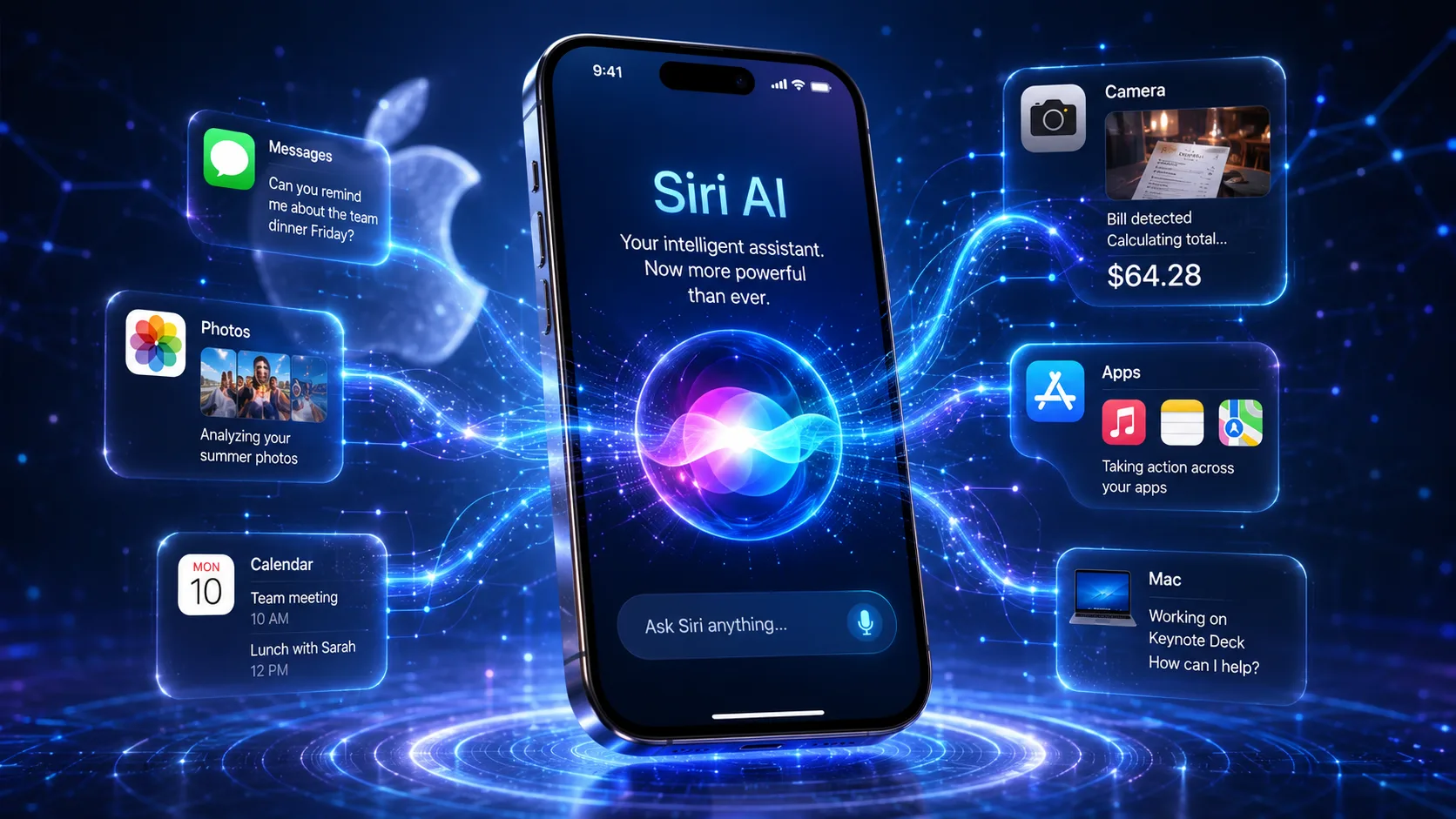
The centerpiece of Apple’s presentation was what executives are calling “Siri AI.”
Unlike the current version of Siri, which is largely limited to basic commands and web searches, the new assistant is designed to understand context, analyze content on a user’s screen, remember previous conversations, and interact across apps and devices.
Users will be able to have natural back-and-forth conversations similar to interactions with ChatGPT or Google’s Gemini.
For example, a user could ask Siri about upcoming World Cup games, then continue the conversation by asking the assistant to help organize a watch party, create reminders, and coordinate scheduling.
The new Siri will also be able to access information stored on Apple devices, including photos, messages, notes, calendars, and other personal content to provide more personalized answers.
Apple plans to launch the service in beta later this year.
Why Wall Street Has Been Growing Impatient
Apple’s AI rollout has not gone smoothly.
While competitors have introduced increasingly powerful AI chatbots and digital agents, Apple’s initial “Apple Intelligence” features have been viewed as incremental improvements rather than game-changing innovations.
The company has introduced tools for translating speech, creating custom emojis, and identifying content on-screen, but many analysts have argued Apple lacked a compelling AI vision.
That concern has become increasingly important because investors view artificial intelligence as one of the most significant technology shifts since the smartphone itself.
Analysts have repeatedly pressed Apple executives during earnings calls about how AI fits into the company’s long-term growth strategy.
Gene Munster of Deepwater Asset Management recently summed up the concern by noting that Apple had yet to release anything that truly impressed consumers compared with offerings from competitors.
Monday’s announcement was clearly designed to address those concerns.
Siri Is Becoming Much More Than A Voice Assistant
One of the most significant upgrades involves visual understanding.
Apple demonstrated a new camera-powered Siri mode capable of interpreting what users are looking at in real time.
Imagine pointing your iPhone camera at a restaurant bill. Siri could identify the items you ordered, calculate your share of the bill, and even help send payment.
On Mac computers, users will be able to highlight content directly on their screen and ask Siri questions about the selected material.
The assistant will also remember previous conversations, allowing users to return to ongoing projects, plans, or research topics without starting over each time.
This moves Siri closer to becoming an AI agent rather than a simple assistant.
That distinction matters because AI agents are widely viewed as the next major phase of artificial intelligence, capable of completing tasks instead of merely answering questions.
Apple Is Quietly Leveraging Google’s Strengths
Perhaps one of the most important details from Apple’s AI strategy is that the company is not building everything itself.
Apple previously confirmed a partnership with Google to incorporate Gemini-powered AI models into some of its products and services.
That partnership could significantly accelerate Siri’s capabilities.
According to Bloomberg Intelligence analyst Anurag Rana, Google’s Gemini models have emerged as some of the strongest performers in the AI industry.
Rather than attempting to compete directly with Google and OpenAI on foundation models, Apple appears focused on integrating leading AI technology into its massive ecosystem of devices.
For Apple, the strategy may be less about winning the AI model race and more about winning the user experience race.
The Billion-iPhone Opportunity
Apple’s greatest advantage may not be technology.
It may be distribution.
More than 2.5 billion Apple devices are currently active worldwide, giving the company a user base unmatched by most competitors.
If Apple successfully integrates AI into its ecosystem, it can immediately place those capabilities in front of hundreds of millions of users.
At the same time, Apple faces an upgrade opportunity.
Analysts estimate roughly 1 billion iPhones currently in use cannot support Apple Intelligence because they were released before the iPhone 15 Pro generation.
As AI becomes a more important part of the Apple experience, many consumers could eventually find themselves upgrading hardware to gain access to newer capabilities.
That creates a potential long-term catalyst for future iPhone sales.
AI Is Expanding Across Apple’s Entire Ecosystem
Siri wasn’t the only AI announcement.
Apple revealed plans to embed artificial intelligence throughout its software ecosystem.
New capabilities include:
- Safari automatically organizing tabs by topic
- AI-generated browser extensions created through simple prompts
- Messages suggesting reminders and notes based on conversations
- Enhanced dictation and more natural voice options
- Smart home features that analyze security camera footage and generate summaries
The company also acknowledged that some advanced AI functions may face daily usage limits because of the significant computing power required to operate them.
That highlights a growing reality across the industry: AI remains expensive to run at scale.
A Major Leadership Transition Adds More Pressure
The WWDC event also carried additional significance because it marked the beginning of a major leadership transition.
Current CEO Tim Cook is expected to step aside in September and become executive chairman, while Apple’s hardware chief John Ternus takes over as chief executive.
Many observers viewed Monday’s presentation as Cook’s final major WWDC keynote as CEO.
The success or failure of Apple’s AI strategy will likely become one of Ternus’ first major tests as leader of the world’s most valuable technology company.
What Investors Should Watch Next
Apple’s AI story is still in its early stages.
The company must now prove that it can successfully execute on the ambitious vision it presented.
The beta launch later this year will offer the first real glimpse into whether Siri AI can compete with ChatGPT, Gemini, and other advanced assistants.
For investors, the key question isn’t whether Apple can build AI features.
It’s whether Apple can once again do what it has done repeatedly over the past two decades: take an existing technology and make it mainstream.
If the new Siri succeeds, Apple could transform artificial intelligence from a niche tool into a daily habit for hundreds of millions of users worldwide.
And with more than 2.5 billion devices already in circulation, few companies are better positioned to capitalize on that opportunity.
About Author