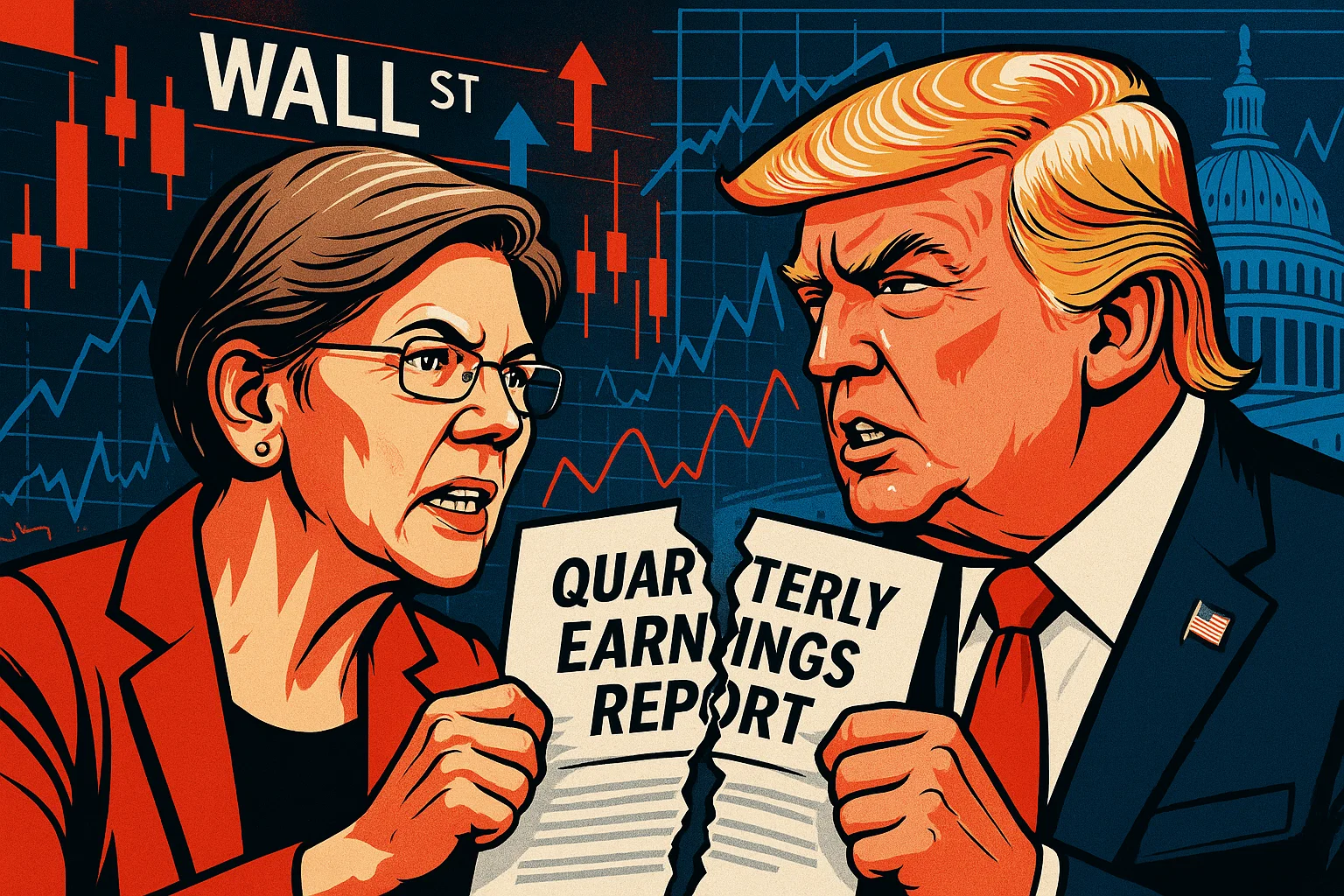
President Trump has renewed calls to relax the long-standing requirement for publicly traded companies to file earnings reports with the U.S. Securities and Exchange Commission (SEC) every three months. He wants companies to shift to reporting every six months, arguing this would reduce costs and free management to focus on long-term growth.
Senator Elizabeth Warren sharply criticized the idea, warning it could undermine transparency and harm investors. She told Business Insider, “That is the whole point here.” Warren believes the real motivation is to obscure unfavorable economic data, pointing to Trump’s firing of the Bureau of Labor Statistics commissioner after a disappointing July jobs report.
For investors, the frequency of corporate disclosures is not just an administrative detail. It affects how quickly you can respond to risks, how accurately you can model future performance, and how confident you can be in the information you are given.
What Is Being Proposed
Under current SEC rules, public companies must report earnings every quarter. This quarterly cadence has been in place in the United States since the 1970s.
On Monday, President Trump said the requirement should be relaxed to every six months, arguing it would save companies money and encourage long-term thinking. White House spokeswoman Taylor Rogers did not address Warren’s comments directly, instead attacking her credibility. In a statement to Business Insider, Rogers said, “The last person who should be giving advice on SEC requirements is Pocahontas. She could not even tell the truth about her own background.”
The SEC has indicated it will prioritize Trump’s proposal, but any change would still need to go through a formal approval process. That means public comment, internal analysis, and potentially legal challenges before any rule becomes final.
Why This Matters For Investors
Quarterly earnings reports are one of the most important data streams investors rely on. Reducing the frequency of these disclosures would mean less timely information and more uncertainty. Here are the major trade-offs:
| Factor | Quarterly Reporting | Semiannual Reporting |
|---|---|---|
| Timeliness | More regular updates on company performance. | Longer gaps between data releases. |
| Forecasting | Better inputs for analyst models and trend analysis. | Fewer data points, more guesswork. |
| Transparency | Ongoing accountability for management. | Higher risk of delayed or hidden bad news. |
| Costs | Higher compliance costs for companies. | Lower compliance costs, less reporting burden. |
As Warren put it, “Investors do not need to see less information about the companies that they are investing in. After all, those companies are using investors’ money.”
Lessons From Europe
The European Union eliminated its mandatory quarterly reporting requirement in 2015, moving to a system of annual and half-year reports. The UK made similar changes around 2014.
The results have been mixed. Studies in Germany and across the EU have found that reducing reporting frequency can increase information asymmetry, lower liquidity, and sometimes depress valuations. When fewer companies report quarterly, investor attention tends to drift away from those that provide less frequent updates, leading to a “visibility discount.”
Some firms voluntarily continue to issue quarterly updates to maintain investor confidence, suggesting that even if U.S. rules change, companies may still have strong incentives to communicate frequently.
Key Questions Still Unanswered
Investors should pay attention to how the SEC and companies address several unresolved issues:
- Will companies still be required to disclose material events between formal reports? Without strong continuous disclosure rules, semiannual reporting could create blind spots.
- What information will be included in the reports? Frequency matters, but so does completeness.
- How will analyst coverage change? Fewer data points might discourage coverage of smaller firms, reducing liquidity.
- Which investor segments will gain or lose? Long-term investors may benefit from less short-term noise, but traders and quant funds will have less data to work with.
- What safeguards will regulators introduce to maintain investor protection?
Market Context And Trends
Trump’s proposal reflects a broader debate about short-termism in U.S. markets. Some CEOs and exchanges have argued that quarterly reporting fosters an unhealthy focus on beating short-term earnings targets. They believe fewer reports could encourage long-term investment and innovation.
However, investor advocacy groups like the CFA Institute have warned that less frequent reporting risks eroding trust in markets. In a survey of CFA members, a majority opposed eliminating quarterly reports, citing transparency and fairness concerns.
The SEC will now have to weigh these competing arguments as it evaluates the proposal.
Action Steps For Investors
Here are practical ways to prepare for or even capitalize on a shift to semiannual reporting:
Monitor the rulemaking process closely
Keep an eye on SEC announcements, comment periods, and drafts of proposed rules.
Evaluate companies’ disclosure practices
Firms that voluntarily maintain quarterly reports may enjoy a transparency premium. Those that cut back may face a higher cost of capital.
Adjust your modeling and risk expectations
With fewer data points, expand your forecast ranges and rely more on alternative signals like guidance updates, management commentary, and industry metrics.
Focus on governance quality
Companies with strong investor relations and proactive communication will stand out.
Tilt portfolios accordingly
Stable, predictable businesses may be less harmed by reduced reporting frequency. Volatile or high-growth sectors could become riskier.
The Big Picture For Investors
Relaxing the requirement for quarterly earnings reporting is not just a technical tweak. It changes how often you see the scoreboard and how quickly you can respond to risks.
If you value clarity, timeliness, and accountability, semiannual reporting could increase your risk or force you to demand more from companies voluntarily. If you prefer long-range thinking and are comfortable with less frequent snapshots in return for less reporting cost and potentially less short-term noise, you may support the change.
Either way, anticipating how disclosure practices evolve can help you protect capital and even find opportunities where others see only risk.
About Author